(Chosun Ilbo Report on the Distortion of Government Employees Pension Accrued Liability Statistics, April 2020) Last Year's Increase in Civil Servants' Accrued Pension Liability Cut From 100 Trillion to 4 Trillion Won by Changing the Accounting Basis — a 'Trick' (Posted October 4, 2026)
In closing the 2019 accounts, the government changed its accounting basis in a direction that reduces national liabilities, drawing criticism that it was a 'trick.'
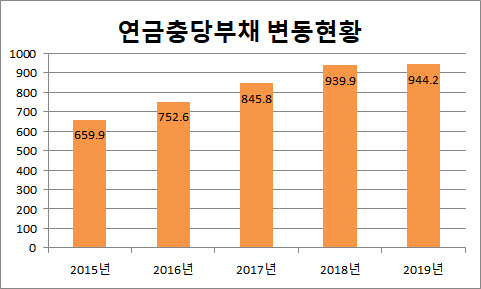
The 'Fiscal Year 2019 National Settlement Report,' approved at the Cabinet meeting on the 7th, puts the pension burden to be paid to civil servants and military personnel in the future (the accrued pension liability) at 944.2 trillion won, an increase of only 4.3 trillion won from 2018. The accrued pension liability had grown by an average of 93 trillion won a year, from 752.6 trillion won in 2016 to 939.9 trillion won in 2018, but last year the increase shrank sharply.
The increase shrank as follows. First, calculating the accrued pension liability requires a two-step process: ① estimating the pension amounts to be paid in the future and ② converting them to present value. Estimating pension amounts requires projected inflation and wage growth rates, and through 2018 the accrued pension liability was calculated on the basis of the inflation projection (2.1%) and the wage growth projection (5.3%) of the '2015 Long-Term Fiscal Projection.' In the 2020 Long-Term Fiscal Projection, however, the inflation and wage growth rates were lowered to 2.0% and 3.9%, respectively. Applying the changed basis sharply reduced the increase in the accrued pension liability. Had the 2019 accounts been closed on the basis of the 2015 projection, the accrued pension liability would have been 1,040.4 trillion won, up 100.5 trillion won from the previous year. In the end, changing the accounting basis reduced the increase in the accrued pension liability by nearly 100 trillion won.
The problem is that the 2020 Long-Term Fiscal Projection has not yet been released. The 2020 projection was originally scheduled for release in the second half of this year, when next year's budget is submitted to the National Assembly. Yet the government borrowed in advance only the wage and inflation projections from a projection that has not been released.
Professor Cho Dong-geun of Myongji University said, "Isn't this a reaction to criticism that fiscal soundness has deteriorated sharply since the Moon Jae-in administration took office?" adding, "It appears that a 'trauma' over the deterioration of fiscal soundness has surfaced in this way."
In response, the Ministry of Economy and Finance explained, "Because the 2015 inflation and wage growth projections no longer fit recent economic realities, given the trend of low growth and low inflation, we used the latest projections in the calculation," adding, "Applying the 2015 Long-Term Fiscal Projection basis, which does not match reality, would itself be a violation of national accounting laws and regulations."
https://www.chosun.com/site/data/html_dir/2020/04/08/2020040800331.html