[Interview] Yoo Si-min: “Government Employees Pension: Receiving More Is Impossible Without a Substantial Increase (October 2014)” JTBC News (Posted October 8, 2026)
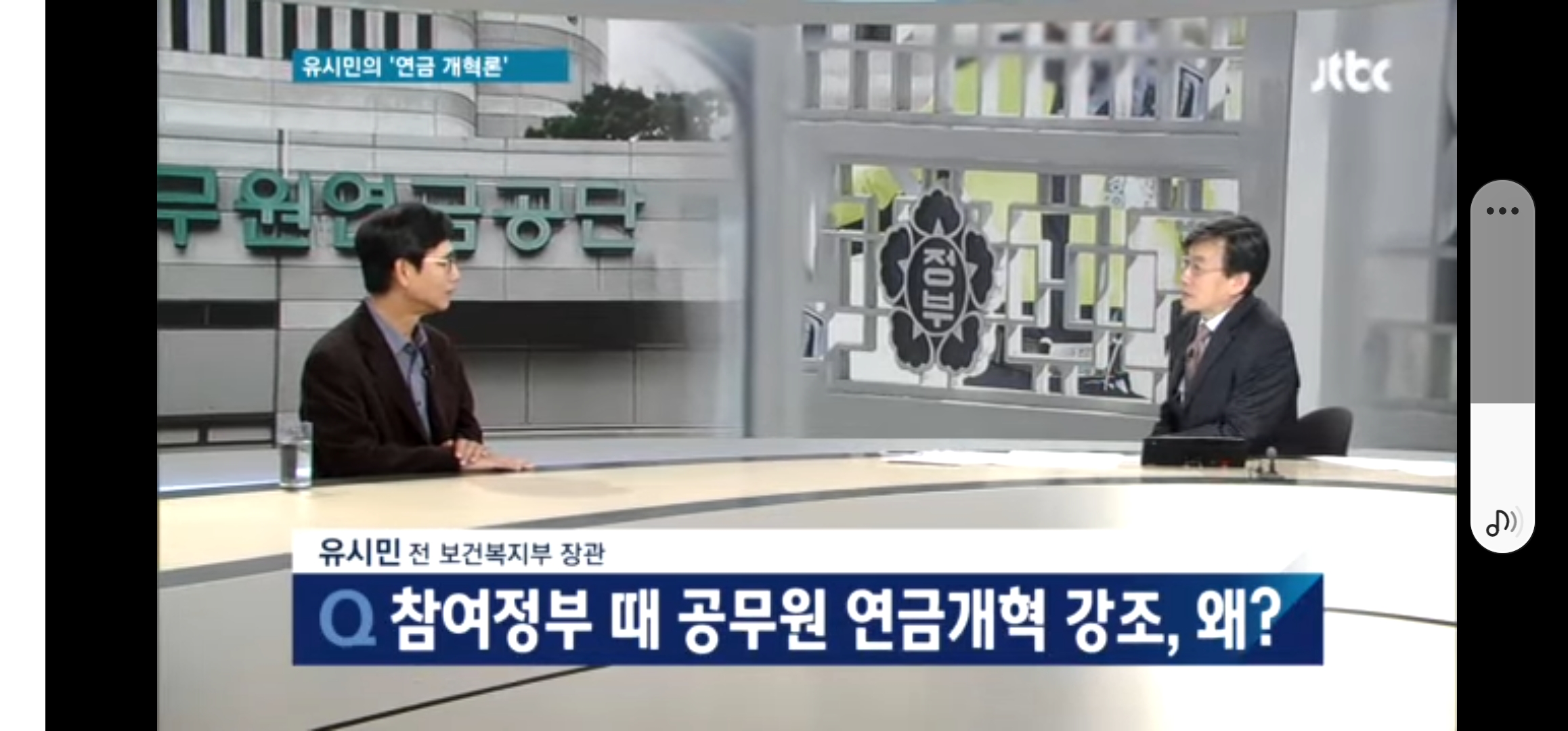
At the height of the debate over Government Employees Pension reform,
in October 2014,
former Minister of Health and Welfare Yoo Si-min gave this interview to JTBC.
Whether he still remembers it himself
we do not know, but
after resigning as Minister of Health and Welfare,
through a lawmaker-initiated bill
he introduced an amendment to the Government Employees Pension Act.
The content of that Government Employees Pension Act amendment
is almost identical to the position
argued by Committee Member Yun Suk-myung,
who was then deeply involved
in the debate over Government Employees Pension reform.
(When Yoo Si-min was Minister of Health and Welfare,
he hosted a debate at the National Assembly Members’ Office Building
on Government Employees Pension reform, and the presenter was
from the Korea Institute for Health and Social Affairs (KIHASA):
Yun Suk-myung, Director of its Pension Research Center.)
The amendment introduced by Representative Yoo Si-min
to the Government Employees Pension Act
would have lowered the Government Employees Pension to the National Pension’s level,
an income replacement rate of 40%,
and paid retirement benefits (or retirement pensions)
at the same level as in the private sector.
The public hearing (debate), held, as I recall, in January 2008,
on the Government Employees Pension Act amendment
ahead of its introduction
took place in a very chilly atmosphere.
The words of the lawmaker who personally presented the amendment at the time,
Representative Yoo Si-min, still
ring in my ears:
“To keep the promise I made as Minister of Health and Welfare,
I have come to submit, as lawmaker-initiated legislation,
this amendment to the Government Employees Pension Act.”
Beginning in February 2014,
having pursued Government Employees Pension reform in earnest,
President Park Geun-hye, too,
seems to have had in mind,
through structural reform of the Government Employees Pension,
integrating its operation with the National Pension.
Under the frame of “strengthening public pensions,”
the National Pension’s income replacement rate
was raised to 43%
in the March 2025 deterioration of the National Pension Act.
All the more, then, those who
led this deterioration—
the experts, forces, and groups—
must be set down in the historical record
in vivid detail.