(TV Chosun Report on Government Employees Pension Reform, May 7, 2015) [News Show Pan] "Government Employees Pension Must Start Again From Square One" (Posted September 16, 2026)
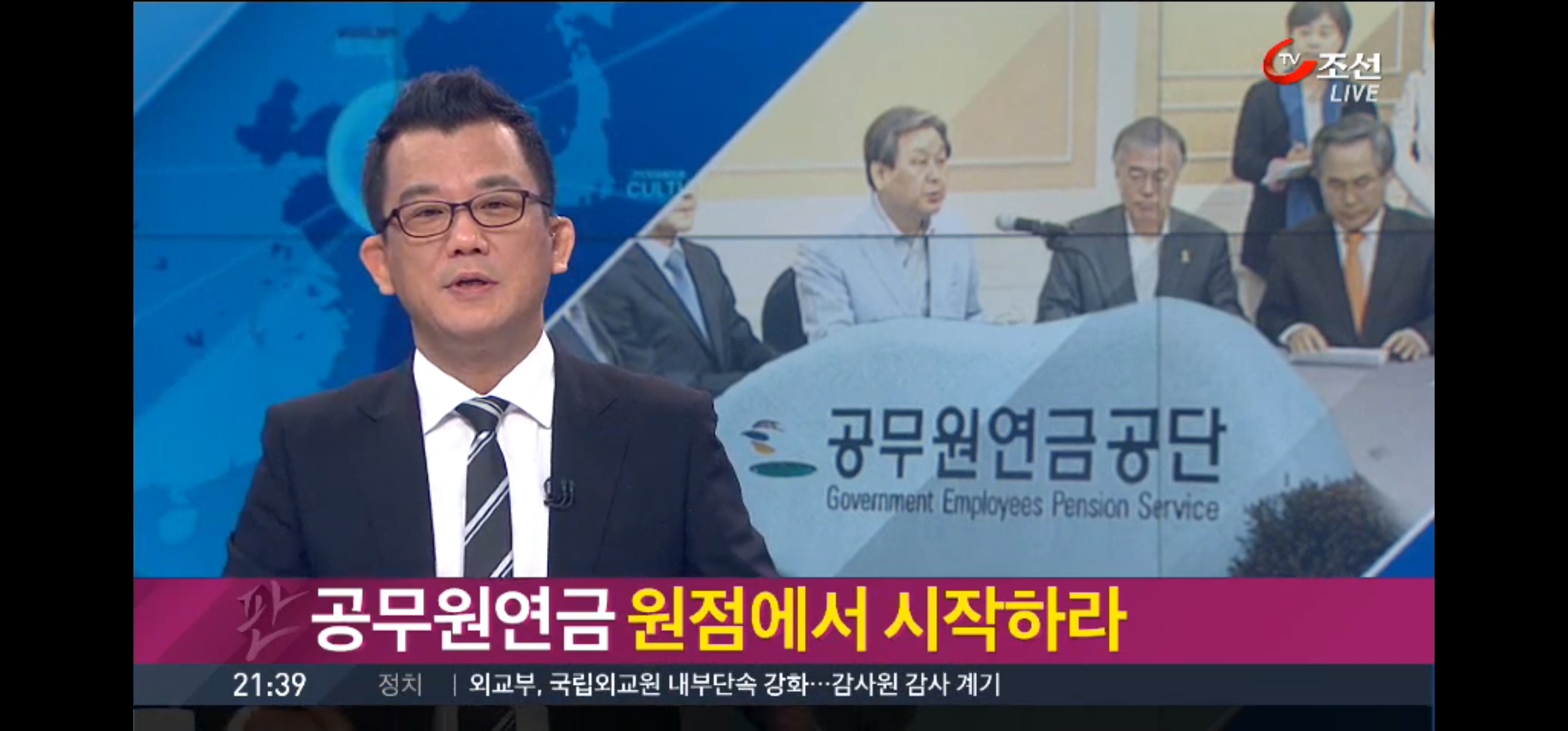
[Anchor]
Although it ultimately was not passed, the Government Employees Pension reform plan agreed upon by the ruling and opposition parties this time contains serious problems, so arguments are being made that, now that things have come to this, discussions should start again from square one.
Reporter Shin Jung-hoon reports.
[Report]
Must Reexamine From Square One
There are many voices claiming that rather than parametric reform, which only adjusts numbers, structural reform that changes the roots must be reexamined from square one.
Lee Han-gu / Saenuri Party Representative
"I believe a process is needed to build public opinion on whether it would be better to scrap it entirely and start the work over, even if it takes more time."
Lee Nae-young / Professor of Political Science and International Relations at Korea University
"In the long term, for the sake of the people, we must look into the Government Employees Pension reform again from square one and consider how to best handle the problems of the National Pension..."
Must Not Shift Burden to Future Generations
The fact that the burden was shifted to the younger generation rather than to retirees and civil servants in their 50s or older is also a point that must be addressed.
Yun Suk-myung / Research Fellow at the Korea Institute for Health and Social Affairs (KIHASA)
"Both the 2009 reform and this current reform are such that long-term employees are barely sharing the pain regarding the inherent problems of the Government Employees Pension, instead deferring them to junior civil servants."
Shortening the Contribution Period by 10 Years Is Also a Problem
While claiming it is a reform for fiscal savings, it is also pointed out as a problem that the minimum contribution period, currently 20 years, was reduced to 10 years, thereby actually increasing privileges.
Lee Han-gu / Representative of the Saenuri Party
"In the process of trying to improve it, they are instead trying to change this in a direction that is more favorable to civil servants..."
Fiscal Savings Effect Also Uncertain
Experts point out that the fiscal savings effect of the agreed plan is at most only six years.
Won Jong-wook / Director of the Future Strategy Office at the Korea Institute for Health and Social Affairs (KIHASA)
"Since shifting the burden to the next generation is not reform, I believe it is inappropriate to state the total amount as 333 trillion won regarding how much was shifted."
The point being made is that it would be right to rebuild the system from scratch on this occasion.
This is Shin Jung-hoon from TV Chosun.
https://news.tvchosun.com/site/data/html_dir/2015/05/07/2015050790246.html