(KBS TV News. 2013 Issue & News. Report of October 23, 2013) Government Employees Pension, a "Tax-Eating Hippo"? — "Social Consensus" Is Desperately Needed (Posted September 17, 2026)
(In the broadcast below,
the 9.6% contribution rate mentioned in "the
Government Employees Pension contribution rate was
raised from 7% to 9.6% in
1995" corresponds to 6.24%
by National Pension standards.
At that time, the base salary,
excluding various allowances from the
monthly salary,
was at a level of 65% of the total salary,
and Government Employees Pension
contributions were calculated based on the
base salary excluding allowances.
From the time of the amendment to the Government Employees Pension Act in 2009,
the calculation basis for Government Employees Pension
contributions was changed from the base
salary to the total amount.)
Anchor Remarks
The Government Employees Pension has suffered from a chronic deficit since 1993.
Since 2001, it has been sustained by state subsidies and taxes; during that time,
approximately 10 trillion won of taxes have been poured in.
This year alone, the deficit size is 1.89 trillion won, and next year, the public's taxes must be transfused to cover a deficit of 2.3 trillion won.
Whenever the state's finances were in difficulty, calls for the reform of the Government Employees Pension were loud, but they often faded away while being swayed by resistance and populism.
However, there are now strong voices saying that the Government Employees Pension can no longer be left as it is.
First, Reporter Ha Song-yeon reports in detail on the increasingly deteriorating state of the Government Employees Pension operation.
Report
The Government Employees Pension scheme, which began in 1960 as the first public pension in our country...
was introduced as a consideration for those who work for the nation but receive low pay and do not even have severance pay.
Over the past 50-odd years...
as the number of pension beneficiaries surged due to rapid population aging, the deficit of the Government Employees Pension has been increasing exponentially.
The cumulative deficit from 2001 to this year is 11.7 trillion won, and calculations show it will reach 46 trillion won by 2022.
During that time, civil servants' wages rose and the retirement allowance was created, but the pension scheme was further strengthened.
In 2001, a law was even enacted to cover the entire deficit of the Government Employees Pension with taxes.
[Interview] Yun Suk-myung (Center Director, Pension Research Center, Korea Institute for Health and Social Affairs (KIHASA)): "Because reforms were carried out in a direction of paying more than in the past, there was resistance from the insured civil servants. In the process of resolving that resistance..."
This is why the Government Employees Pension has been branded as a "tax-eating hippo."
Accordingly, between 1995 and 2010, the government carried out four reforms in the direction of paying more and receiving less, such as increasing the contribution rate and pushing back the pension eligibility age.
However, because existing high-benefit recipients were left as they were and the changes were applied only to newly hired civil servants, the deficit structure was not improved, and it cannot avoid criticism for being a half-reform.
Reporter's comment
Comparing the Government Employees Pension to the National Pension, the benefits are far superior.
First, looking at the funding structure, for the Government Employees Pension, the individual pays 7% of their salary and the government bears 7%; for the National Pension, the individual pays 4.5% of their salary and the company bears 4.5%.
However, the Government Employees Pension has continued to increase benefit amounts by linking them to the inflation rate.
This is the biggest reason why it has been in a state of imbalance—that is, a deficit—since 1993.
On the other hand, the National Pension has changed in a direction of gradually reducing benefit amounts.
Shall we look at the benefit amounts?
The per-person pension benefit amount received by retired civil servants this year is approximately 2.19 million won.
This is about 2.6 times the average monthly National Pension benefit of 844,000 won.
Then, what is the status of the Government Employees Pension's fund management?
The return on the Government Employees Pension, which invests in various stocks and bonds, was 3.49% last year.
Compared to other public pensions—the National Pension at 7.02% and the Private School Teachers Pension at 6.63%—it has ranked last for five consecutive years.
It is failing to manage the fund properly.
The bigger problem lies ahead.
The number of Government Employees Pension beneficiaries has continued to grow, increasing by 23% from 290,000 in 2009 to 357,000 this year.
The number of beneficiaries is increasing and the benefit amounts are rising, yet management is poor.... Ultimately, it is a structure where the amount filled by the public's taxes only continues to grow.
For this reason, there are strong calls that the reform of the Government Employees Pension must no longer be delayed.
Report
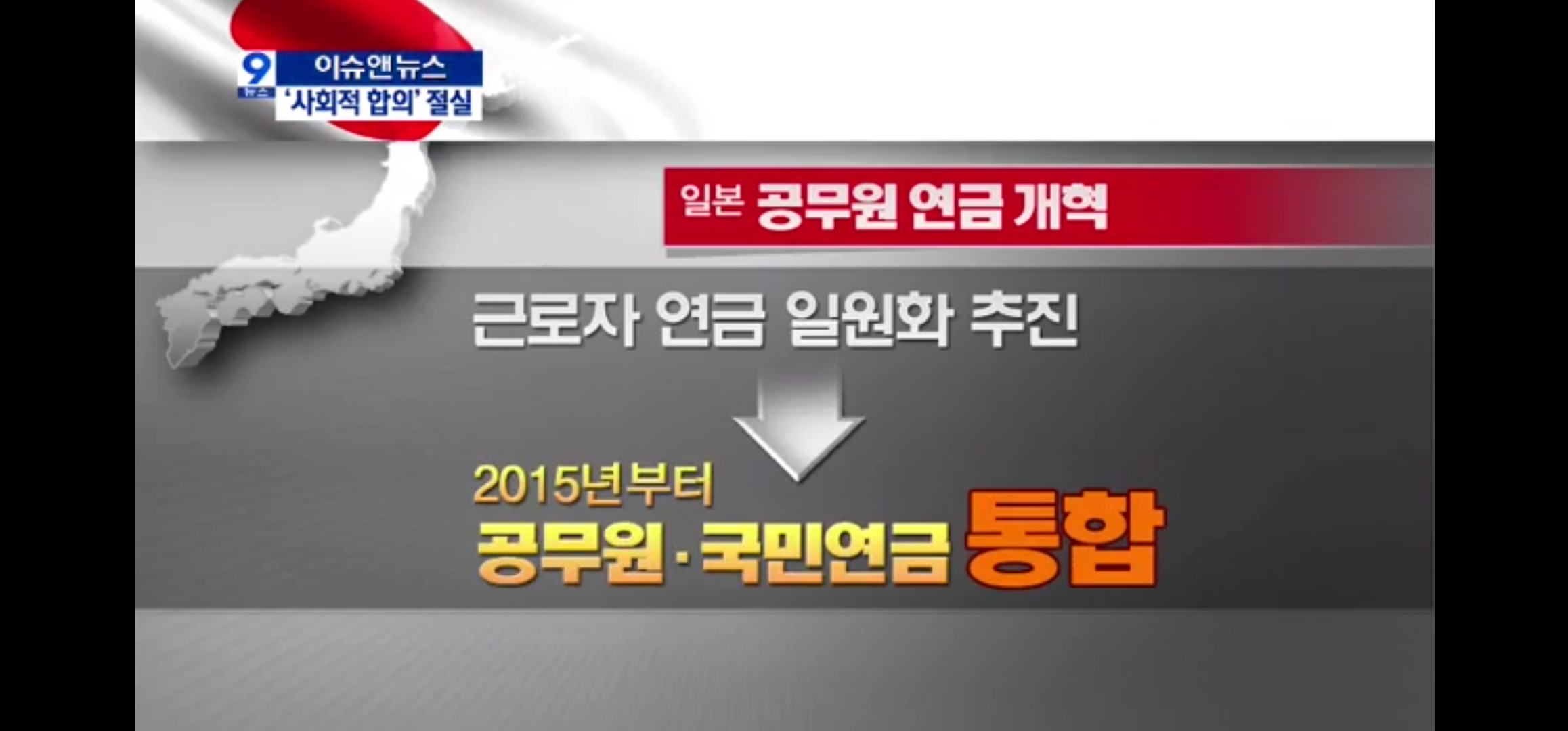
Japan, a neighboring country, stands out as a representative success story of Government Employees Pension reform.
In 1986, when reform discussions began, they established the grand principle of eliminating discrimination between civil servants and private-sector employees.
After pursuing the 'unification of worker pensions' over a long period of 26 years, they decided to integrate the Government Employees Pension and the National Pension starting from 2015.
The core of pension reform is a social consensus based on persistent effort
(Dialogue provided by the broadcaster up to this point)
(Available for viewing by clicking 'Watch on YouTube')
Attachments
- Screenshot_20260917_032420_Samsung Browser.jpg(519.8 KB)
- Screenshot_20260917_032456_Samsung Browser.jpg(696.6 KB)
- Screenshot_20260917_032513_Samsung Browser.jpg(641.7 KB)
- Screenshot_20260917_032523_Samsung Browser.jpg(649.3 KB)
- Screenshot_20260917_032547_Samsung Browser.jpg(676.6 KB)
- Screenshot_20260917_032600_Samsung Browser.jpg(574.5 KB)
- Screenshot_20260917_032622_Samsung Browser.jpg(608.5 KB)
- Screenshot_20260917_032636_Samsung Browser.jpg(368.6 KB)
- Screenshot_20260917_032644_Samsung Browser.jpg(407.7 KB)
- Screenshot_20260917_032701_Samsung Browser.jpg(395.0 KB)