(SBS TV Debate on Government Employees Pension Reform Issues, March 26, 2015) [Issue Inside] What Is the Breakthrough for 'Government Employees Pension Reform'? (Posted September 17, 2026)
(It is regrettable that the
video shows only a portion
of the debate
rather than the whole,
but I am grateful to
SBS for preserving it so
that it can
be used as a historical record.)
With only two days remaining in the activity period of the National Grand Compromise Body for Government Employees Pension Reform, attention is focused on whether the ruling and opposition parties and the government employees' unions can reach a grand compromise at the last minute.
The New Politics Democratic Union, which had previously only opposed the ruling party's plan, presented its own reform plan on the 25th, three days before the Grand Compromise Body's activity period ended.
However, regarding the opposition party's reform plan,
the Saenuri Party dismissed it as a "steamed bun without
filling," and the government employees' unions
are also protesting, calling it "a
deception of civil servants."
The core of the
controversy is the question of how much
the Government Employees Pension will be cut.
Based on a civil servant who served for 30 years (with an average monthly salary of 3 million won), the current system requires contributions of 210,000 won per month and provides a pension of 1.71 million won after retirement.
However, if it changes according to the government and the ruling party's plan, they will make contributions of 300,000 won per month and receive a pension of 1.38 million won. The opposition party's plan is a "structure of paying less and receiving more" than the ruling party's plan.
They would pay approximately 270,000 won in contributions and receive about 1.53 million won per month after retirement.
The government employees' unions maintain the position that they cannot accept either the government and the ruling party's plan or the opposition party's plan.
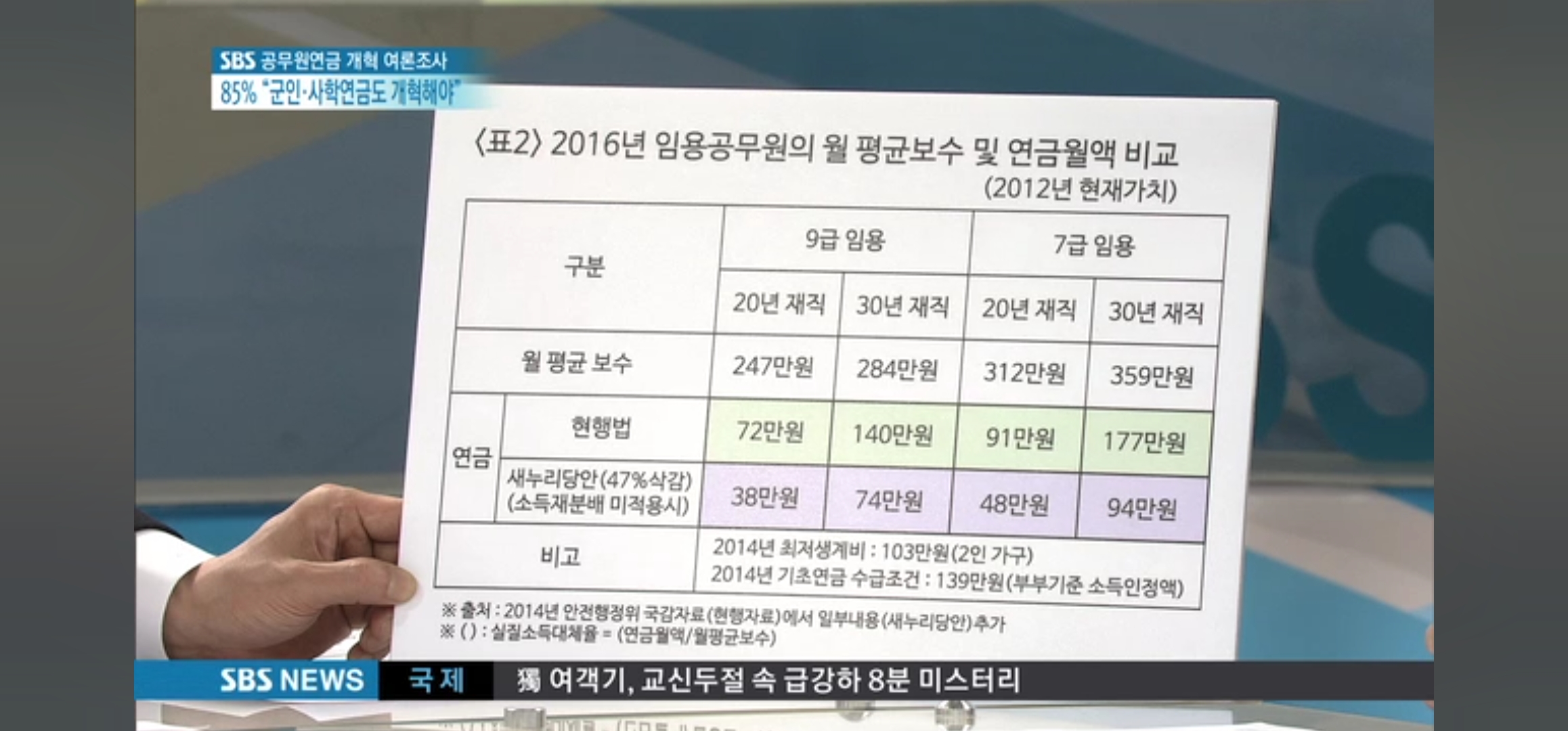
They argue that if it changes according to the Saenuri Party's plan, a grade 9 civil servant who served for 30 years would receive a Government Employees Pension amount of 740,000 won, which does not even reach the minimum cost of living for a two-person household.
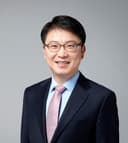
Yun Suk-myung, Research Fellow at the Korea Institute for Health and Social Affairs, who appeared on SBS's [Issue Inside] "Finding a Breakthrough for Government Employees Pension Reform" on March 26,
stated, "When the Government Employees Pension system began in 1960, there were no financial deficit problems because life expectancy was slightly over 50.
However, life expectancy now exceeds 80. Let us assume someone became a civil servant at age 30, served for 20 years, and retired at age 50.
We must provide a pension for over 40 years to someone who worked for 20 years, so we cannot say that the monthly pension is too small.
New civil servants entering the workforce in the future are people who will live to be over 90.
That is why we must reform the Government Employees Pension now," arguing for the necessity of Government Employees Pension reform.
In response, Lee Hee-woo, Deputy Director of the Policy Research Institute at the Korean Government Employees' Union, who also appeared on the program,
countered, "Are they telling us to live a thin and long life?
But can one live a long life in a situation where the pension does not even meet the minimum cost of living?
There is a five-year gap from retiring at age 60 until receiving the pension at age 65,
and during that time, we would just have to suck our fingers.
Will health or assets be maintained during that period?
With the current Government Employees Pension
reform plan, it is difficult to maintain old-age
living itself."
(SBS New Media Department)
Source: SBS News
Original link: https://news.sbs.co.kr/news/endPage.do?news_id=N1002899749&plink=COPYPASTE&cooper=SBSNEWSMOBEND