(JoongAng Ilbo Report on the Current State of the Government Employees Pension, August 27, 2026) 629 Trillion Won From the National Treasury Must Be Poured Into the Government Employees Pension Over 40 Years — Private School Teachers Pension to Be Depleted in 16 Years (Posted September 16, 2026)
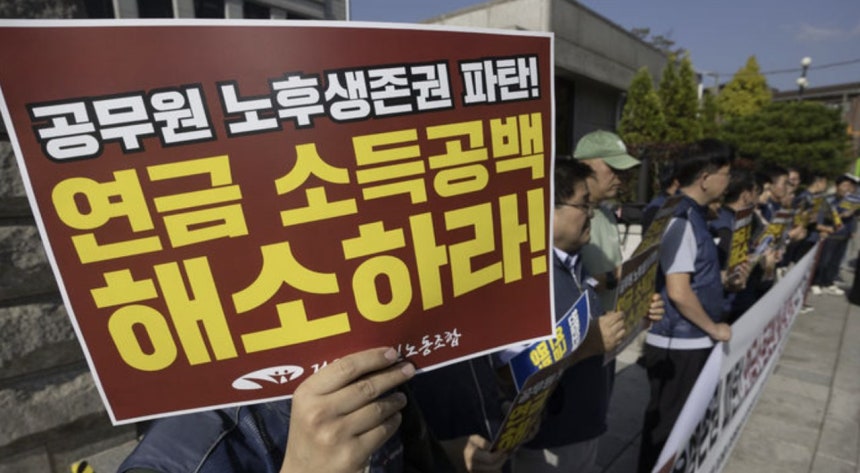
As the deficit of the Government Employees Pension grows daily, a projection has emerged that 629 trillion won from the national treasury must be injected over the next 40 years.
Additionally, the Private School Teachers Pension is projected to turn to deficit in 2028 and face fund depletion in 2042.
Ten years have passed since the 2015 reform of these two pensions, yet the fiscal crisis has not been significantly resolved.
In December last year, the Private School Teachers Pension Financial Estimation Committee (6th) recommended that "fiscal stabilization measures must be prepared promptly," but there has been no movement since.
The Government Employees Pension began running a deficit in 1993 and has been filling the deficit with the national treasury for 25 years since 2001.
In 2015, a reform was implemented to raise contributions and lower the pension payment rate. Due to the effects of that reform, it was projected that deficit subsidies from the national treasury for 2016–2025 would be halved to 34 trillion won (39 trillion won when reflecting inflation).
However, the actual amount spent reached 41 trillion won. In particular, the deficit subsidies, which were in the 2 trillion or 3 trillion won range, soared after 2022, jumping 2.6 times in four years to 8.3173 trillion won last year.
Before the reform, 27% of Government Employees Pension expenditure relied on national treasury subsidies, but this rose to 36% last year (according to the National Assembly Budget Office data).
To fill the Government Employees Pension deficit,
629 trillion won from the national treasury over 40 years
Chairman Yoon Young-seok of the National Assembly Special Committee on Pension Reform estimated the national treasury funds required for Government Employees Pension deficit subsidies from 2026 to 2065 based on data submitted by the Ministry of Personnel Management, and the result was 629 trillion won (based on 2024 monetary value).
This increases to the 10 trillion won range in 2030 and the 20 trillion won range in the late 2050s. Choi Jae-sik, former Chairman of the Government Employees Pension Service, stated, "The Government Employees Pension deficit is growing every year, and 10 trillion won of the public's taxes are spent to fill it.
The Private School Teachers Pension is facing imminent depletion," he said, adding, "Despite this situation, no one is stepping forward."
The number of Government Employees Pension contributors has increased by approximately 200,000 (an 18% increase) over the past 10 years, influenced by the Moon Jae-in administration's increase in civil servants and firefighters. An increase in contributors helps the finances in the short term. However, the reason the deficit is growing is that the number of pension beneficiaries is increasing much more.
They increased by approximately 300,000 (a 70% increase) from 2016 to 2025. The National Assembly Budget Office (the Budget Office) projected that expenditure growth (an annual average of 5.5%) will outpace revenue growth (4.3%) from 2026 to 2029.
According to the Ministry of Personnel Management, the shortfall in pensions to be paid (accrued liability) increased from 905 trillion won in 2021 to 1,076 trillion won last year.
The Private School Teachers Pension is also approaching a crisis. In 2022, the pension amount payable already surpassed contribution revenue for the first time (by 221.8 billion won), and this increased 5.7 times to 1.2619 trillion won last year.
While contribution revenue increased by an annual average of 1.9% from 2021 to 2025, the amount payable increased by 8.9%.
Thanks to fund investment returns, it will hold out for six years before turning to a current-year deficit in 2028, and is projected to erode the fund over 14 years and reach fund depletion in 2042 (Budget Office projection).
The number of Private School Teachers Pension contributors increased by about 40,000 when national university hospital employees were newly incorporated in 2016 (Ministry of Education statistics), but this cannot offset the increase in pension beneficiaries.
The National Pension, Government Employees Pension, and Private School Teachers Pension recalculate their finances every five years.
The Government Employees Pension does not disclose the results.
The 6th Fiscal Recalculation Report of the Private School Teachers Pension projected last December that contributors will peak in 2040 and begin to decrease, while beneficiaries will continue to increase.
In particular, there is a significant increase in linked pension beneficiaries who receive pensions in connection with the National Pension.
The report estimated the date of fund depletion to be 2047. This is two years earlier than the 5th financial projection five years ago.
It is five years later than the financial projection (2042) of the National Assembly Budget Office. The Private School Teachers Pension side explains that there are differences in the variables used for the projection.
The Financial Estimation Committee estimated that if things remain as they are, the contribution rate (the pay-as-you-go cost rate) must become 26.1% in 2050 and 34.3% in 2095 to pay pensions in those years.
One-third of income would have to be paid as contributions. The current contribution rate is 18%.
The Budget Office expressed concern that "as the school-age population decreases, the number of private school faculty and staff will decrease (leading to a decrease in contributors and revenue), and it will be affected by demographic changes."
What is the reason why the crisis of the Government Employees Pension and Private School Teachers Pension continues?
Yun Suk-myung, Research Fellow Emeritus at the Korea Institute for Health and Social Affairs (KIHASA), said, "It is because it was not properly reformed in 2015."
At that time, the weakest option among various reform plans was adopted. There were plans to lower the annual pension payment rate from 1.9% to 1.3% or 1.6%, but it was eventually decided at 1.7%.
He pointed out that "increasing the number of civil servants and incorporating national university hospital employees into the Private School Teachers Pension helps the finances immediately,
but it will act as a great burden when they begin to receive pensions."
Kim Ki-tae (36), an office worker, said, "I do not understand why the deficit of the Government Employees Pension has been filled with taxes for 25 years while people are told to pay more and receive less because of worries over the National Pension's
depletion," adding that "delaying reform and passing hundreds of trillion won in debt to future generations is clear unfairness." He said, "The government and the political sphere should stop worrying about public perception and immediately perform a proper surgery to meet the public's expectations."
Experts also raise the need for additional reform. Professor Kim Yong-ha of the Department of IT Finance and Management at Soonchunhyang University (Chairman of the 6th Financial Estimation Committee of the Private School Teachers Pension) said, "The 2015 reform aimed to align the level with the National Pension.
However, the National Pension underwent reform last year, shifting its position by delaying the date of fund depletion by nine years. Therefore, the Government Employees Pension and Private School Teachers Pension must also undergo additional reform to align with this," he said.
However, the government is not taking action.
An official at the Ministry of Personnel Management, which is in charge of the Government Employees Pension, said, "The 2015 reform is still ongoing.
Furthermore, the income gap between retirement (age 60) and pension receipt (age 65) is widening. In this situation, I believe it is difficult to talk about reform. A process of social consensus and concession is necessary," the official said.
An official at the Ministry of Education, which is in charge of the Private School Teachers Pension, said, "We cannot lead the pension reform.
We will participate if the Ministry of Finance and Economy and the Ministry of Health and Welfare take the lead."
A deputy director (38) at a central government ministry said, "When I started my public service, the pension amount had already been cut significantly compared to before; it does not seem right to implement additional reform citing the deficit.
The popularity of civil service is already declining, and if only current civil servants' pensions are cut while leaving previous beneficiaries untouched, morale will drop seriously," the deputy director said.
Welfare Specialist Reporter Shin Sung-sik, Reporter Chae Hye-seon