Reform After 18 Years? Benefits for High Earners, and a 6,159 Trillion Won Unfunded Liability in 25 Years [Deep&wide] (March 31, 2025, 4:30 a.m.)
Editor’s Note
An in-depth report in which experts in each field analyze major domestic and international issues with deep knowledge and a wide perspective.
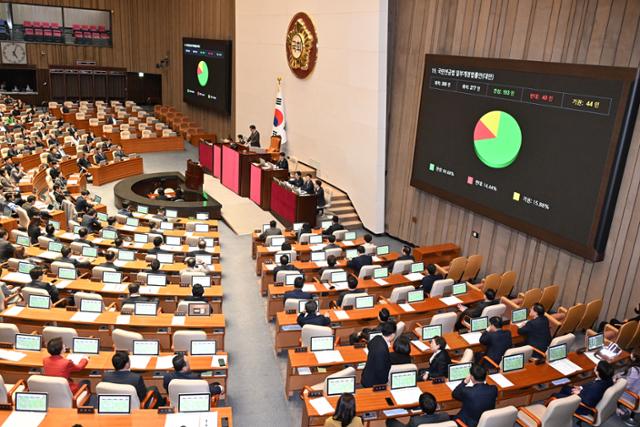
The partial amendment to the National Pension Act passes a plenary session of the National Assembly on March 20. Reporter Ko Young-kwon
For once, the ruling and opposition parties have agreed on a National Pension overhaul. But this is only a beginning in terms of achieving the sustainability of the National Pension and equity across generations.
The fiscal stabilization measure the ruling and opposition parties agreed on amounts to no more than “a 43% income replacement rate and a 13% contribution rate.” The introduction of an automatic adjustment mechanism, originally the biggest point of contention, was passed on to a special committee to discuss later. Along with writing the payment guarantee into law, the childbirth and military service credits were expanded, and this part also needs careful adjustment.
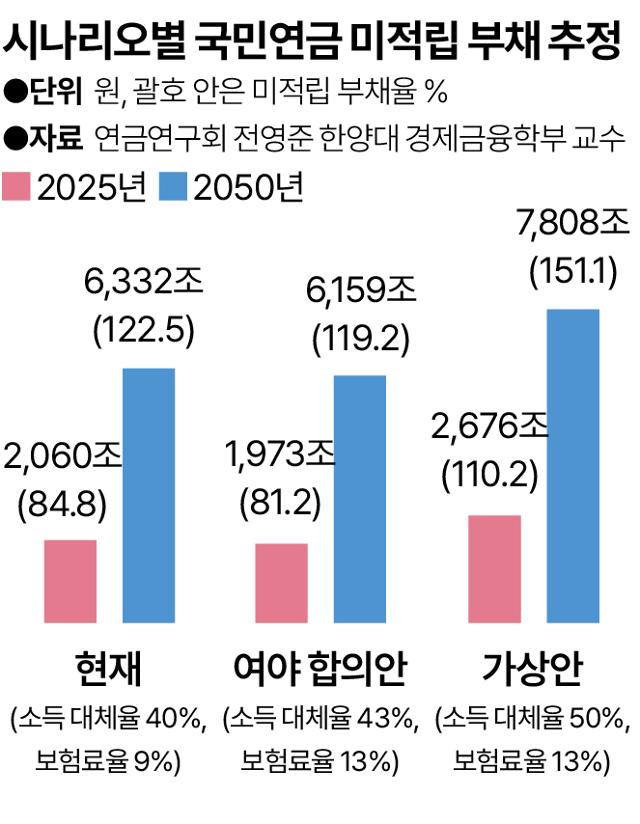
Estimated unfunded liability of the National Pension by scenario.
Raising the replacement rate and contributions is the first stage of reform
National Pension reform has long remained a political “hot potato.” The income replacement rate in particular was the biggest point of contention, because the income replacement rate (the ratio of the pension amount to monthly earnings), at 41.5% this year, was scheduled to fall to 40% by 2028. Those who argued that 40% was too low have clashed with those who argued that, in terms of the system’s sustainability, even maintaining 40% would be difficult. In 2023, the 5th National Pension Financial Estimation Committee and the advisory committee of the National Assembly Special Committee on Pension Reform overwhelmingly favored keeping it at 40%. The citizen representatives of the National Assembly’s public deliberation committee, however, took a different position: 56% of the citizen representatives preferred “a 50% income replacement rate and a 13% contribution rate.”
The representativeness of the 500 citizen representatives was called into question, because the panel was composed with larger numbers of citizens who preferred receiving more and of age groups representing the interests of the older generation. That the citizen representatives decided without knowing key information came to light through Representative Yoo Kyung-joon, who was the ruling party’s secretary on the Special Committee on Pension Reform of the 21st National Assembly. Under the “50% income replacement rate and 13% contribution rate” the citizen representatives preferred, the pay-as-you-go contribution rate would reach 43.2% in 2078, and the lifetime National Pension contribution burden of those born in 2005 and those born in 2035 would differ by as much as 21.3 percentage points. There was much criticism that, because the citizen representatives studied from new learning materials from which this data, originally included, had been deleted, they made a choice different from that of the experts.
For this reason, a government plan centered on “a 42% income replacement rate plus the introduction of an automatic adjustment mechanism” was announced last September. To secure intergenerational equity, it also included “differentiated contribution burdens by age.”
If the bipartisan agreement takes effect, the income replacement rate will be raised by 3 percentage points to 43% starting next year. The childbirth credit, which had excluded the first child, will apply for 12 months, and from the third child onward 18 months each will apply without limit regardless of the number of children. The military service credit, previously 6 months, was expanded to up to 12 months. A provision guaranteeing payment by the state was also written into law. Although the income replacement rate was raised by 3 percentage points, it has no immediate effect on alleviating elderly poverty; its full effect can appear only after 40 years. The increase in the income replacement rate applies immediately, but contributions are raised over eight years, so fiscal instability has grown even more severe.
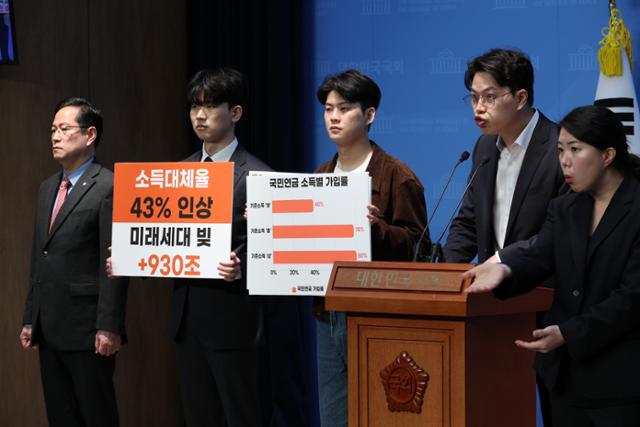
Representative Park Su-young of the People Power Party (far left), Son Young-kwang, head of Youth Action for Pension Reform (fourth from left), and others hold a press conference at the National Assembly Communication Center on March 21 denouncing the passage of the pension reform bill. Newsis
Clear winners and losers
The winners and losers of the pension overhaul are clear. The fund depletion date has been pushed back nine years, to 2064. On the other hand, the pay-as-you-go contribution rate in 2078, after depletion, has risen by as much as 3 percentage points, to 38%. In conclusion, the pension vested interests of those aged 50 and over, that is, the “generation that pays little and receives much,” have become even more entrenched. Unless other measures are taken, this amounts to shifting a greater burden onto young people and future generations.
Resolving these structural problems requires additional measures. According to the 5th National Pension financial projection of 2023, even reforming to “a 40% income replacement rate and a 17% contribution rate” was estimated to make fiscal stabilization difficult to achieve. Even switching to “a 30% income replacement rate and a 12% contribution rate,” the fund would be depleted in 2070 and the pay-as-you-go contribution rate would soar to 26.5%.
Yet this time the income replacement rate was raised by as much as 3 percentage points. A 3-percentage-point increase is a measure that permanently raises monthly pension amounts by as much as 7.5%. Contributions, by contrast, are raised over eight years, so fiscal instability is inevitable, because the effect on the money received appears immediately from next year while the effect of the contribution increase can be fully reflected only after eight years. Because high-income earners tend to stay enrolled in the National Pension longer, the increase in the income replacement rate, while adding to the burden on future generations, is likely to accrue mainly to high-income earners.
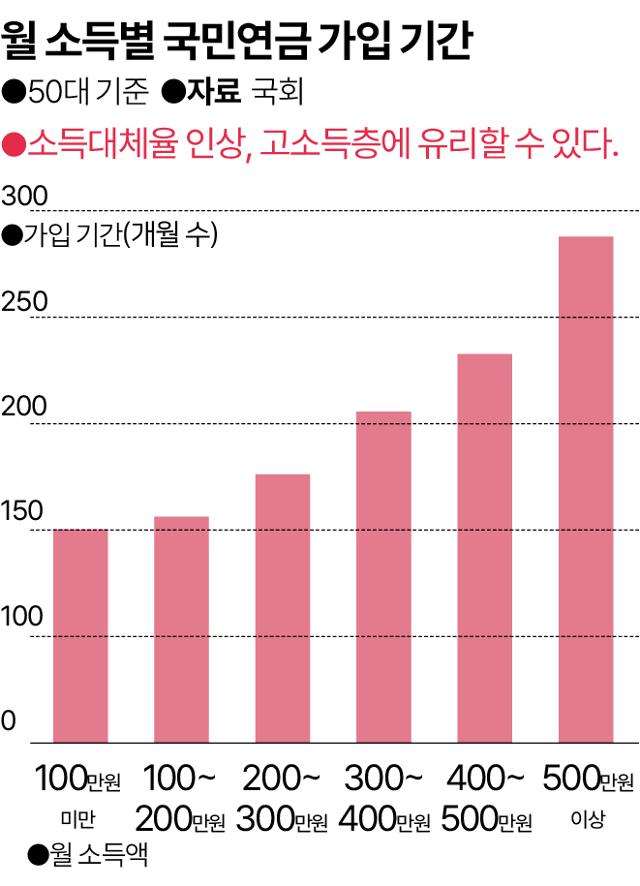
National Pension contribution period by monthly income
The area now demanding priority attention is the management of the unfunded liability. Because the National Pension has set future benefit amounts in advance while collecting relatively low contributions, the unfunded liability—the shortfall in benefits owed—has continued to build up. According to Pension Future Forum estimates, the National Pension’s unfunded liability reaches 2,060 trillion won (as of 2025, equivalent to 84.8% of GDP).
To raise the income replacement rate to 43% without increasing the unfunded liability, the contribution rate would have had to be raised immediately to 21.2%. But even eight years from now the rate will still fall short by as much as 8.2 percentage points, so the unfunded liability will surge to 6,159 trillion won (119.2% of GDP) by 2050. This is why this overhaul is assessed as falling far short of achieving fiscal stability. Because maintaining the system is difficult, introducing an automatic adjustment mechanism appears unavoidable.
The provision writing the payment guarantee into law could even become a motive for neglecting pension reform. It must be kept in mind that a proper payment guarantee means securing the money to be paid to young people and future generations. With this expansion of the credits adding 97 trillion won, a total of 237 trillion won in funding is needed. If most of the required funding is passed on to future generations, the pension finances are bound to deteriorate.
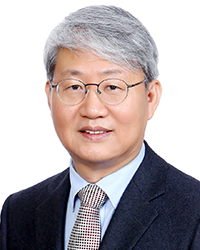
Who is Research Fellow Emeritus Yun Suk-myung?
M.A. in economics from Korea University; Ph.D. in economics from Texas A&M University in the United States (on pensions and health security). At the Korea Institute for Health and Social Affairs he served as Director of the Social Security Research Division and head of the Pension Research Center, among other posts, researching public pensions and the health insurance system. He has served as a member of the 1st through 5th National Pension financial projection and system development committees and as President of the Korean Pension Association, among other roles. He is currently Research Fellow Emeritus at the Korea Institute for Health and Social Affairs and a leader of the Pension Future Forum.
Yun Suk-myung, Research Fellow Emeritus, Korea Institute for Health and Social Affairs; former President of the Korean Pension Association
https://www.hankookilbo.com/news/article/A2025032614450001929