
(Hankook Ilbo) [Dialogue] “For Presidential Candidates to Dodge Pension Reform Is to Ruin the Country” (December 2, 2021)
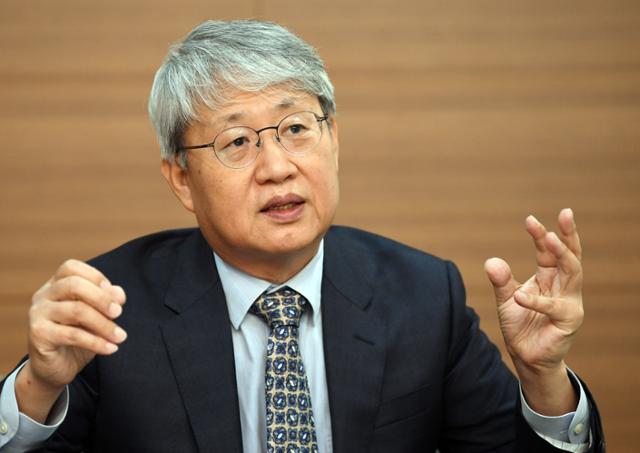
Yun Suk-myung, President of the Korean Pension Association, declared in a Hankook Ilbo [Dialogue] interview: “It is irresponsible behavior, conscious only of votes, for the leading presidential candidates not to step forward with pension reform pledges.” Reporter Hong In-gi
[Jang In-cheol’s Observations]
Yun Suk-myung, President of the Korean Pension Association and
Research Fellow at the Korea Institute for Health and Social Affairs
“The Candidates in This Presidential Election Must End the ‘Passing the Bomb Around’ on Pension Reform”
Ahn Cheol-soo, the People’s Party presidential candidate, recently ignited the pension reform agenda in this presidential race by unveiling a groundbreaking pension reform pledge. Yet Lee Jae-myung and Yoon Suk-yeol, regarded as the leading candidates of the ruling and opposition parties, have still not presented full-fledged pension reform pledges. Warning lights have been flashing for a long time that the three major public pensions—the National Pension, the Government Employees Pension, and the Military Pension—are gravely ill, and that the Private School Teachers Pension, too, is racing toward collapse, yet the candidates appear to be deliberately turning away from reality.
Easing the pension crisis, which is heading toward fiscal depletion, urgently requires a painful “pay more, receive less” reform. If it could not be done at once, at least a gradual approach should have been found. But the Moon Jae-in administration instead pledged to strengthen public pensions in order to solve old-age poverty, and pursued the absurd remedy of “pay less, receive more,” the opposite of the prescription. As a result, it wasted its five years in power without even touching pension reform. The pension situation has worsened further, and now the next administration, at least, must undertake reform without fail.
But if the presidential candidates keep shunning pension reform pledges while watching voters’ moods as they do now, the irresponsible “passing the pension reform bomb around” is likely to be repeated under the next administration as well. Yun Suk-myung, President of the Korean Pension Association, insists that “to go on avoiding pension reform is to ruin the country,” adding, “If the presidential candidates avoid pledges to the end, we are in a situation where society must act so that they have no choice but to make them.” We hear from President Yun about the desperate state of the three major public pensions and the direction of reform.
We hear from President Yun about the desperate state of the three major public pensions and the direction of reform.
“Avoiding Pension Reform Will Place an Enormous Burden on the Younger Generation”
-Pension reform has been regarded as one of the most urgent reform tasks in our society. Yet in this presidential race, even as pledges for young people and ordinary citizens are pouring out like a flood, a strange situation is unfolding in which it has not even emerged as a major pledge.
“From job-seeking allowances to basic housing and cost-price housing, and even rent support of 200,000 won a month per person, populist support measures for young people are pouring out as the presidential election approaches. But pension reform is more urgent than any handout. If pension reform is not carried out now, the pension finances will be depleted, and in only 30-odd years the public will have to pay 30% of their income in pension contributions alone or accept sharply reduced pensions. It amounts to passing debts that will be hard to bear on to young people and future generations. Yet both the government and the presidential candidates are turning away. It is irresponsible behavior, like watching a deadly cancer spread before one’s eyes and trying to get by with painkillers and a few pieces of candy. We are in a situation where society must act to pressure and urge the presidential candidates to put forward clear pension reform pledges.”
-It is not as if there have been no pension reform pledges in the presidential race so far. I recall that, before the recent pledge from People’s Party candidate Ahn Cheol-soo, there were pension reform pledges in the ruling and opposition parties’ respective primaries as well.
“The pension reform pledge recently put forward by People’s Party candidate Ahn Cheol-soo is groundbreaking enough to deserve attention. In particular, the ‘unified pension system’ is a proposal to effectively unify, on the basis of the National Pension, the financial design of the three major public pensions—the National Pension, the Government Employees Pension, and the Military Pension—and the Private School Teachers Pension, whose differing contribution rates and income replacement rates have caused endless disputes over inequality and unfairness. Until now there has been only talk in principle; it is the kind of proposal that no administration and no party has dared to turn into a pledge, mindful of opposition from civil servants, military personnel, and others. In that respect, regardless of whether I support him, I believe Candidate Ahn’s pledge deserves very high marks. Before Candidate Ahn, in the primaries, Representative Yoo Seung-min and former Representative Yoon Hee-sook of the People Power Party, Representative Park Yong-jin of the Democratic Party, and Kim Dong-yeon, the candidate of the New Wave (provisional name), among others, expressed their intention to make related pledges. Yet Lee Jae-myung and Yoon Suk-yeol, considered the most likely presidential candidates, have not yet put forward full-fledged pledges. Candidate Yoon has at least evaluated the Park Geun-hye administration’s Government Employees Pension reform and said something to the effect that ‘pension reform cannot succeed if pursued by only one political faction,’ but Candidate Lee appears to be all but ignoring it. It is disheartening to see the two most likely candidates turning away from pension reform pledges.”
“A Welcome Start for Ahn Cheol-soo’s Case for Integrating the Three Major Public Pensions
Lee Jae-myung’s and Yoon Suk-yeol’s Avoidance of Pension Pledges Is Irresponsible
They Must Show They Answer to the Future, Not to ‘Votes’”
-Why do you think the Lee Jae-myung and Yoon Suk-yeol camps are so reluctant to put forward concrete pension reform pledges?
“The pension pledges made in elections over the past 20 years have mostly been ones that would pay off in votes, such as introducing a new Basic Pension or raising Basic Pension amounts further. But now there is no more sugarcoating left, and normalizing the pension system has made burden-sharing by the public unavoidable. So they seem to be deliberately turning away for fear of losing votes by bringing up a pledge to share the pain. Even so, scattering ‘handout pledges’ to win young voters while turning away from the pension problem, which inevitably shifts an enormous burden onto those same young people and future generations, is a hard-to-forgive sin. French President Macron even gave up his own presidential pension to push through a ‘work more, receive less’ pension reform. I hope the two most likely candidates will act responsibly, and I want to believe they surely will.”
-Why must pension reform not be postponed any longer?
“The Government Employees and Military Pensions have already run out of funds. Government budget funds spent on covering their losses over the past ten years alone amount to 76 trillion won. The National Pension is said to be in better shape, but even by the government’s projection its finances will be depleted by 2057. The Private School Teachers Pension is in the worst shape. The financial condition of the public pensions has deteriorated this badly because of structural problems.
Take the National Pension: when it was introduced in 1988, it started with a benefit rate (income replacement rate) of 70% and contributions of 3%. Given the benefit rate, contributions of at least 20% should have been collected, but it started with low contributions in order to encourage people to enroll. Instead, there was a plan to raise contributions to an appropriate level as quickly as possible. But for various reasons they still remain at 9%. For reference, people in OECD countries that pay pensions at our level pay contributions of about 20%.
Meanwhile, with the aging of the roughly 7.2 million members of the first baby-boom generation, the largest group in our population structure, the number of pension beneficiaries is increasing faster than anywhere else in the world, while the fertility rate is the lowest in the world. So the timing for reform has, in effect, already been missed. If reform is delayed further, today’s young people and the generations after them will be driven into a harsh situation in which they must either accept drastic pension cuts or pay at least 30% of their income in pension contributions, and in the end the country, too, will inevitably face a serious crisis.”

View original Yun Suk-myung, President of the Korean Pension Association, predicted in a [Dialogue] with Editorial Writer Jang In-cheol: “If we turn away from reform now, after the National Pension Fund is depleted in 2057, either pension benefits will have to be cut sharply or the economically active population of the time will face the extreme situation of paying at least 30% of their income in pension contributions.” Reporter Hong In-gi
“Without Reform, a Deficit of 17,000 Trillion Won by 2088”
-How would you explain, in structural terms, the crisis the current pension system will bring about, including the depletion of pension finances and the resulting surge in the burden on later generations?
“As I said earlier, the National Pension started at its introduction with a benefit rate of 70% and contributions of 3%. Ten years later, in 1999, the benefit rate was cut by 10 percentage points, and 60% was paid until 2007. Then, with the 2007 pension reform, the payment rate was cut by 10 percentage points in 2008 and then by 0.5 percentage points every year from 2009 to 2028, so that a 40% benefit rate is scheduled to be paid from 2028. At the time of the 2007 reform, the plan was to raise contributions to 12.9% by 2018, but it could not be carried out because of political opposition, and the National Pension’s condition became more serious.
Even according to the 2018 Fourth National Pension Financial Projection, regarded as optimistic, the fund will be depleted by 2057. And by 2088, 70 years on, which the National Pension uses as its financial assessment period, the cumulative deficit is projected to reach 17,000 trillion won. This shows that it is a system that cannot be sustained if left as it is. Once the reserve fund is depleted, there is no choice but to switch to a pay-as-you-go system in which the young generation of the day (the economically active generation) chips in for the pensions paid to the older generation; in that case, taking low fertility and population aging into account, the National Pension contribution burden on today’s young people and later generations will inevitably exceed 30% of income even by a conservative estimate. If the situation is left to reach that point, both the young generation paying contributions and the older generation forced to bear pension cuts will take to the streets, and even the government will face a catastrophe it can do nothing about.”
-Beyond the structural problems of pension finances, there is also the problem that pension income is too low. A recent Korea Economic Research Institute report found that the pension amount received by single-person elderly households aged 65 and over in Korea is 828,000 won a month, only half that of Japan. Shouldn’t this problem also be included in pension reform?
“As of the end of May 2021, the average monthly National Pension (old-age pension) per person was tallied at 550,361 won. That barely exceeds this year’s minimum cost of living for a one-person household under the National Basic Livelihood Security Act (548,349 won). It is lower than the relative poverty line, the OECD’s poverty-rate benchmark. National Pension amounts are low because the National Pension system has a shorter history than in other countries, so contribution periods are short and pensions are small. I expect this to improve gradually in the course of pension reform. In fact, I think pension polarization is a more urgent problem than the low average pension income.”
“Resolving ‘Pension Polarization’ Is as Urgent as Stabilizing Pension Finances”
-What does pension polarization look like, and what is the solution?
“Korea’s old-age income security system is divided into the Basic Pension, funded 100% by taxes; the National Pension for the general public; and the Government Employees, Military, and Private School Teachers Pensions. Beneficiaries of the Government Employees, Military, and Private School Teachers Pensions may have more pension income than most young people with jobs. The problem is the National Pension for the general public, and in fact what matters more than the low average pension income is pension polarization.
Those insured under the National Pension who held stable jobs during their working lives receive pensions well above the average, whereas those who did not either could not even join the National Pension or, if they did, have short contribution periods and small pensions. On top of that, people who worked at good jobs are likely to receive retirement pension and personal pension benefits in addition to the National Pension. That is how pension polarization arises.
Two solutions need to be pursued. For the insured who have held or hold stable jobs, the way the system is run must be overhauled substantially so that the National Pension, retirement pensions, and personal pensions together make a stable retirement possible. More urgent are those left out of the pension system. Considering that the Basic Pension paid to 70% of older people is 300,000 won a month, and 480,000 won for a couple (600,000 won minus a 20% deduction), we must look for ways to strengthen the old-age income of vulnerable groups at the middle and below. Government fiscal resources should go to vulnerable groups with middle incomes or lower, while for groups with middle incomes or higher, it is necessary to create jobs through labor market reform and to enable them to stay in the National Pension for a long time and increase their benefits.”
-President Moon Jae-in also pledged pension reform in the 2017 presidential election, but in the end he accomplished nothing and let five years go to waste. The public pension situation must have worsened in the meantime; how does the current financial condition of the three major public pensions compare with five years ago?
“It has deteriorated beyond imagination. According to calculations by the office of Representative Choi Hye-young of the ruling Democratic Party, there is even an analysis that the delay in reform has added at least 14 trillion to 17 trillion won to the public’s burden. The Government Employees Pension and the Military Pension increased national liabilities by more than 100 trillion won last year alone. Because the Moon Jae-in administration hired more than 100,000 additional civil servants while leaving the fiscally unstable Government Employees Pension as it was, the new factors worsening pension finances that they have added have also become serious.”
-How did the Moon Jae-in administration’s pension reform fail, and why?
“One has to conclude that the Moon Jae-in administration had no will for pension reform from the start. The reality of our pension system is that it is like a time bomb about to go off, yet the administration put forward the absurd pledge of raising the National Pension payment rate further in the name of strengthening public pensions. It is actually fortunate that the current administration’s pension pledges, which would have markedly reduced the sustainability of public pensions and deepened the polarization of old-age income among those insured under the National Pension, were not actively pursued. The problem is that while time has been wasted, the National Pension is piling up more than 400 billion won in latent liabilities a day, and the national liabilities attributable to the Government Employees, Military, and Private School Teachers Pensions are growing by more than 100 trillion won a year. The government’s pension reform failed because its pension pledges were so unrealistic that, apart from the small group pushing them, criticism never ceased, and the reform lost momentum.”
“Fiscal Stabilization Through a ‘Pay More, Receive Less’ Reform Is Urgent
An ‘Automatic Adjustment Mechanism’ for Pension Finances Is Also Needed
Plus Fiscal Support for the Vulnerable to Resolve ‘Pension Polarization’”
-What reform directions would you propose to the ruling and opposition presidential candidates for the three major public pensions and the Private School Teachers Pension?
“First of all, I want to urge a responsible attitude of doing what must be done for young people, for future generations, and for the future of the country, rather than chasing immediate votes. I think voters in their twenties and thirties will also cheer candidates who show that attitude.
As for the direction of reform, first, a ‘pay more, receive less’ reform must be pursued to secure the sustainability of public pensions. The introduction of an ‘automatic adjustment mechanism’ for pension finances, under which pension benefits are indexed and adjusted according to wages (or prices), life expectancy at retirement, and the financial condition of the pension, should also be pursued. That would be the measure that at least slows the pace of fund depletion.
In reforming the public pensions scheme by scheme, the Government Employees and Military Pensions and the Private School Teachers Pension, which are in the most critical condition, must be fixed first. Furthermore, even apart from Candidate Ahn Cheol-soo’s pledge, there is a strong need to pursue the integration of the three major public pensions, which has been raised continually. Japan has already built a ‘unification of public pensions (Common pension).’”
-The Government Employees Pension and the Military Pension have already exhausted their funds, and the fiscal burden is growing. How should they be overhauled?
“Fund depletion is only the trailer for the storm to come. The unsoundness of the Government Employees and Military Pensions is beyond imagination. For these systems to operate properly, contributions would have to be 35% or more, about twice the current 18%. If there are practical limits to raising the burden, there is no alternative but to cut the benefit rate sharply, however painful. For reference, although the Government Employees Pension system has been reformed several times, compared with the payment rate when the Government Employees Pension was first introduced in 1960, it still pays more than 1.8 times as much in pensions.”
Editorial Writer Jang In-cheol ([email protected])
