(Korea Auditors Federation Position, April 2022) "It Is Only Natural to Unify the Country's Debt Under 'National Liabilities' — the Term 'National Debt' Distorts the Statistics"
Korea Auditors Federation Proposes Amending the National Finance Act as a National Policy Agenda Item to the Presidential Transition Committee
"The Current Government's Statistic for the Country's Debt, 'National Debt,' Does Not Take the Accrued Pension Liability Into Account"
"Requiring Companies to Record Accrued Liabilities While the Government Does Not Record Its Own Is 'Government Window Dressing of the Accounts'"

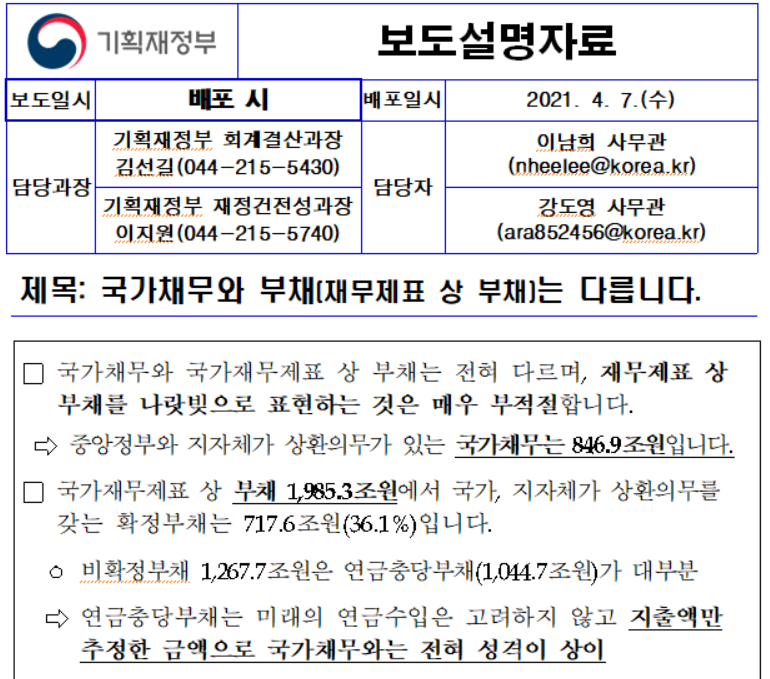
In April last year, the Ministry of Economy and Finance issued an explanatory note stating that national debt and national liabilities are different and that the country's debt is national debt (D1).
Accounting scholars have voiced sharp criticism that, instead of using 'national liabilities (D2),' the international accounting standard, the government is distorting the level of the country's debt to the public with 'national debt (D1).'
The Korea Auditors Federation, an incorporated association, reviewed problems with national statistics and the 'National Finance Act,' and on the 4th, following a resolution by its board of co-representatives, delivered to the Presidential Transition Committee a statement titled "Correct the Distortion of National Liabilities Statistics and Normalize Fiscal Management."
Critics point out that although the government tells the public, through the concept of 'national debt,' that Korea's level of 'the country's debt' is lower than the Organisation for Economic Co-operation and Development (OECD) average, 'national debt' is a domestic statistic from the era of single-entry bookkeeping and a figure that is not recognized internationally.
Last year the government stated that 'national debt' stood at 846.9 trillion won, or 42.2% as of 2019, a sound level compared with major countries (OECD average 110%).
Accounting experts, however, argued that when speaking of 'the country's debt,' statistics should be cited on the basis of national liabilities (D2) in the national financial statements under the 'National Accounting Act,' not national debt, and that the very term 'national debt' from the era of single-entry bookkeeping should be deleted altogether.
The Auditors Federation pointed out that "national liabilities officially submitted to international organizations under the IMF's Government Finance Statistics Manual (GSM) stood at 1,981.7 trillion won as of the end of 2020, or 114.0% of GDP."
Where 'national debt' differs from 'national liabilities' is that national debt does not take the 'accrued pension liability' into account.
Kim Kwang-yun, president of the Korea Auditors Federation (Professor Emeritus at Ajou University) and a former president of the Korean Accounting Association, explained, "National debt (D1) must not be used for the country's debt. Statistics should basically be cited on the basis of national liabilities (D2) in the national financial statements under the 'National Accounting Act,' in force since 2008, in which case the ratio exceeds the OECD average (110%)."
Professor Kim criticized the practice, saying, "National Pension contributions paid in are recorded as assets, yet the pensions that must be paid out, which the state guarantees, are not recorded as the country's debt at all," and adding, "This is inconsistent with the principles of double-entry bookkeeping, which rest on assets and liabilities."
He went on to remark pointedly, "Requiring companies to record accrued liabilities when preparing their financial statements while the government does not include in the country's debt the accrued pension liability it is obliged to pay is 'window dressing of the accounts.'"
He also criticized the government for confusing ordinary citizens, who use debt and liabilities as synonyms, by using the terms 'national debt' and 'national liabilities' interchangeably.
In addition, the Auditors Federation called for amending the National Finance Act, saying that although the act mandates preliminary feasibility studies for large-scale national projects, there are so many exceptions and special provisions that the requirement has been swayed by the whims of the political sphere and rendered meaningless.
The Auditors Federation proposed, "The National Finance Act should be extensively amended to make it consistent with the National Accounting Act and, befitting an OECD member country, should properly reflect accrual-basis double-entry accounting, abandoning the domestic statistical 'national debt' (D1) altogether and unifying around the internationally comparable term 'national liabilities' (D2)," adding, "Fiscal management, too, should conduct preliminary feasibility studies without exception, and a reform that normalizes national fiscal management should be made a national policy agenda item of the new government."
※ The following is the full text of the Auditors Federation's statement.
"Correcting the Distortion of National Liabilities Statistics and Normalizing Fiscal Management Are Imperative"
-Korea Auditors Federation (April 4, 2022)-
After the long COVID-19 period and several elections, there is great concern over the soundness of the national finances, which have grown lax. Households have 'liabilities' and companies have 'liabilities,' yet the state uses the term 'debt,' confusing ordinary people who take it to be synonymous with national liabilities.
In April last year, a press release posted on the website of the Ministry of Economy and Finance, the ministry in charge of the national budget, under the joint names of the Director of the Accounting and Settlement Division and the Director of the Fiscal Soundness Division, explained that 'national debt and national liabilities are different, and the country's debt = national debt (D1),' putting it at 846.9 trillion won as of the end of 2020, and we were startled by how low the figure was. Looking for the basis, we found that the National Finance Act, which succeeded the Budget and Accounts Act and the Framework Act on Fund Management of the cash-basis era, both abolished at the end of 2006, still retains the term 'national debt' in its Article 1 (Purpose), and in its Article 91 (Management of National Debt) narrowly defines it as monetary obligations borne by the state's accounts or funds (including government bonds, borrowings, and acts incurring national treasury obligations, but excluding treasury bills and temporary borrowings from the Bank of Korea), so that national debt is managed in this narrow sense. To remedy the problem of the public using the terms interchangeably, after the IMF foreign exchange crisis the old cash-basis Budget and Accounts Act was abolished, and the National Finance Act and the National Accounting Act, the latter based on the IMF accrual basis then in international use, were enacted separately from the end of 2007, with external reporting done accordingly; Article 56 (Settlement of Accounts) of the National Finance Act also expressly provides that, from 2008, the national settlement report under the National Accounting Act is introduced. Even so, we found that public officials still have not unified around national liabilities and stubbornly keep using, as a separate measure, the national debt of the single-entry era, which is useless externally.
At present, there are three national liabilities statistics compiled by the Center for Fiscal Accounting and Statistics at the Korea Institute of Public Finance, which is under the Ministry of Economy and Finance. The first is national debt (D1): a narrow, domestic measure of national liabilities (846.9 trillion won as of the end of 2020, 48.7% of GDP) used by the heads of central government agencies on a cash basis for domestic fiscal management plans and debt management plans, and it corresponds to national claims. The second is general government liabilities (D2), the ordinary measure of national liabilities calculated on an accrual basis for the central government, local governments, and their affiliated nonprofit public institutions; it is the national liabilities figure officially submitted to international organizations under the IMF's Government Finance Statistics Manual (GFSM) (1,981.7 trillion won as of the end of 2020, 114.0% of GDP), and it corresponds to national assets. The third is public-sector liabilities (D3), a broad measure of national liabilities that adds the liabilities of nonfinancial public corporations to the general government liabilities above and is calculated on an accrual basis using the OECD method (PSDS); it is used to manage the fiscal soundness of the public sector. It easily exceeds 2,000 trillion won (the government does not disclose it), but only seven countries worldwide, including Japan, submit it to the OECD, so it is not widely used for comparative statistics.
Therefore, when speaking of the country's debt today, one must not use national debt (D1), which lazy public officials and public finance scholars cite; statistics should basically be cited on the basis of national liabilities (D2) in the national financial statements under the National Accounting Act, in force since 2008, in which case the ratio exceeds the OECD average (110%). The debt that some officials and public finance scholars ignorant of accounting insist on is generally smaller than liabilities, because in accounting terms liabilities include not only legal debts but also accrued liabilities, which are estimated government payment obligations, so the figure comes out larger than debt. This concept became universal long ago in the financial statements of private companies, yet it is being distorted, so that to some populist politicians the national liability ratio appears to be around 50%, low compared with other countries, and this is abused to claim that there is room to issue more government bonds.
Meanwhile, in terms of fiscal management, the fiscal deficit has deepened through repeated populist supplementary budgets, such as universal disaster relief payments and exemptions from preliminary feasibility studies for large-scale national projects, not only because of the COVID-19 crisis but also through several elections.
In particular, Article 38 (Preliminary Feasibility Studies) mandates prior studies for new projects with total project costs of 50 billion won or more and state fiscal support of 30 billion won or more, but with its many exceptions and special provisions it is being swayed by the whims of the political sphere and rendered meaningless, so amending the law is imperative. In addition, the National Finance Act has a Chapter 5 for fiscal consolidation, but Article 86 (Efforts for Fiscal Consolidation) should manage not only 'national claims,' the counterpart of national debt, but all 'national assets' under the National Accounting Act. Article 87 (Enactment and Amendment of Laws Entailing Fiscal Burdens) requires that, when a bill to enact or amend a law entailing fiscal expenditure or tax reductions is submitted, estimates of the increase or decrease in fiscal revenue and expenditure for the five fiscal years from the year the law takes effect, together with a corresponding financing plan, be attached to the bill; only if this is required without exception of lawmaker-initiated bills as well, rather than being limited to government bills, can indiscriminate legislating be curbed. Furthermore, the 'national debt' management plan under Article 91 should be broadened into a 'national liabilities' management plan, making fuller use of the National Accounting Act and taking even greater care in managing the national finances.
Furthermore, normalizing the accounting of the eight major social insurance programs for which the state bears a direct or indirect burden (Government Employees Pension/Military Pension, National Pension/Private School Teachers Pension, employment insurance/industrial accident compensation insurance, National Health Insurance/long-term care insurance) is also an urgent task for the government. At present, only the Government Employees Pension and the Military Pension are properly recognized as assets and liabilities in the national financial statements, and the rest are incomplete. In particular, for the National Pension, in which the entire nation takes an interest, only the contributions paid in are recognized as assets, while the accrued liabilities expected to be paid to future generations are not recognized as liabilities at all, which amounts to sham window dressing of the accounts. Apart from questions of raising the contribution rate or the level of pension benefits, it would be desirable, as companies do, to recognize all future accrued liabilities at present value as liabilities (IPSAS); at a minimum, a major reform is needed, such as presenting the accrued liabilities for the pension shortfall in the notes to the financial statements, as the United States does, or presenting all pension-related assets and liabilities in a separate social insurance report so that they are managed by generation.
In sum, even if the National Finance Act is kept separate, we propose, as a national policy agenda item for the new government, a reform that normalizes national fiscal management: amend the act extensively to make it consistent with the National Accounting Act; befitting an OECD member country, properly reflect accrual-basis double-entry accounting, abandoning the domestic statistical 'national debt' (D1) altogether and unifying around the internationally comparable term 'national liabilities' (D2); and, in fiscal management too, conduct preliminary feasibility studies without exception.
Copyright © Ilgan NTN (日刊 NTN). Unauthorized reproduction and redistribution prohibited.
https://www.intn.co.kr/news/articleView.html?idxno=2021659#09hN