(JoongAng Ilbo Report, 2019) The Government That Says the Government Employees Pension Is 'the Nation's Debt' but the National Pension Is Not 'Debt' (October 4, 2026)

[Kim Do-nyeon's Economy Through Numbers]
The sharp rise in liabilities in last year's national financial statements was largely due to the growth of the accrued pension liabilities of the Government Employees Pension and the Military Pension.
Yet there is an asset that is left out of the liabilities column, even though its nature differs little from that of the Government Employees Pension in that the government pays it to the public.
That asset is the National Pension, for which President Moon Jae-in himself said, "Make the payment guarantee clear." Accounting experts point out that because the National Pension is not recorded as a liability, an 'illusion' arises in which national liabilities look smaller than they actually are.
━
Reflecting National Pension Liabilities Would Turn Korea's Net Assets Negative
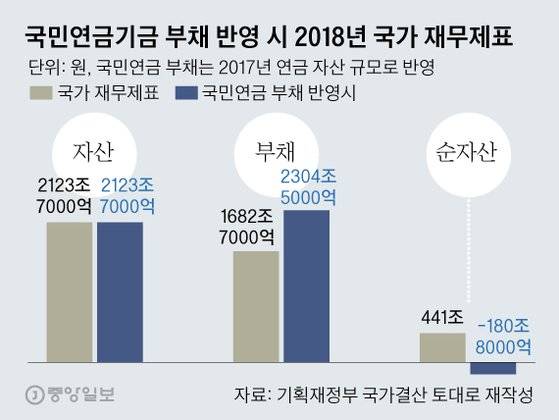
Liabilities in the fiscal year 2018 national financial statements, released by the Ministry of Economy and Finance on the 2nd, amounted to 1,682.7 trillion won.
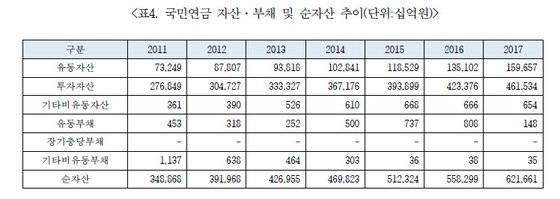
However, if the National Pension's 621.8 trillion won (as of 2017), which is recorded only as an asset, were recognized as an accrued pension liability like the Government Employees Pension, liabilities would grow to 2,304.5 trillion won.
In that case, net assets—what remains of total assets after liabilities are subtracted—would plunge from the existing 441 trillion won to -180.8 trillion won. For a private company, this would mean a state of 'capital impairment,' in which survival is difficult without an injection of additional capital.
Of course, unlike a company, a state does not 'go out of business' even if it falls into capital impairment (negative net assets), as long as it has no trouble raising funds by issuing government bonds.
Still, negative national net assets mean that there is no choice but to collect more taxes in order to keep providing public services to the people at the current level. It can also be seen as carrying the risk that increased government bond issuance could worsen the state's finances.
Government: "The National Pension Is a Social Security Fund — Not a Liability Because There Is No Obligation to Cover Shortfalls"
There are also accounting reasons why the government records the National Pension only as an asset and excludes it from the calculation of accrued pension liabilities, which are classified as 'the nation's debt.' It is a 'non-exchange transaction' in the nature of a social security policy that the government operates to guarantee the public's old-age income. The National Pension is not a fully 'proportional relationship' in which members get back in the future as much as they paid in. By state authority, it is designed so that lower earners 'pay less and receive more,' and it also plays an income-redistribution role that lets benefits reach more people.
The government also points out that no law stipulates an obligation for the state to cover the shortfall if the nation's coffers run dry. Put simply, for the Government Employees Pension and the Military Pension, the amounts to be paid in the future are calculated as accrued pension liabilities on the understanding that the state is the employer. The National Pension, however, carries no such legal payment obligation, so it is not recognized as a government liability. This is an international standard also accepted by the International Monetary Fund (IMF) and others. Others, however, point out that it is because the government is wary of the negative public opinion a surge in national liabilities would bring if it recorded the National Pension, worth more than 600 trillion won, as a liability.
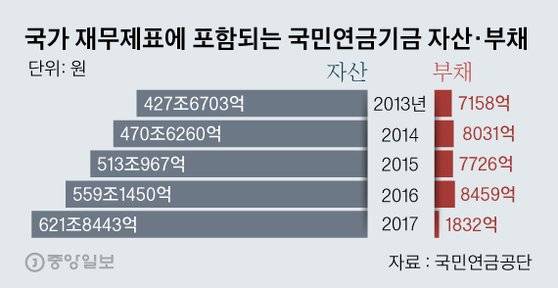
"The National Pension Distorts the Books — If It Is Money 'to Be Paid Out,' It Should Be Recorded as a Liability"
The problem is that, since the National Pension is ultimately money the government will have to pay in the future, this accounting treatment could spark controversy over 'hidden debt.' Accounting experts argue that excluding the National Pension from liabilities and recording it only as an asset widens the distortion of the books. If the government 'sincerely' believes the National Pension is money that must be paid out to the people, they say, there is no reason not to record it as a liability.
In the report 'Status of the National Financial Statements and Tasks for Improvement,' accountant Kim Sang-no of Hangil Accounting Corporation proposed, among other options, recognizing the National Pension as an accrued pension liability like the Government Employees and Military Pensions, or removing its assets and liabilities from the national financial statements altogether, as is done with postal savings. Only then, he argues, can the government draw up fiscal plans in line with the timeline under which the National Pension Fund is expected to be depleted by 2057.
In the report, accountant Kim pointed out, "Given its size, the National Pension significantly distorts the size of national assets," adding, "Although spending of public money (fiscal spending) is expected once its resources are exhausted, the financial statements present the situation as the exact opposite."
Experts say that reflecting the National Pension's liabilities is urgent, if only for the sake of sound fiscal management to reduce the burden on future generations as population aging accelerates. In this regard, Kim I-bae, president of the Korean Academic Society of Accounting, stressed, "It may be good for the older generation receiving pensions, but because it could make things hard for our descendants, it is time to talk about the essentials in national accounting as well."