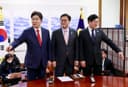
(Government Employees Pension, Seoul Sinmun Report, January 2023) The Betrayal of Pensions — Civil Servants Born with "Golden Spoons," the Public with "Dirt Spoons" (Posted October 4, 2026)
(Even though the Moon Jae-in administration hired civil servants on a massive scale
and they are paying contributions,
the deficit subsidy for the Government Employees Pension
has already exceeded twice the original projection.)
3.5 trillion won in taxes poured into the deficit-ridden Government Employees Pension
State subsidy leaves no sense of urgency for reform
A 4.7-fold gap with National Pension benefits
Unfairness in pension design and elsewhere must be fixed
The Yoon Suk-yeol administration has raised the banner of labor, pension, and education reform. None of them is unimportant, but pension reform in particular is a "hot issue" closely linked to low fertility and population aging, our society's chronic problems, and bearing directly on each citizen's retirement planning.
The National Assembly has recently been discussing pension reform, but one cannot help worrying whether it has set the right direction for reform. That is because, although the National Pension is the largest, the one with the most problems, which must be put under the knife right away, is the Government Employees Pension.
If priorities for reform are to be set, common sense says to cut first where taxes are going in.
Whereas the National Pension fund is projected to be depleted in 2057, the Government Employees Pension is already having its deficits covered with taxpayers' money. Last year the Government Employees Pension's deficit came to 3.5 trillion won, and it is projected to reach some 19 trillion won in 2070.
How did the Government Employees Pension come to this? It has been reformed four times under successive governments, yet far from shrinking, its deficit is growing exponentially.
That is because, although drastic medicine in the form of deep pension cuts was fundamentally needed, only stopgap measures were offered, such as small increases in contributions, so that it was "reform in name only" and fell hopelessly short of reducing the pension deficit. The global trend in pensions today is "pay more, receive less, and receive later."
Another reason the Government Employees Pension reform must come first is that it bears directly on equity and fairness. National Pension recipients receive an average of 530,000 won a month, whereas Government Employees Pension benefits average 2.48 million won a month, a full 4.7 times as much. Civil servants argue that they "pay higher contributions and pay them longer," but experts point out that even when the conditions are matched to those of the National Pension, the Government Employees Pension pays far more.
In particular, the structure of the Government Employees Pension itself is designed more favorably, so the pensions received cannot help being larger. The pension ceiling is 8.6 million won a month for the Government Employees Pension but 5.5 million won a month for the National Pension. This means that Government Employees Pension members can pay 1.6 times as much into the pension as National Pension members and, as a result, can receive more. The starting line itself is not fair.
Another problem is that the gap in benefits with the National Pension is so large that it is bound to cause social conflict.
That is also why the Organisation for Economic Co-operation and Development (OECD) recommends running the two pensions as one. Among OECD countries, only four, including Korea, have not integrated the two pensions. Even so, the government does not disclose the relevant data and is busy hiding the privileges. It even brazenly tells the lie that the Government Employees Pension pays 15% less than the National Pension.
Even in Japan, which we used as a benchmark, the civil-servant pension started out financed entirely by government support, but in 2015 the civil-servant pension and the national pension were unified, so that all citizens and civil servants receive the same pension. Former Prime Minister Koizumi's forceful push for pension reform in 2004 was what made it work.
In Korea, however, whenever the Government Employees Pension runs a deficit, the state unconditionally takes responsibility and covers it, so there can be no sense of urgency about a painful pension reform.
It is said that, apart from Korea, it is hard to find anywhere in the world a case in which a provision guaranteeing Government Employees Pension payments by the state is explicitly written into law, so there could be no greater privilege.
It is not for nothing that people call South Korea "a nation of civil servants." Last year, the money the state filled in per Government Employees Pension recipient amounted to as much as 7.26 million won a year. In 2070 it will grow 2.4-fold, to 17.54 million won.
If the Yoon Suk-yeol administration does not pursue pension reform properly, it may, like its predecessors, only beat around the bush and fail. Its first target must be the reform of the Government Employees Pension, into which enormous amounts of taxes are poured.
If National Pension reform is pursued while the Government Employees Pension, a "tax-eating hippo," is left alone, the logic for persuading the public will be thin. The unfair situation in which the retirement of civil servants is underwritten by the taxes of a public already struggling economically must now come to an end.
Senior Journalist Choi Kwang-suk