(Pension Debate. JoongAng Ilbo, January 7, 2026) [Joo Jeong-wan, Editorial Writer, Reports] 1,820 Trillion Won in Pension Liabilities by 2095 — Automatic Adjustment Mechanism Must Be Introduced Without Delay (Posted October 12, 2026)

The solution to the snowballing National Pension shortfall
(The pension law, amended so that people pay more and receive more,
speeds up pension depletion — a clear drawback
The 'state payment obligation' clause is also a burden
A shortfall of 200 trillion won every year after 2064
Introduce an automatic adjustment mechanism, as Japan and Germany have
Payments must be adjusted when pension funds fall short)
In the new year, the National Pension — the people's retirement savings — faces major changes, so much so that Jung Eun-kyeong, the Minister of Health and Welfare, stressed that they carry "special significance in the history of the National Pension system." First, the contribution burden on the insured rises step by step. Through last year, 9% of monthly income was paid as pension contributions; this year, 9.5% of monthly income must be paid. For workplace-based insured persons, however, the employer and the employee each bear half. For example, a workplace-based insured person with a monthly income of 3.09 million won must pay an additional 7,700 won a month, and an individually insured contributor with the same income an additional 15,400 won a month, the Ministry of Health and Welfare explained. The National Pension contribution rate will rise by 0.5 percentage points every year from this year, reaching 13% of monthly income in 2033.
What the insured get back later also increases. The income replacement rate — the indicator of what percentage of lifetime average income is returned as a pension — is set at 43% from this year's contributions onward. Last year the rate was 41.5%. The original plan, under the pension reform of the former Roh Moo-hyun administration, had been to lower the income replacement rate in stages to 40%. But last year, when the National Assembly amended the National Pension Act in the direction of 'paying more and receiving more,' the income replacement rate was revised upward. Raising the income replacement rate has the advantage of expanding old-age income security, but it also has the clear drawback of speeding up the depletion of the National Pension Fund.
The newly amended National Pension Act also contains a provision that does not affect the insured right away but carries grave significance over the medium to long term: the state's 'payment guarantee obligation' set out in Article 3-2 of the National Pension Act. The provision states that "the State shall guarantee the stable and sustainable payment of pension benefits under this Act and shall formulate and implement the policies necessary for this."
This means that even if the National Pension Fund someday runs dry, the state is obliged to take responsibility for paying pensions. Until last year, the law specified only the state's 'obligation to formulate policies,' stating that "the State shall formulate and implement the policies necessary so that pension benefits under this Act are paid stably and sustainably." The Ministry of Health and Welfare explained that "the amendment defines the state's payment guarantee obligation more clearly."
70-Year Cumulative Pension Burden: 6,358 Trillion Won
On the surface, a state guarantee of National Pension payments sounds like an uncontroversial proposition, but the reality is far more complex. To guarantee pension payments by law is tantamount to making the state legally responsible for the large-scale pension deficits expected in the future. In the end, the government will have no choice but to fill the shortfall by raising taxes sharply or by issuing deficit-financing bonds. As deficit-financing bond issuance increases, the ratio of national debt to gross domestic product (GDP) rises accordingly. A sharp rise in the national debt ratio risks leading to a downgrade of the country's credit rating and instability in the foreign-exchange market.
According to the "Third Long-Term Fiscal Projection" that the government submitted to the National Assembly last September, the National Pension Fund is expected to be completely depleted, without a single won left, by 2064. That is when those born in 1999 will turn 65 and begin receiving the old-age pension. After that, the National Assembly Budget Office projected, a 'hole' of more than 200 trillion won a year will open up in the National Pension Fund. In other words, the pension contributions (revenue) paid by the working generation alone will be utterly unable to cover the pension payments (expenditure) to the retired generation. If the entire shortfall were filled by issuing deficit-financing bonds, the national debt-to-GDP ratio would rise by 6 percentage points every year.
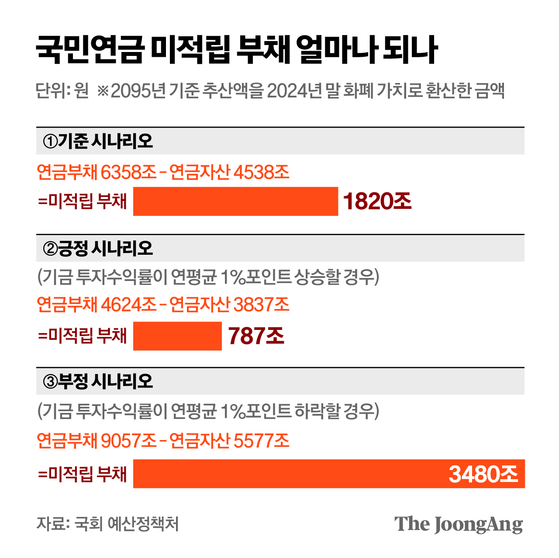
How large is the National Pension burden for which the state will be responsible in the future? The technical term is 'accrued pension liability.' According to a Budget Office report ("Analysis of the Fiscal and Policy Effects of the 2025 Amendment to the National Pension Act"), the National Pension's accrued liability — the sum of all pension benefits to be paid over the next 70 years — is 6,358 trillion won. That is the money owed to the insured in the future, converted into its value as of the end of 2024.
"National Debt Ratio Could Exceed 300%"
That said, the state does not have to bear the entire accrued pension liability by itself. There are also, though not sufficient, the contribution revenue paid in by the insured and the returns earned by investing surplus funds (fund investment returns). The amount that is ultimately short after all revenue and expenditure have been weighed is called, in technical terms, the 'unfunded pension liability.' The National Pension's unfunded liability estimated by the Budget Office comes to 1,820 trillion won. It is National Pension expenditure over the next 70 years minus contribution revenue and fund investment returns.
View original Reporter Kim Joo-won
The astronomical scale of the National Pension's unfunded liability also emerged as a hot issue at a meeting of the private advisory committee members of the National Assembly Special Committee on Pension Reform last November. Committee Member A said, "If you estimate the national debt ratio including the National Pension's unfunded liability, it exceeds 300% of GDP as of 2095," adding, "This is an unsustainable system, and it is the reality we have to face." The member went on to explain that "the unfunded liability is a concept the World Bank used in a report it published in 1994 to point out that public pensions are fiscally unsustainable."
Committee Member B countered, "(The unfunded liability) has a conceptual problem in that it varies greatly depending on the assumptions," adding, "It is a highly controversial concept that has not yet been settled." The point is that the size of the unfunded liability can also vary greatly depending on how various economic and social variables, such as population and the economic growth rate, move in the future. Committee Member C then rebutted, "The very concept of the unfunded liability refers to the emergence of an actuarial imbalance," adding, "Basically, when an actuarial imbalance arises, it is a subject that politicians, the press and academia all take up in most advanced countries, including the United States."
The Latent Pension Liability That Roh Moo-hyun Also Warned About
Warnings that enormous pension liabilities would arise in the future were sounded during the earlier Roh Moo-hyun administration as well. At the time, the term used was 'latent liability' rather than unfunded liability. In a special address in June 2007, President Roh stressed, "In the National Pension alone, latent liabilities are piling up by 80 billion won a day, reaching 30 trillion won a year," adding, "(The opposition) must not hold up this law (the National Pension Act), which would otherwise remain an enormous burden on our children's generation." It was an appeal to the opposition party of the time (the Grand National Party), which had been reluctant about pension reform, to cooperate in passing the bill.
In the national settlement report that the government publishes every year, the size of the accrued pension liability is currently estimated and disclosed only for the Government Employees Pension and the Military Pension. As of 2024, the Government Employees Pension's accrued liability is 1,052 trillion won and the Military Pension's accrued liability 260 trillion won.
Experts are divided over whether the National Pension should also be included in the accrued liabilities of the public pensions that the government discloses. Supporters argue that responsible structural reform is possible only if pension liabilities are first disclosed transparently. Opponents argue that while the state can be said to be the employer for the Government Employees Pension and the Military Pension, that is not the case for the National Pension. The Budget Office pointed out that "if accrued pension liabilities are not included in the national financial statements and the like, a reasonable basis needs to be presented that the public and international credit rating agencies can accept."
Overseas, the term for the unfunded liability differs slightly from country to country. The United States uses the term Unfunded Obligations, and Canada the term Actuarial Obligations. Japan has adopted the term 'dual burden.' It means that the insured have taken on a burden twice over, in that they pay the contributions needed to receive their own pensions in the future while also taking responsibility for the shortfall that has already arisen in the past.
Structural Reform Including an Automatic Adjustment Mechanism Is Urgent
Experts are increasingly calling for the swift introduction of an 'automatic adjustment mechanism' to reduce the National Pension's unfunded liability even slightly. An automatic adjustment mechanism is a system that adjusts pension payments and the like according to predetermined conditions when an imbalance arises in pension finances. According to the Ministry of Health and Welfare, 24 member countries of the Organisation for Economic Co-operation and Development (OECD), including Japan, Sweden and Germany, operate an automatic adjustment mechanism. With such a mechanism in place, pension liabilities can be reduced to some extent while lowering the social cost of further pension reform.
The reason experts who took part as advisory committee members in the National Assembly Special Committee on Pension Reform stress the unfunded liability is that it is closely tied to the introduction of an automatic adjustment mechanism in the National Pension. At last November's meeting, Committee Member C said, "In European countries such as Sweden that have an automatic adjustment mechanism, when an actuarial imbalance is detected, adjustments to pension benefits and contributions are reflected automatically." Committee Member D argued, "What we have now (the current National Pension) is a system that shifts everything onto future generations," adding, "We need a structural reform that builds in an automatic adjustment mechanism." Committee Member E, by contrast, struck a cautious note, saying, "In some respects it is premature to discuss an automatic adjustment mechanism."
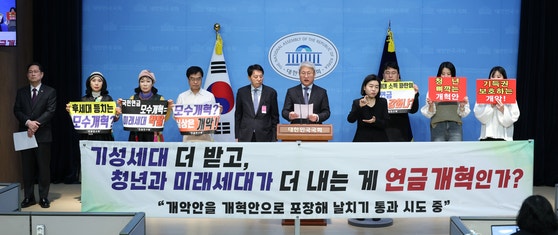
View original Officials of the Pension Future Forum, including Yun Suk-myung, Research Fellow Emeritus at the Korea Institute for Health and Social Affairs, hold a press conference at the National Assembly in Yeouido, Seoul, last March, calling for the introduction of an automatic adjustment mechanism as part of pension reform. News1
Last March, the Democratic Party of Korea and the People Power Party agreed on a 'parametric reform' that raises both the National Pension contribution rate and the income replacement rate, and decided to discuss whether to introduce an automatic adjustment mechanism in the National Assembly Special Committee on Pension Reform. The committee's mandate, originally set to run through the end of last year, has been extended to the end of this year by agreement between the ruling and opposition parties.
Joo Jeong-wan, Editorial Writer