(Yun Suk-myung, Center Director, Argument for Government Employees Pension Reform, Published in the JoongAng Ilbo, December 13, 2013) [Op-Ed] The 'Time Bomb' of the Government Employees Pension (Posted September 19, 2026)
(Although the Park Geun-hye administration committed
a blunder on the introduction of the Basic Pension that history will not erase,
the passion and tenacity it showed from
2014 to 2015 while
pushing Government Employees Pension reform
forward
deserve
high praise.
The Op-Ed published on December 13, 2013, in the
JoongAng Ilbo,
‘The Time Bomb: Government Employees Pension’,
became the starting point of the Park Geun-hye administration’s
Government Employees Pension
reform.
On February 5, 2014 (Wed.) at the request of
Park Jun-woo, then Senior Secretary for Political Affairs
to the Park Geun-hye administration,
Center Director Yun Suk-myung,
at a tea meeting in the presidential office, with Senior Secretary Park Jun-woo,
a secretary from the Ministry of the Interior and Safety (the ministry in charge of the Government Employees Pension),
and a senior administrative officer
as the only other attendees,
spent about
1 hour 10 minutes
explaining the JoongAng Ilbo Op-Ed
point by point in detail.
At the end of the explanation,
Senior Secretary Park Jun-woo
looked at the secretary and said,
“So is this what VIP asked you
to look into?”—and that
was the only remark he made.
Then something surprising happened.
For on the Sunday of that week,
that is, February 9, from the afternoon on,
news that the Government Employees Pension
would be reformed
came pouring out of the presidential office.
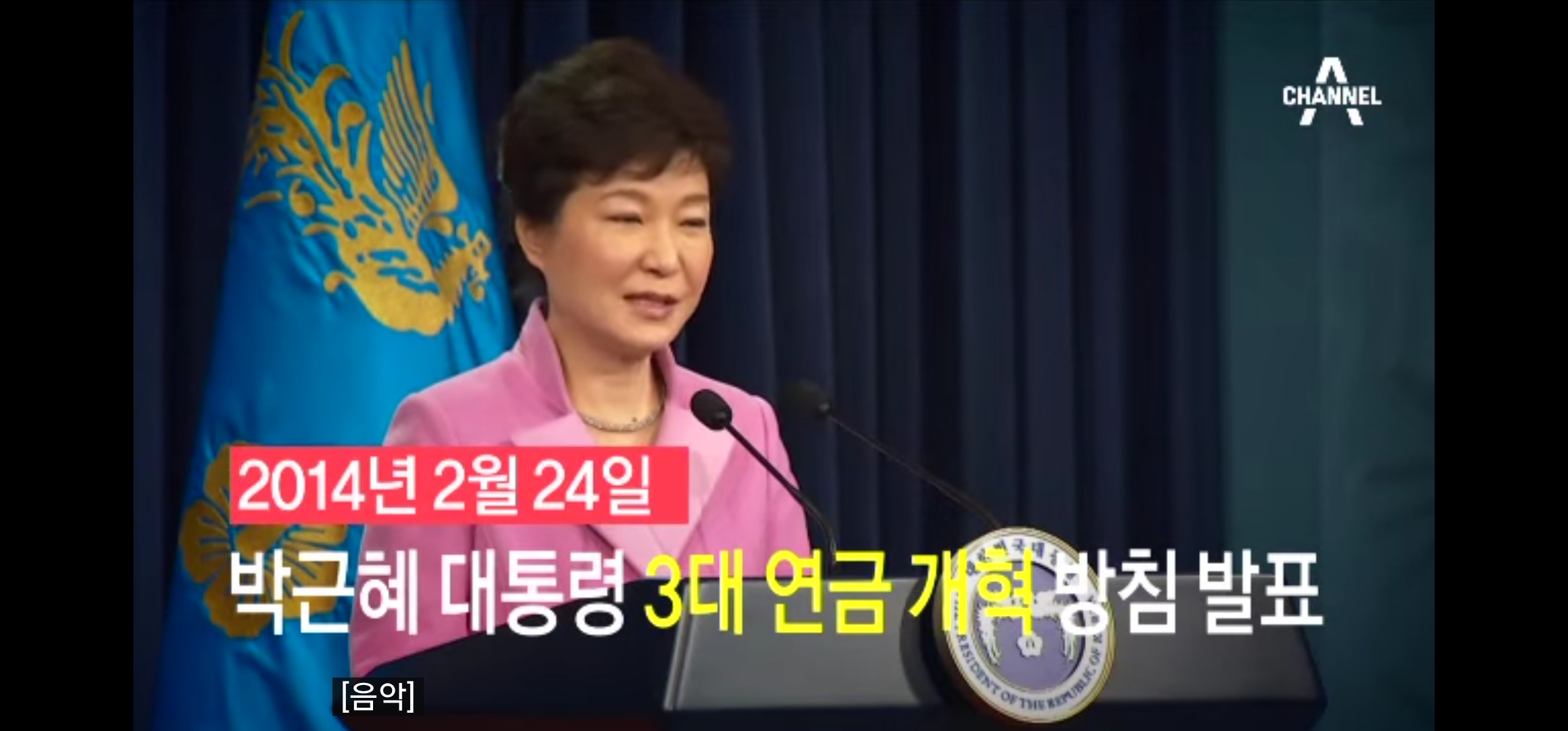
In the attached photo, a caption
says that on February 24, 2014,
President Park Geun-hye
formalized
Government Employees Pension reform.
Yet every time one searches
for this Op-Ed,
one question arises.
Why on earth
can this important column
not be found on Naver!
Search with almost any
combination of terms,
and Naver
still does not find it.
For reference,
Google and Daum
find it easily.)
(Yun Suk-myung,
head of the Pension Research Center at the Korea Institute for Health and Social Affairs (KIHASA))
"The intensity of the reform is too weak. I suspect problems will arise in less than five years. This is the honest assessment of someone who earns a living working on pensions."
These are the words the author spoke as a witness at the National Assembly public hearing on the Government Employees Pension in December 2008.
This was an assessment of the government's reform plan, which, compared to the reform plan proposed by an expert-led committee, pays 35% more (based on new civil servants) and collects 17% less in contributions (based on current employees).
And five years have passed.
The deficit subsidy for the Government Employees Pension under the Lee Myung-bak administration was 7.77 trillion won, and it is expected to be 15 trillion won under the Park Geun-hye administration.
In the early 2020s, the annual deficit subsidy alone is projected to exceed 8 trillion won.
The problem is that the subsidy amount increases as time passes.
An effective way to build a consensus on the necessity of reform is to examine foreign cases.
The current burden level of the Finnish Government Employees Pension, which pays 20% less than our Government Employees Pension, is twice ours.
Even in this situation, the political sphere in Finland agreed on the 2017 pension reform.
The reason is that the current system is not sustainable.
This is why reform of our Government Employees Pension is inevitable, despite the complaints from the civil servant community that they have already undergone two reforms and pay high contributions.
As of last year, the payment guarantee liabilities of the special occupational pension schemes exceeded 457 trillion won.
Last year alone, more than 10 trillion won in payment guarantee liabilities for the Government Employees Pension accumulated.
If this state continues for 10 years, the net increase in Government Employees Pension liabilities alone will exceed 100 trillion won.
This is an amount that could buy more than 400 of those expensive next-generation stealth fighters.
The Korean national liabilities, known to be 35% of gross domestic product (GDP), would exceed 70% of GDP if the payment guarantees for the Government Employees Pension and others were included.
Every year, an amount exceeding 3% of the government budget accumulates as payment guarantee liabilities for the Government Employees Pension. The situation is even more serious for the Private School Teachers Pension.
It is also a problem that the Government Employees Pension becomes an obstacle to the reform of the National Pension.
Despite the fact that pension amounts were cut by 43% through two reforms, an increase in contributions for the National Pension is inevitable due to population aging.
As long as the current Government Employees Pension is maintained, it is impossible to persuade the public for the reform of the National Pension.
This is because the reform efforts for the Government Employees Pension, which has a 53-year history, are too weak compared to the National Pension, which cut pension amounts by 43% within 20 years of its introduction.
2.19 million won and 800,000 won: this is a comparison of the average pension amounts of the Government Employees Pension and the National Pension.
Furthermore, for the National Pension, this is the average pension amount for contributors with a contribution period of 20 years or more.
The average amount for all National Pension beneficiaries is 310,000 won per month.
The income ceiling of the National Pension, which has an income redistribution function, is 3.98 million won per month.
On the other hand, the income ceiling of the Government Employees Pension, whose benefits are 100% proportional to one's own income, is 7.83 million won.
The claim that the benefit-to-contribution ratio of the Government Employees Pension is low when considering severance pay is also different from reality.
While most civil servants can receive the retirement allowance introduced in the early 1990s, only half of the general economically active population is able to receive severance pay.
For a significant number of the National Pension contributors who receive severance pay, the pension amount drops sharply due to the income redistribution function.
Even at the maturity stage of the National Pension (2050), the effective income replacement rate for a National Pension contributor receiving 4 million won per month (average contribution period of 25 years) is less than 20%.
Despite the surge in welfare spending, a significant number of citizens do not feel the benefits of welfare in their daily lives.
Reform of the Government Employees Pension is inevitable and urgent, if only to embrace the vulnerable classes, who are becoming increasingly impoverished due to income polarization, and to provide them with more welfare benefits.
Instead of the reform plan of the expert-centered 'Government Employees Pension Development Committee' announced in January 2007, the current Government Employees Pension is based on the proposal of the second committee, which centered on stakeholders of the Government Employees Pension.
This has effectively proven the limitations of stakeholder-led pension reform.
To prevent both the Government Employees Pension and the National Pension from becoming time bombs, discussions on pension reform are needed through an objective body that excludes stakeholders of the Government Employees Pension.
Yun Suk-myung, head of the Pension Research Center at the Korea Institute for Health and Social Affairs (KIHASA)