(JoongAng Ilbo Basic Pension, September 14, 2026) [Reset Korea] The Basic Pension Must Be Reformed Without Considering Political Gains and Losses (Posted September 14, 2026)
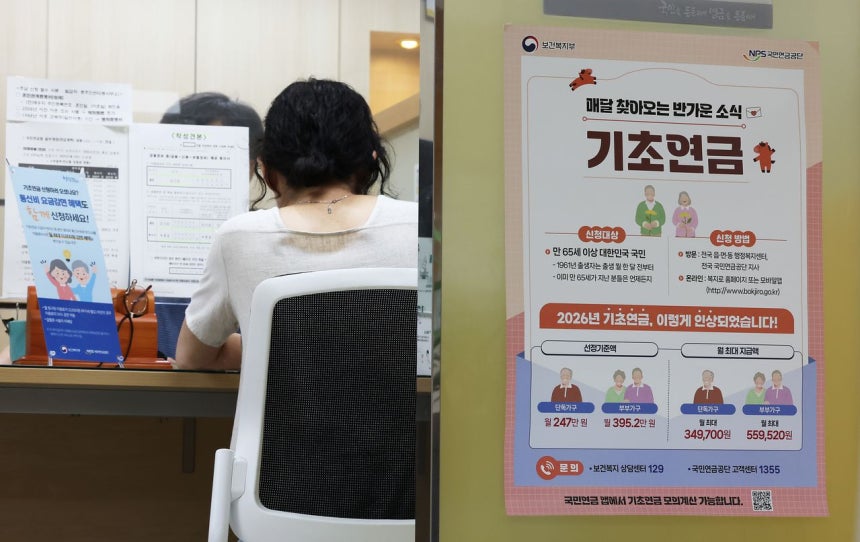
(This is an evaluation by Yun Suk-myung, Leader of
the Pension Future Forum, regarding the government's
Basic Pension overhaul plan announced on September 1,
2026, and his views on the
desirable direction for system improvement.)
Reform Initially Pursued with "More for the Lower, Less for the Upper" Goal
System for 70% of Older People Is Unsustainable
Target Group Must Be Reduced to Provide More Help to Poor Older People
The discussion on the Basic Pension overhaul under the Lee Jae-myung administration is going astray. This is because there are many problems with the overhaul details from the Ministry of Health and Welfare, which has been reviewing system improvements by presidential order.
While it will cost more money than if left as is, it seems difficult to significantly lower the elderly poverty rate, which is said to be the highest among member countries of the Organisation for Economic Co-operation and Development (OECD).
With the older population surging, the prevailing view was that the current system, which provides benefits to 70% of older people aged 65 and over, is unsustainable.
However, the overhaul plan presented by the government has only increased the burden of a system that is already unsustainable.
"More for the lower, less for the upper" was the goal, but it only mimicked the "more for the lower" part and failed to even touch the "less for the upper" part.
While maintaining the target group at 70%, it proposed paying an additional 30,000 won per month to low-income older people in the bottom 30% to gain the justification of having achieved "more for the lower."
Although it seems like only a minor adjustment, it will cost an additional 2.5 trillion won of the public's taxes next year alone, or 600 billion won on the basis of the net increase resulting from the system overhaul.
This is why it is being evaluated as having added a lump while trying to remove one.
The OECD has pointed out for some time that there are many problems with the Basic Pension in Korea. This is because it fails to significantly lower the elderly poverty rate despite spending a large amount of money.
There are few OECD member countries that operate a universal Basic Pension funded by taxes in addition to the National Pension, which requires contributions for 10 years or more. This is because countries that operated such systems in the past abolished the universal Basic Pension and introduced systems targeting vulnerable older people. Sweden, Norway, and Finland are examples.
Countries that currently operate a universal Basic Pension do so either as the sole public pension or by requiring contributions to be paid for a certain period before benefits are received.
The 2025 amendment to the National Pension Act increased the burden on future generations; if the Basic Pension also increases the burden on young people and future generations, intergenerational conflict will only grow.
This is why the Future Generations Network, a youth organization under the Pension Future Forum—a research group formed through the talent donations of experts from all generations—issued a statement saying, "While increasing what is received, they completely omitted what should be reduced."
Initially, the Ministry of Health and Welfare prepared an overhaul plan to pay more to vulnerable older people while reducing the number of beneficiaries. As the situation for the government and the ruling party is not favorable, it seems that reform of the system in that direction has been stalled.
Since this involves amending the law, the role of the National Assembly has become important. There is a possibility that they may add a lump while claiming to refine the government's proposal, by arguing that the "more for the lower" part is insufficient and needs further supplementation.
While there is a need to supplement the "more for the lower" part, there is a prerequisite.
This is because "less for the upper" measures must necessarily accompany it.
The emergence of this seemingly absurd government overhaul plan appears to stem from the dissatisfaction of people in their 50s, who are the main support base of the government and the ruling party.
This is because a significant number of people in this age group, who expected to receive benefits, believe they will be unable to do so due to the "less for the upper" measures that reduce the number of beneficiaries.
For this age group, who are not far from retirement, it is necessary to amend relevant laws so that they can increase their National Pension benefits through the extension of the contribution period, as well as their salaries and severance pay, via measures such as "re-employment after retirement."
Proper principles must also be applied to the "more for the lower" part.
This is because if only the "more for the lower" part is emphasized unconditionally, a fairness controversy will arise with those who faithfully contributed to the National Pension.
In a situation where the average National Pension benefit is 730,000 won per month, and half of those are 500,000 won or less, if the "more for the lower" part of the Basic Pension is significantly increased, it could exceed the National Pension amount.
This is also why the number of "more for the lower" beneficiaries must be minimized, and the benefit payment method must be dualized into in-kind benefits, such as daily necessities and housing or medical vouchers, in addition to cash.
There is a problem with the payment of the Basic Pension to low-income Government Employees Pension beneficiaries included in the government proposal.
Unlike the National Pension, which can only be received as a pension, the Government Employees Pension can be received as a combination of a pension and a lump sum.
If Basic Pension payments are allowed for beneficiaries of the Government Employees Pension and the Private School Teachers Pension, some people may adjust the ratio of pension to lump sum to their liking to obtain the Basic Pension.
It is not only the votes of the middle-aged and older population that matter. There are also the votes of the 20s and 30s generation.
Following the controversies over "scrapped buses" and the "National Pension Fund's 1% investment in public rental housing," if they attempt an "amendment to the Basic Pension Act that adds another lump" by further increasing the burden on young people and future generations, their anger will reach the skies.
It is time to consider whether there is a future for a political group that is rejected by young people.
※ Contributed articles by external authors may differ from the editorial direction of this newspaper.
Yun Suk-myung, Research Fellow Emeritus at the Korea Institute for Health and Social Affairs (KIHASA) and Head of the Pension Reform Division of Reset Korea