
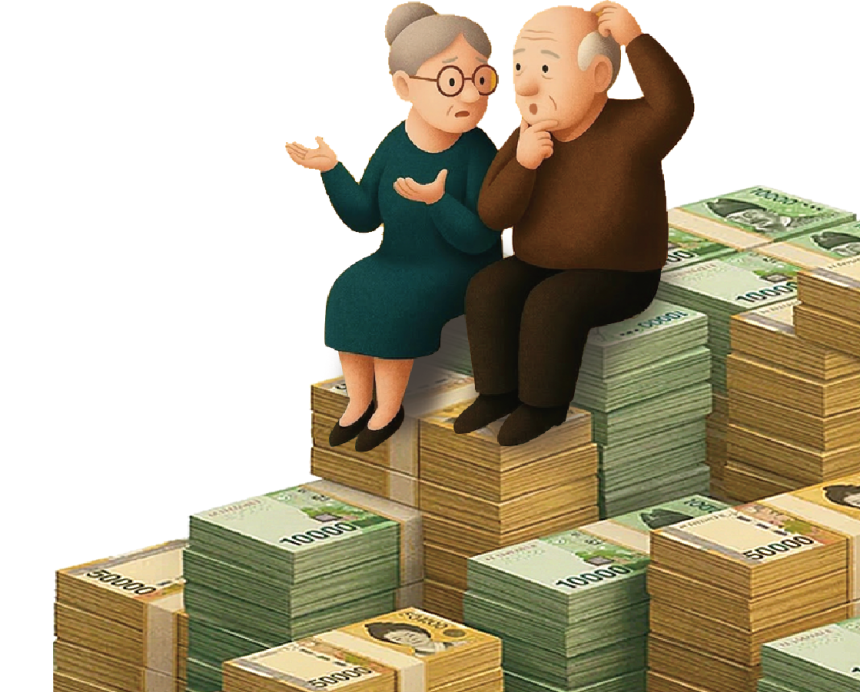
To Escape Its No. 1 Ranking in Elderly Poverty… Basic Pension Leans Toward “Differentiated Payment by Income Level” (2026.03.17.)
- #연금특위
(Among the interviewees in the Dong-A Ilbo article below,
are Professor Kim Yong-ha of Soonchunhyang University and Chairman Oh Gun-ho, who,
five months before the Basic Old-Age Pension — the predecessor of today’s Basic Pension — was introduced, opposed the Roh Moo-hyun administration’s pension reform and argued for introducing a universal Basic Pension.
Professor Kim Yong-ha designed the Basic Pension under the Grand National Party’s plan,
and Chairman Oh Gun-ho designed the Basic Pension for the Democratic Labor Party.
At the time, the Roh Moo-hyun administration was devoting all its efforts to National Pension fiscal stabilization measures based on the first National Pension financial projection.
The decisive reason why the “income replacement rate 50%–contribution rate 15.9%” proposal — the Roh Moo-hyun administration’s National Pension reform plan — was thwarted
was the insistence of the then-opposition Grand National Party and Democratic Labor Party on introducing a universal Basic Pension — and in light of that fact,
there ought to be an explanation for this change in position!
Regarding the then-opposition parties’ insistence on introducing a universal Basic Pension,
the Roh Moo-hyun administration had originally proposed a system that would pay only 45% of those aged 65 and over.
The basis for setting the beneficiary population at 35% rested on the Korea Institute for Health and Social Affairs’ (KIHASA) “Survey on the Living Conditions of the Elderly.”
This was because the survey found that older people in need of government support amounted to roughly 35% of all older people.
Even though this was the actual situation at the time,
Professor Kim Yong-ha, who at the time emphasized that introducing a universal Basic Pension was absolutely necessary — we include below the title of his column and its website.
“The Basic Old-Age Pension Is a Defective Knockoff of the Basic Pension” (2006. 11. 6)
https://m.ohmynews.com/NWS_Web/Mobile/at_pg.aspx?CNTN_CD=A0000371357&CMPT_CD=SEARCH#cb
The above website has been posted in the Pension Future Forum’s resource archive category since February 1, 2026.)
A plan to apply different rates of increase to the Basic Pension amount depending on income level is also being discussed.
Currently, the Basic Pension payment amount is indexed to the inflation rate and raised every year; under the plan, the lower a person’s income, the more it would be raised, while the higher a person’s income, the lower the rate of increase would be, or it would not be raised at all.
Professor Kim Yong-ha of the Department of IT Finance and Management at Soonchunhyang University said, “If the direction is to not apply further increases to the middle class going forward, this would, in effect, produce a fiscal-savings effect once inflation is taken into account.”
Over the medium to long term, a plan to cap the Basic Pension payment ceiling at ‘100% of the standard median income (the median value of all households’ income)’ is also under review.
Even if the bottom-70% criterion is left as is, setting the median income as the ceiling would mean that, as the economy grows, older people whose income exceeds the median income would naturally be excluded from eligibility. This year’s Basic Pension eligibility threshold (2.47 million won) has already reached 96.3% of the standard median income.
Oh Gun-ho, Co-representative of Welfare State I Make, said, “Now that the baby-boom generation, which is relatively well-prepared for retirement, has become eligible for the Basic Pension, the pool of recipients itself should gradually be narrowed while substantially raising the pension amount for low-income groups.”
https://n.news.naver.com/article/020/0003704626?sid=100

![(OBS TV Report on the Basic Pension Implementation Date, July 1, 2014) [Today's Hot Issue] Full-Scale Implementation of the Basic Pension — Who Is Eligible and How to Apply? (Posted September 17, 2026)](/_next/image?url=%2Fuploads%2Feditor%2F2026%2F09%2Fcfa1b95557a44c008121140349d5ec5f-Screenshot_20260917_005448_Samsung-Browser.jpg&w=128&q=75)