
(Chosun Ilbo Report, February 25, 2025) Ruling and Opposition Parties at Odds over a One-Percentage-Point Difference in the National Pension Income Replacement Rate; Ruling Party Youth Roundtable: "If It Is to Be Raised, an Automatic Adjustment Mechanism Must Be Included" (Posted September 5, 2026)
(We are posting a Chosun Ilbo article reporting
the Pension Future Forum's long-standing argument
that a one-percentage-point increase in the income replacement rate
will add a further 1,000 trillion won
to the burden on future generations.)
On the 25th, the People Power Party held a roundtable with young people at the National Assembly on the subject of National Pension reform. Voices in the political sphere have called for carrying out at least parametric reform first — adjusting the money paid in (the contribution rate) and the money received (the income replacement rate) — but the party judged that this would not dispel the distrust of younger cohorts, who fear they may pay in for even longer and still not receive a pension, and so it set out to gather their views.
On parametric reform, the People Power Party and the Democratic Party have agreed to raise the contribution rate from the current 9% to 13%. But over how far to raise the income replacement rate, which currently stands at 40%, the People Power Party (42–43%) and the Democratic Party (44–45%) remain in a tight standoff.
The People Power Party's position is that an "automatic adjustment mechanism" — which would allow the pension amount paid out to be adjusted automatically in line with the inflation rate, the number of insured persons, life expectancy, and other factors — and structural reform are both absolutely necessary.
On this point, Son Young-kwang, co-representative of Pension Reform Youth Action, said at the roundtable, "There is 1,800 trillion won in accumulated pension liabilities alone, piled up by loading the burden onto future generations, so now I ask the ruling and opposition parties to make a decision for the sake of the generation in their twenties and thirties."
Participants argued, "The liabilities are not being resolved, so the income replacement rate should be kept at the current 40%," and "If the income replacement rate is to be raised, an automatic adjustment mechanism must be included." They are also reported to have signaled that they would file a constitutional complaint if the Democratic Party forces through an income replacement rate of 45%.
In the Democratic Party, however, the argument is that since the income replacement rates the two parties are calling for differ by about 1 percentage point, they should first find a compromise and carry out parametric reform, and then embark on structural reform that would redesign the old-age income security structure in linkage with the Basic, retirement and special occupational pension schemes.
With a deficit currently accumulating at 88.5 billion won a day, the argument runs, pursuing parametric reform and structural reform at the same time would take a long time.
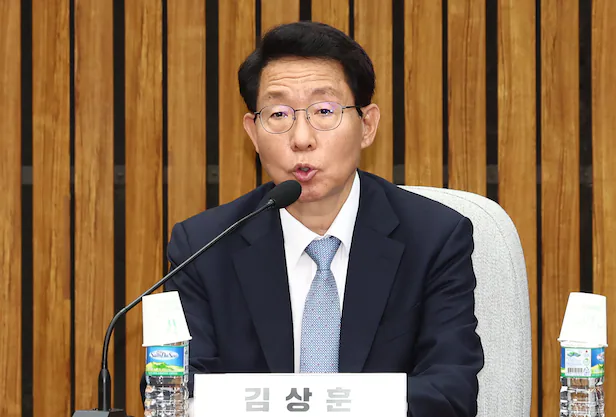
But Kim Sang-hoon, chair of the People Power Party's Policy Committee, said, "(A difference of 1–2 percentage points in the income replacement rate) is not a matter that can be spoken of lightly."
According to Ministry of Health and Welfare data, on the current path the pension fund's cumulative deficit 70 years from now will reach 21,669 trillion won.
If, however, the parameters were adjusted to a contribution rate of 13% and an income replacement rate of 43%, the cumulative deficit could be reduced by 6,973 trillion won, while adjusting the income replacement rate to 44% would reduce it by 5,991 trillion won.
In other words, about 1,000 trillion won hangs on 1 percentage point.
https://www.chosun.com/politics/politics_general/2025/02/26/WY5V426GJNDJDJQZNYEZKLTBJI/


