
(KBS TV Report, February 25, 2025) 'What Is It About One Percentage Point?' — The Core Issues in Pension Reform (Posted September 5, 2026)
(Is it acceptable for KBS,
a public broadcaster funded by the public's taxes,
to report in such a distorted way?
The Pension Future Forum hereby puts this question publicly.
This is because KBS airs only the interview with
Professor Joo Eun-sun, who downplays
the significance of 1 percentage point
of the income replacement rate.
By contrast, at the 2023
Fifth National Pension Financial Estimation Committee and at the
Advisory Committee to the 21st National Assembly
Special Committee on Pension Reform, the point
that a difference of 1 percentage point
in the income replacement rate
could be enormously significant
was made again and again by
Committee Member Yun Suk-myung.
And it is because an interview with him—or with any expert
who argues along similar lines—
is missing.
Up until March 20, 2025,
when the deterioration of the National Pension Act
was carried through,
the media, including many terrestrial broadcasters,
reported the matter in a distorted way. To correct that,
if only a little, we present the remarks made at the
2023
Fifth National Pension Financial Estimation Committee's
22nd meeting
by Committee Member Yun Suk-myung:
the original minutes booklet (PDF)
and a capture of the relevant passage
are attached.
By now our society, too,
should be able to tell who
is a genuine pension expert
and
who is acting for one particular camp
alone, one-sidedly,
as its mouthpiece—
at least that much.
The time for that,
it seems, has come.
So that we are no longer
taken in by this agitation!)
Anchor
The National Pension Fund is projected to be depleted 30 years from now, and to prevent that, debate over pension reform is running hot in the political sphere.
There is now a degree of agreement on raising the contribution rate—the money the public pays in—but the ruling and opposition parties are locked in a standoff over the income replacement rate—the money the public receives—and over an "automatic adjustment mechanism" that would link pension amounts to population and prices.
As the negotiations stalled, the ruling and opposition parties agreed to begin by launching the National Assembly Special Committee on Pension Reform.
A pension reform special committee was also active in the 21st National Assembly, but it produced no results.
The ruling and opposition parties have agreed to reconvene the ruling party–opposition–government consultative council on state affairs the day after tomorrow, the 28th, and to open discussions in earnest.
So what are the core issues in a National Pension reform plan this hard to agree on? Reporter Jung Yeon-wook takes a look.
Report
The parametric reform now under discussion in the National Assembly would keep the basic framework of the National Pension intact while adjusting the contribution rate and the income replacement rate.
Last year the ruling and opposition parties did agree to raise the contribution rate from 9% to 13%.
On the income replacement rate, currently 40%, the People Power Party is calling for a rise to 42–43% and the Democratic Party for 44–45%.
The two sides are locked in a standoff over a 1-percentage-point gap in the money received.
For an insured person with an average income of 3 million won a month who pays contributions for 40 years, the ruling party's proposal of a 43% income replacement rate would mean a pension of 1.29 million won a month.
Under the opposition's proposal of 44% it would be 1.32 million won—a difference of 30,000 won a month.
Current pension recipients are unaffected.
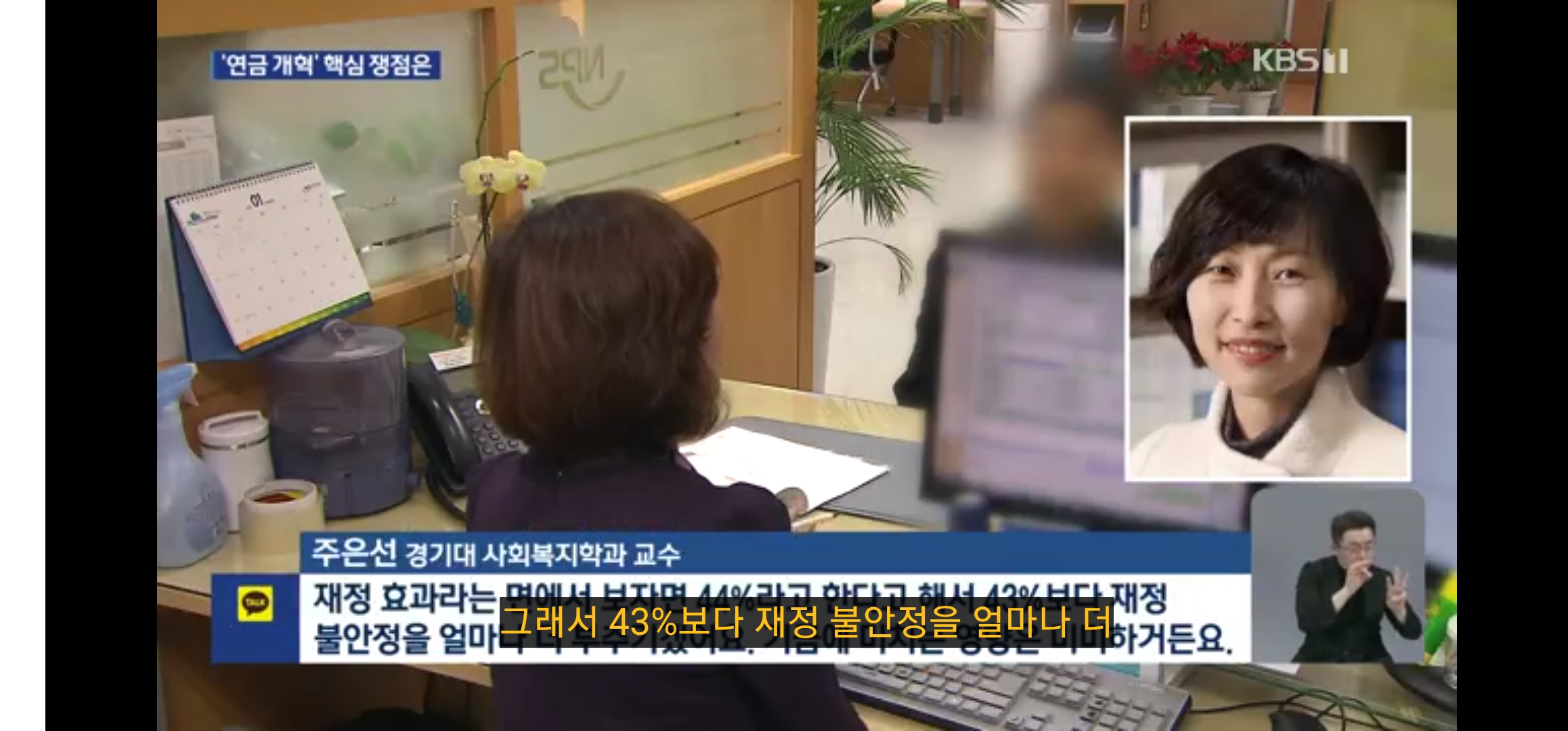
[Joo Eun-sun / Professor, Department of Social Welfare, Kyonggi University:
"Looking at it in terms of the fiscal effect, say it is 44%,
just how much more fiscal instability is that going to stoke than 43%?
The impact on the fund is negligible."]
There are also concerns that the higher the income replacement rate goes, the larger the National Pension's liability ratio will become.
Recently a new variable has entered the picture as well: the "automatic adjustment mechanism."
It is a system that automatically adjusts the contribution rate and the amount of pension received in line with the demographic structure or economic conditions, and the government and the ruling party are calling for its immediate introduction.
The Democratic Party is said to remain cautious.
If the consultative council scheduled for the day after tomorrow fails to reach a conclusion, passing a National Pension reform plan by agreement within the February extraordinary session of the National Assembly looks unlikely.
This has been Jung Yeon-wook, KBS News.


