
The World's Debt Pile, Swelling at the Speed of Light, Tops 500,000 Trillion Won (2026.03.14.)
- #테스트
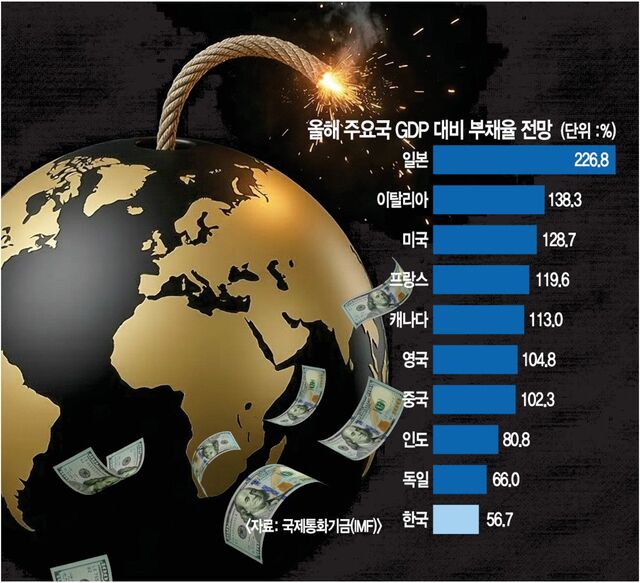
(Global Debt Bomb
Borrowing to Wage War and Invest in AI… Up 40,000 Trillion Won in a Year Each Country Stimulating Its Economy Through Easy Fiscal Expansion)
World's total debt was found to have surpassed 500,000 trillion won last year, driven by increased government defense spending and expanded corporate investment in artificial intelligence (AI).
The United States, despite having piled up 'national debt' equivalent to its own gross domestic product (GDP) — the world's largest — is projected to further increase the scale of its debt this year by carrying out military operations against Iran and Venezuela.
Major economies such as China, Japan, and Europe are also pursuing fiscal expansion for their own reasons — whether strengthening defense capabilities or stimulating their economies — accelerating the pace of debt growth.
The Institute of International Finance (IIF) stated in its 'Global Debt Monitor' report, released on the 25th of last month (local time), that "the scale of the world's debt was tallied at 348 trillion dollars (about 516,000 trillion won) as of the end of last year, again setting a new all-time high."
This is an increase of 29 trillion dollars (about 43,000 trillion won) from the previous year, and Reuters reported that the annual pace of increase was the steepest since the COVID-19 pandemic.
(Excerpt omitted)
The burden of national debt is not a problem for the United States alone. France, unable to bear a debt scale that has exceeded 110% of GDP, saw its prime ministers resign one after another last year, plunging the government into a state of collapse, while in Japan — which has the highest government debt ratio — the Takaichi Sanae cabinet has stirred controversy by pursuing 'money printing' through expansionary fiscal policy.
China, too, at the opening ceremony of the National People's Congress (NPC) on the 5th, set its fiscal deficit ratio at around 4% of GDP, continuing its expansionary fiscal stance.
Its defense budget grew 7% from the previous year, maintaining an increase in the 7% range for the fifth consecutive year.
Atif Mian, Professor at Princeton University in the United States, wrote in the March issue of the International Monetary Fund (IMF)'s F&D magazine that "an economic growth structure that relies on debt carries fundamental instability," and
"the endpoint of a policy that drives household consumption through debt was the 2008 global financial crisis," he warned.
https://n.news.naver.com/article/005/0001837048?ntype=RANKING

![(OBS TV Report on the Basic Pension Implementation Date, July 1, 2014) [Today's Hot Issue] Full-Scale Implementation of the Basic Pension — Who Is Eligible and How to Apply? (Posted September 17, 2026)](/_next/image?url=%2Fuploads%2Feditor%2F2026%2F09%2Fcfa1b95557a44c008121140349d5ec5f-Screenshot_20260917_005448_Samsung-Browser.jpg&w=128&q=75)