
"Raising the Income Replacement Rate to 50% Would Bring the National Pension's Potential Liability to 120 Million Won Per Person" — Pension Future Forum Analysis (November 7, 2023)
- #연금특위
(Remarks by a Democratic Party lawmaker — the ruling party — at a recent meeting of the 22nd National Assembly's Special Committee on Pension Reform suggest that they are toying once again with the Public Deliberation Committee card, which played a decisive role in distorting the pension discussions of the 21st National Assembly.
The Pension Future Forum states that it is paying close attention to these remarks by a lawmaker belonging to the committee — someone who, more than anyone else, ought to understand the reasons and background behind the establishment of the Special Committee on Pension Reform in the 22nd National Assembly.
This is also why it is necessary, at this point, to emphasize once again just what a disastrous decision the 21st National Assembly's Public Deliberation Committee made.
This is the background for posting, on the Pension Future Forum website's data room, a Seoul Economic Daily article that reported in detail on the content of a Pension Future Forum seminar analyzing the problems with the Public Deliberation Committee's decision.)
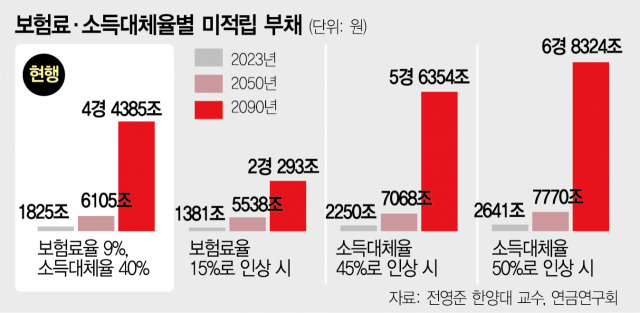
A research finding has emerged that if the income replacement rate is raised from the current 40% to 50%, the National Pension's potential liability this year would reach 2,641 trillion won, approaching 120 million won per person. This is an increase of about 45% over the roughly 82 million won in per-person liability under the current system. Amid the pension reform discussions set to move forward in earnest, centered on the National Assembly, there are calls for deeper reflection on the burden facing future generations as well.
A research finding has emerged that if the income replacement rate is raised from the current 40% to 50%, the National Pension's potential liability this year would reach 2,641 trillion won, approaching 120 million won per person. This is an increase of about 45% over the roughly 82 million won in per-person liability under the current system. Amid the pension reform discussions set to move forward in earnest, centered on the National Assembly, there are calls for deeper reflection on the burden facing future generations as well.
Professor Jeon Yeong-jun of Hanyang University's School of Economics and Finance presented analytical findings containing this content at the 'Pension Future Forum's Second Seminar,' held on the 7th at the Franciscan Center in Jeongdong, Seoul. Professor Jeon estimated how much the unfunded liability (implicit debt) would increase under each of the following scenarios: △the current system (a 9% contribution rate, a 40% income replacement rate); △raising the contribution rate in stages to 15% over the next 15 years; △a 45% increase in the income replacement rate; and △raising the income replacement rate to 50%.
The unfunded liability refers to the value obtained by subtracting the present value of contributions paid in and the National Pension fund balance at each point in time from the present value of the pension benefits that National Pension subscribers will receive until death. The larger the unfunded liability, the larger the amount that future generations will have to make up through taxes or contributions once the National Pension fund is depleted. In 2006, the Roh Moo-hyun administration announced an estimate that 'the unfunded liability stands at 210 trillion won and will grow by 30 trillion won each year over the next 30 years,' and in 2007 it carried out a pension reform lowering the income replacement rate from 60% to 40%.
Professor Jeon pointed out, "When the income replacement rate is adjusted upward, the net tax burden on the current generation decreases somewhat, but the net tax burden on future generations increases." Professor Jeon's argument is that even if the current system is maintained, the unfunded liability will reach 1,825 trillion won (as of 2023), approaching 80.1% of GDP. This is a similar level to the 1,735 trillion won that the National Pension Research Institute, a government agency, estimated the unfunded liability to be as of the end of 2021. Professor Jeon added, however, that if the income replacement rate is kept unchanged while the contribution rate is raised to 15%, the unfunded liability would fall by 24.3% to 1,381 trillion won.
The explanation is that the implication of this study is that the burden borne by future generations will vary depending on the direction of parametric reform. A government official stated, "Discussion of pension reform is set to move into full swing at the National Assembly going forward, and in that process, discussion of fiscal soundness, including the unfunded liability, must clearly take place." The government announced a National Pension reform plan on the 27th of last month, but it did not include concrete proposals for adjusting the contribution rate or the income replacement rate.
https://m.sedaily.com/article/13788036

