
We Cannot Break the Backs of Future Generations Just to Live Well Now.(2006. 11. 6)
- #연금특위
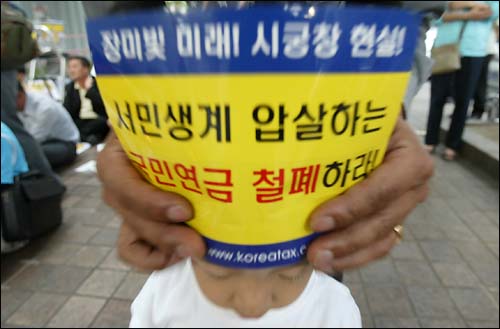
(Recently, the Democratic Party of Korea’s Special Committee on Pensions held a forum on the direction of the Basic Pension overhaul. The Basic Pension began with the Basic Old-Age Pension, enacted in April 2007. At the time, there was considerable turmoil in the political world surrounding the introduction of the Basic Old-Age Pension.
Five months before the Basic Old-Age Pension was introduced, OhmyNews organized paired expert columns supporting the opposition party’s plan and the government’s plan; we post it here on the Pension Future Forum website as a historical record.
This is the column by Research Fellow Yun Suk-myung, who at the time supported the government’s introduction of the Basic Old-Age Pension.)
The National Pension, not even 20 years old since its introduction, is facing a harsh period of trial. This is because there are considerable differences among the political world and stakeholders regarding the direction of National Pension reform.
The National Pension improvement proposals currently submitted to the National Assembly are broadly divided into three. ▲the government’s 2003 amendment to the National Pension Act, which focuses on fiscal stabilization; ▲the opposition party’s amendment bill, whose main thrust is introducing a tax-financed Basic Pension; and ▲the Uri Party’s proposal, which pursues both fiscal stability and closing coverage gaps at the same time — these are exactly what they are.
Last October, the Uri Party accepted the problem raised that “the government’s plan focuses only on fiscal stability while overlooking measures to close the coverage gaps,” and submitted a new bill.
For the fiscal stabilization of the National Pension, only the income replacement rate would be lowered by 10 percentage points, from 60% to 50%, while the contribution rate would be kept at the current 9%, with the decision on whether to raise the contribution rate to be made after 2008. The pension coverage gap was addressed by collecting taxes to pay a Basic Old-Age Pension of between 70,000 and 100,000 won a month, depending on income level, to 60% of older people aged 65 and over.
(Excerpt omitted)
The direction of the government’s National Pension reform presented this June can be summarized as seeking stronger fiscal stabilization and a plan to close the coverage gaps that takes into account the developmental trends of the National Pension.
As part of the financial projection, the amendment to the National Pension Act that the government submitted to the National Assembly in 2003 was a plan to lower the income replacement rate by 10 percentage points, from 60% to 50%, by 2008, and to raise the contribution burden from 9% to 15.9% by 2030.
After the government’s plan was submitted, two variables arose. One was that fierce criticism was raised that the plan cared only about fiscal stability and had no measures to close the coverage gaps.
The other variable was that, starting in December 2005, a system converting the existing severance pay into a retirement pension was put into effect.
As converting the 8.3% severance pay into a retirement pension was expected to yield an income replacement rate of around 20%, it was judged that, from a long-term perspective, room had opened up to lower the National Pension’s income replacement rate.
In terms of the burden, it was also considered that, in the long run, combining a 15.9% National Pension contribution rate with an 8.3% retirement-pension contribution rate would raise the burden level to an excessively high 24.2%.
(Excerpt omitted)
On the other hand, based on the recognition that the problem of income-security coverage gaps among the current older population was serious, the government collected taxes and paid a Basic Old-Age Pension of 80,000 won a month to 45% of those aged 65 and older in an effort to address the problem of elderly poverty.
Even though it shares a common point with the opposition party’s tax-financed Basic Pension in that it collects taxes to pay the pension, the government’s plan differs considerably from both the ruling party’s plan and the opposition party’s plan.
The government’s plan is based on research from the Korea Institute for Health and Social Affairs’ survey of the welfare needs of older people, which found that older people requiring government support would amount to about 45% of the total population aged 65 and over.
(Excerpt omitted)
Although there will be some difference in degree depending on the amount of pension paid, if the Basic Pension is introduced, the problem of elderly poverty will improve dramatically.
It could establish itself as an effective income security system for older people who, such as the abused older people frequently appearing in the media these days, failed to prepare for their own retirement in the course of rapid industrialization.
Nevertheless, why is the government opposing the introduction of such a good system? It is because the government, which is responsible for managing the country’s finances, is taking into account the negative effects that would arise in the long run after the system’s introduction.
(Excerpt omitted)
Therefore, if a tax-financed Basic Pension is introduced, there will be no major problem right now, but after 2020, when the country enters a super-aged society, there is a risk that the backs of future generations will be broken by the enormous funding required.
The government’s position is that we cannot break the backs of future generations just so that we can eat and live well. It is also far too irresponsible to shift the burden onto future generations who have not even been born yet without ever asking them.
Even knowing that the overwhelming majority of the public are unhappy about improving the National Pension system in a direction that would mean receiving less than now, the government is presenting a plan to cut the pension amount.
Even if it is unpopular, from the standpoint of a government responsible for the nation’s long-term, hundred-year plan, it is likely an unavoidable choice.
https://m.ohmynews.com/NWS_Web/Mobile/at_pg.aspx?CNTN_CD=A0000371371&CMPT_CD=SEARCH#cb

