(Commentary on an Article) Announcement of the Basic Pension Overhaul Plan Canceled an Hour Before: Mindful of the Falling Approval Rating? (2026.08.28.)
(If the contents of the
Chosun Ilbo article below are accurate,
then the Basic Pension overhaul plan that the Ministry of Health and Welfare
had originally intended to announce
can be assessed as appropriate
in terms of its direction.
The strength of the Ministry’s overhaul plan
falls short of the level the OECD recommends —
that is, it is quite inadequate —
but in that it reflects the direction of those recommendations
it can be assessed as a desirable approach.
If there has been political interference
in the Basic Pension overhaul plan that the policy authorities
had long deliberated over and were preparing to put forward,
then we demand
that it stop here!
“Getting someone to give up
even a little of their vested interest” —
doing that
is the starting point
of genuine reform,
and that is why we make this demand.)
Inside and around the presidential office,
fears of an erosion of support among older voters
It was confirmed on the 27th that the Ministry of Health and Welfare has drawn up an overhaul plan that would change the Basic Pension eligibility criterion from the current “bottom 70% of older people by income” to “80% of the standard median income.”
The plan is to start at 90% of the standard median income next year and lower it in stages to 80% by 2030. The “standard median income” refers to the income of the household that stands exactly in the middle when all households in the country are lined up in order of income.
The aim is to ease the fiscal burden over the long run by reducing the number of Basic Pension recipients and to shift to a “more for the lower, less for the upper” (下厚上薄) approach that pays more to low-income older people. Earlier, in March, President Lee Jae-myung had himself proposed the “more for the lower, less for the upper” approach, saying that “older people with a monthly income of several million won and older people with zero income receive exactly the same Basic Pension amount.”

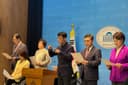
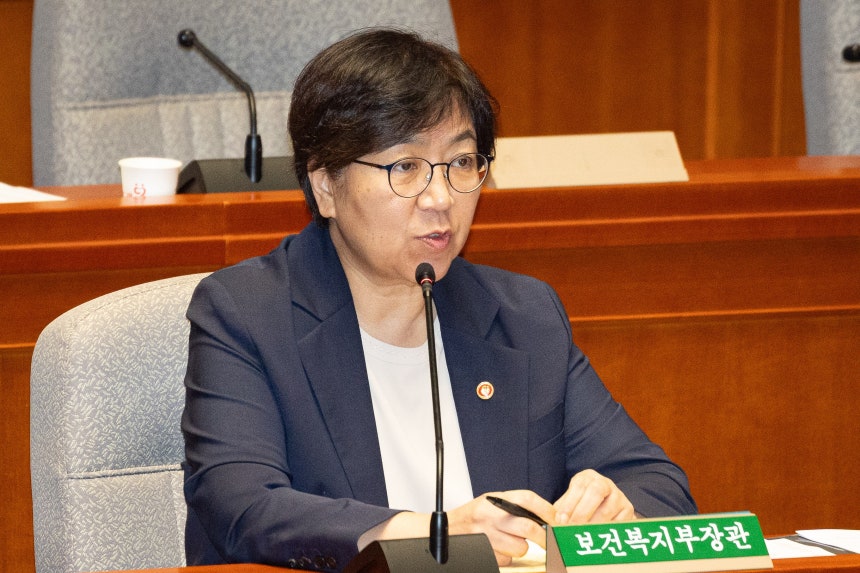
The Ministry had, however, announced an advance briefing at which Minister Jung Eun-kyeong would herself explain the Basic Pension overhaul plan to the press corps that day, only to cancel it abruptly a mere hour beforehand.
The Ministry said that “some elements of the overhaul plan had not been finally settled, so the cancellation was unavoidable,” while adding that “no date has been set for a future announcement.” The cancellation of the briefing is understood to have reflected the wishes of the presidential office.
With President Lee’s job approval rating having fallen into the 30% range in some recent opinion polls, the move was read as one taken mindful of the political burden of a Basic Pension overhaul that would reduce the number of beneficiaries in the future.
It is also uncertain whether the public announcement to the nation that the Ministry had originally scheduled for the first of next month will go ahead. Some have pointed out that “the overhaul plan the Ministry drew up may be scaled back, or the implementation targeted for next April may be delayed.”
Under the draft prepared by the Ministry, the Basic Pension eligibility criterion would start at 90% of the standard median income next year and be lowered in stages to 86.6% in 2028, 83.3% in 2029, and 80% in 2030.
This year the Basic Pension eligibility threshold for a single household is 2.47 million won a month, or 96.3% of the standard median income (2.564 million won).
In effect, this means raising the bar for Basic Pension payments step by step.
In the early stages of the overhaul the number of beneficiaries would not fall sharply, but if the incomes of older people keep rising faster than the standard median income, as they do now, the number of older people dropping out of eligibility would grow substantially over the long run.
Under the draft, benefit amounts would be differentiated by income on a three-tier schedule.
Low-income recipients at or below 20% of the standard median income would receive 380,000 won next year and 400,000 won in 2028. Those between 20% and 40% of the standard median income would receive 359,000 won next year and 367,000 won in 2028.
Beneficiaries above 40% of the standard median income would continue to receive this year’s amount of 350,000 won a month.
Alongside this, consideration is being given to phasing the benefit down over five years for older people who receive the Basic Pension under the current system but do not meet the newly overhauled criterion.
The plan also includes easing the “couples’ reduction” for low-income couples. At present, when both spouses draw the Basic Pension, each award is cut by 20%, but for couples at or below 40% of the standard median income the reduction rate would fall to 10% next year.
Earlier, on the 23rd, the Ministry had said it would “hold an advance briefing for the press corps on the 26th,” only to push it back to the 27th two days later, on the 25th. Then, on the day itself, it canceled the briefing yet again.
Inside and around the government, this was read as not unrelated to the recent day-after-day decline in the approval ratings of the President and the ruling party.
There is said to be particular concern that the backlash is growing among people in their fifties and early sixties who are about to become eligible for the Basic Pension, and that even support among older voters could erode before the general election.
Deliberation is said to be intense over whether to revise the draft’s “scope of beneficiaries” and similar provisions.
Yet delaying the overhaul is not easy either.
This year there are about 7.79 million Basic Pension beneficiaries. Some 23.1 trillion won a year is spent on the program, more than four times the 5.2 trillion won of 2014, when it was first introduced.
Yun Suk-myung, Research Fellow Emeritus at the Korea Institute for Health and Social Affairs, said that “the longer reform is put off, the heavier the burden on future generations becomes.”
Reporter Ahn Jun-yong [email protected]
Reporter Cho Sung-ho [email protected]