(January 23, 2025) Remarks by Witness Yun Suk-myung at the Public Hearing on the Amendment of the National Pension Act (2026. 8. 27.)
(Summary of Witness Yun Suk-myung’s Remarks)
January 23, 2025 (Thu.)
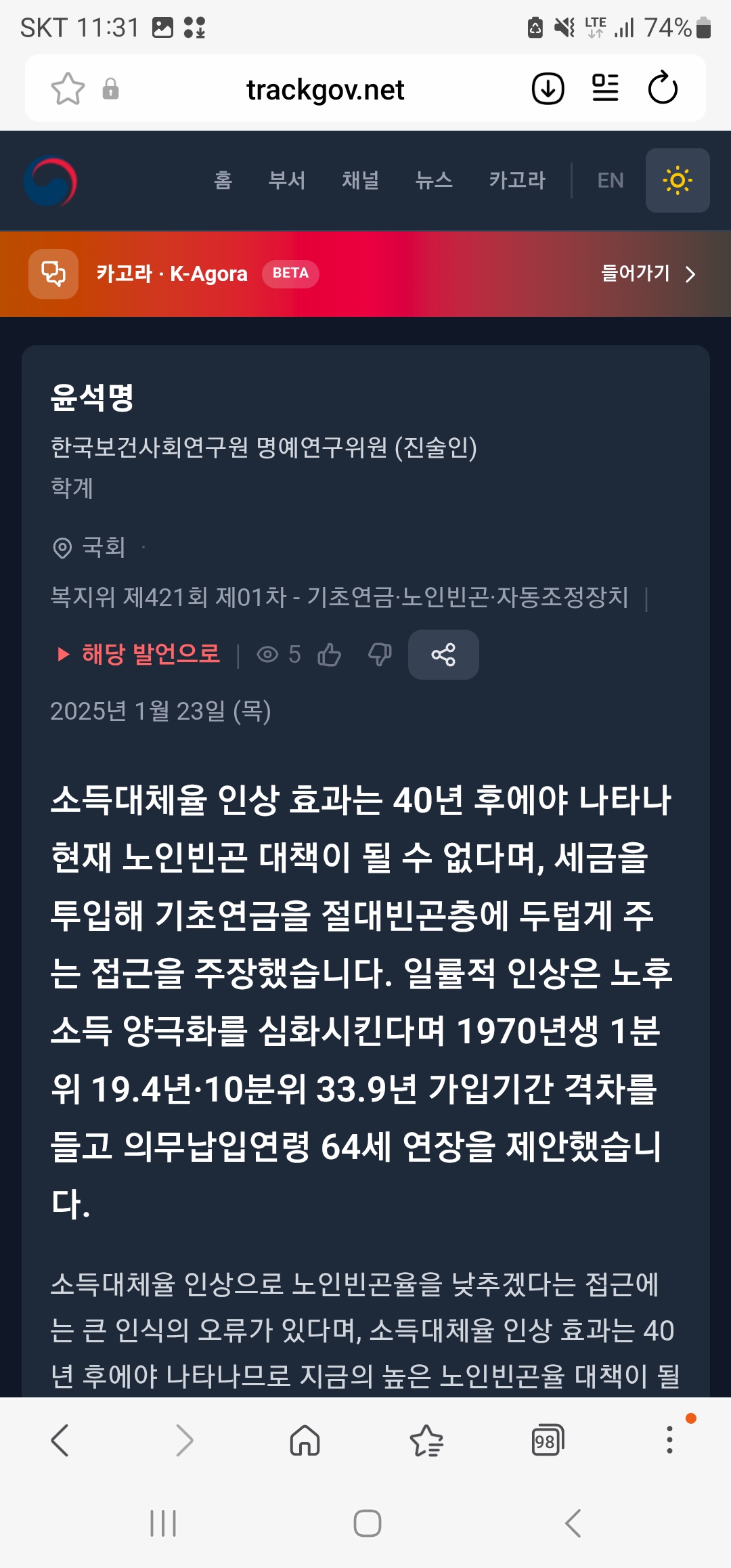
Arguing that the effect of raising the income replacement rate would appear only 40 years from now and so could not serve as a measure against current old-age poverty, the witness advocated an approach of injecting tax money and giving the Basic Pension generously to those in absolute poverty. Saying that a uniform increase deepens the polarization of old-age income, he cited the gap in coverage periods for those born in 1970 — 19.4 years in the first income decile against 33.9 years in the tenth — and proposed extending the mandatory contribution age to 64.
The witness pointed out that the approach of lowering the old-age poverty rate by raising the income replacement rate contains a great error of perception, since the effect of raising the rate appears only after 40 years and so cannot be a measure against today’s high old-age poverty rate. If there is genuine concern about old-age poverty, he argued, the approach should be to inject tax money at once, reduce the number of Basic Pension recipients, and give more generously to those below the absolute poverty line. He also explained that a uniform increase in the income replacement rate in fact deepens the polarization of old-age income, the greatest problem of Korea’s public pensions: on National Pension Service data, for those born in 1970 the expected coverage period in the first income decile is 19.4 years against 33.9 years in the tenth, and once retirement pensions are added, high earners have old-age income that is not small by comparison with any OECD country. Taking issue with the fact that the mandatory contribution age remains fixed at 59 even 50 to 70 years from now, he added that extending it to 64 would raise high earners’ coverage periods to 39 years, close to a 40% income replacement rate.
January 23, 2025 (Thu.)
Rejecting the frame of financial stability versus income security, the witness warned that the National Pension’s unfunded liability exceeded 1,825 trillion won in 2024 (83% of GDP) and that, with an income replacement rate of 50% and contributions of 15%, it would soar to 467% of GDP by 2090. He pointed to the IMF’s analysis that national debt would reach 200% of GDP by 2070, and to the flaw that the citizens’ representative panel made its decision without knowing of a 21-percentage-point gap in contributions between generations.
Saying that it is hard to agree with the very frame of financial stability versus income security, the witness classified matters bluntly: even the proposal he himself put forward cannot achieve financial stability, and the rest are proposals that would wreck the income security of future generations. He warned that, on the Pension Future Forum’s estimate, the National Pension’s unfunded liability exceeded 1,825 trillion won in 2024, about 83% of GDP; that even maintaining an income replacement rate of 40% it would reach 383.9% of GDP by 2093; and that raising the rate to 50% and contributions to 15% would send it soaring to 467% by 2090. He cited the IMF’s November 2023 report, which analyzed that population aging and the pension system would bring national debt to 200% of GDP by 2070, and its finding that even to maintain a 40% income replacement rate, contributions would have to be raised to 22.8% for national debt not to increase further.
He also pointed to the fact that the National Assembly’s deliberative citizens’ representative panel made its decision without knowing that the lifetime contribution burden of someone born in 2005 and someone born in 2035 differs by as much as 21 percentage points, calling this a decisive flaw.