
[Gwanghwamun View] The National Pension That Puts the Public in Danger (2026.08.25.)
![[Gwanghwamun View] The National Pension That Puts the Public in Danger (2026.08.25.)](/uploads/editor/2026/08/7e5b6edfee7045f1ba2fbcc46079ac0a-0003994640_001_20260825102910400.jpg)
When the “celebratory salute” of surging Korean stocks went off,
an amateurish judgment to raise the allocation
The President who said the point of depletion had been deferred —
why the silence after share prices plunged?
American universities that manage large endowments all expanded their allocations to equities in the 1960s. Yale raised an allocation it had kept at 35% for decades to 61%. It was a time when the Vietnam War boom coincided with low interest rates and stocks were surging. Not long afterward the stock market “bubble” burst and the universities suffered heavy losses.
Benjamin Graham, citing this case in The Intelligent Investor, explained the merit of maintaining a set allocation: “because it frees you from the fatal temptation to raise the equity allocation the more prices rise.”
That “fatal temptation” the National Pension could not withstand. It decided to raise its allocation to Korean equities, set at 14.9% on a year-end basis, to 20.8%. The decision came a week after President Lee Jae-myung remarked at the Cabinet meeting in May that “returns have been good and the accumulated amount has grown by nearly 300 trillion won.” In June, too, as Korean stocks surged, President Lee publicized that the point of the National Pension’s depletion had been pushed back considerably as a result. Since the KOSPI has now fallen 26% from that peak, the depletion point must have been brought forward again — yet somehow there is no mention of it.
Throughout the first half of this year, as Korean stocks surged, the National Pension did not carry out the “rebalancing” of selling assets whose valuations had grown. In the meantime it was foreign investors alone who sold Korean stocks by the book and took their profits out. Jung Eun-kyeong, Minister of Health and Welfare, rebutting the charge in the National Assembly last week that the National Pension had been mobilized to prop up share prices ahead of the local elections, said, “In a situation of volatility it was hard to judge.” A trader at one brokerage said, “Rebalancing is a technique for reducing loss risk when market volatility increases; I was astonished to hear the exact opposite logic advanced, like an amateur.”
The global investment firm Barclays said in a report not long ago that “pension funds normally play a role in stabilizing markets. The National Pension, by contrast, deferred rebalancing and increased its allocation to Korea, thereby amplifying volatility.” The report’s conclusion is that, because it did not sell when Korean stocks rose, the National Pension’s accumulated assets may be smaller than they would have been had it rebalanced. Market experts estimate that, taking last month’s KOSPI decline into account, the valuation of the National Pension’s Korean equities has fallen by a further 130 trillion won or so.
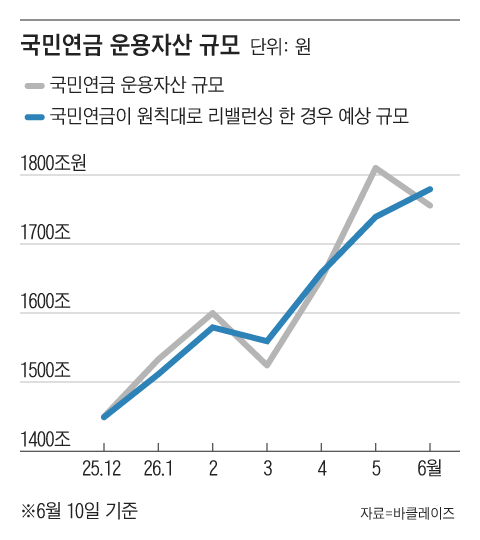
/ Graphic = Jung Da-woon, Chosun Design Lab
That a time will come when the National Pension must sell Korean stocks is another problem. Given Korea’s population structure, the money going out as pensions will inevitably exceed contribution revenue. On the government’s projection, this “cross” is expected between 2030 and 2040. When the time comes, the National Pension will have to sell investment assets to add to what it pays out. The more Korean stocks it sells, the greater the shock to the Korean market. The National Pension had steadily reduced its allocation to Korean equities from 20% in 2015 to the 14% range, and part of the reason was to prepare for precisely this “foreseen risk.” The government has reversed that at a stroke. It has replanted the detonator it had been removing.
In 2021, too, when the KOSPI rose, the National Pension decided after much controversy to expand its allocation to Korean equities. The following year the KOSPI plunged 25%, and the National Pension, having taken heavy losses, drew a great deal of criticism for its judgment. Kim Yong-beom, Chief of the Policy Office; Lee Eok-won, Chairman of the Financial Services Commission; and Lee Chan-jin, Governor of the Financial Supervisory Service, each took part at the time, in their respective posts, in the Fund Management Committee’s decision-making. That makes three government officials with painful experience. Should they not have blocked a similar mistake, even by “lying down in the road”?
Yale, seeking not to repeat its past failure, built the “Yale model,” combining rational asset allocation with strict management of allocations, and became a model for institutional investors. Charles Ellis, the legendary investor who long bore responsibility for its management, explained why, however painful it may be, one must not shake one’s principles: “Change your investment principles and the probability of being wrong rises. Change them in a hurry and you will certainly be wrong.” My retirement money is going down the wrong road.
It is dangerous.
Kim Shin-young [email protected]
![(Report on the Pension Future Forum Statement, Nocut News) [Column] Holding the 'Pension Fund Casino' to Account?… It May Be the Result of Choosing the 'Easy Way' (October 20, 2026)](/_next/image?url=%2Fuploads%2Feditor%2F2026%2F10%2Fc6f13b0799b440d0874a9f72413c6f58-0004200449_003_20261020063615439-1.jpg&w=128&q=75)

![(Report on the Pension Future Forum Statement, JoongAng Ilbo) [Reporting Diary] The National Pension Protected the KOSPI Rather Than the Public's Retirement (October 19, 2026)](/_next/image?url=%2Fuploads%2Feditor%2F2026%2F10%2F7e92f70b0ec843bbb869a4cf46b01f72-0003558751_001_20261019052229249.jpg&w=128&q=75)