
(Maeil Business Newspaper — Pension Future Forum Coverage) Government, Wary of Public Backlash, Keeps the Basic Pension As Is… Raises Payments for Low-Income Recipients by 30,000 Won a Month (2026.09.02.)
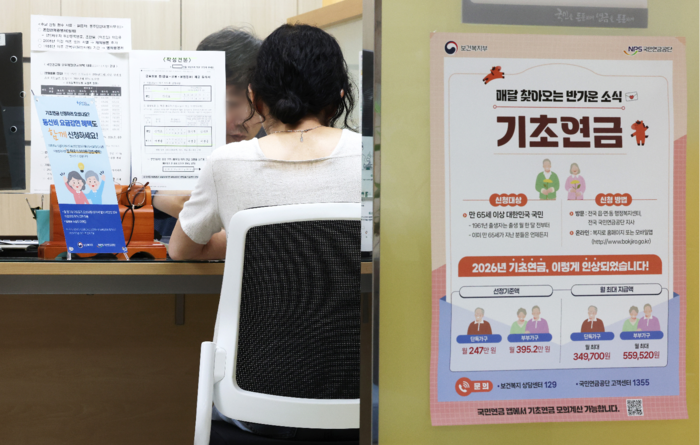
Mindful of public backlash, the government has decided to keep the ‘70% rule’ — under which the Basic Pension is paid to the bottom 70% by income among older people — in place for another year. It will also pay low-income older people in the bottom 30% by income 380,000 won a month, 30,000 won more than this year, to further reinforce the ‘more for the lower, less for the upper’ principle.
The overhaul centered on the standard median income that had originally been under consideration fell through, and fiscal spending has increased instead.
On the 1st, the Ministry of Health and Welfare finalized next year's budget bill, which contains this Basic Pension overhaul, at a State Council meeting presided over by President Lee Jae-myung. According to the Ministry's announcement, the 3.48 million older people in the bottom 30% or below by income will receive 380,000 won a month starting next year. The 1.74 million people in the 30-45% income band will receive 359,000 won a month, reflecting the inflation rate.
(Excerpt omitted)
Low-income beneficiaries of the special occupational pension schemes (the Government Employees, Military Personnel and Private School Teachers pension schemes) and their spouses — currently excluded from the Basic Pension — will also newly be included as eligible recipients, numbering 110,000 people. This applies to those in the bottom 45% by income.
The problem is that the fiscal burden will increase. The Basic Pension budget will rise 11%, from 23.1 trillion won this year to 25.7 trillion won next year. Even compared with simply maintaining the current system, spending will increase by roughly 600 billion won more.
The Ministry had originally considered changing the relative standard of the bottom 70% by income to an absolute standard, such as 80-90% of the standard median income.
But it recently cancelled a scheduled briefing and did not include this content in the final plan.
The Pension Future Forum criticized this, saying, “It has abandoned the structural reform needed to properly help the poorest older people, while passing on nothing but the cost to the next generation.”
The Ministry agrees on the need to change the eligibility criteria to one centered on the standard median income, but takes the position that further public deliberation is needed.
The Ministry plans to complete Basic Pension-related legislation within the year and implement the overhaul starting in April next year. Including special-occupational-pension-scheme beneficiaries will require linking data systems, so that part is scheduled to take effect from July next year.
![(연금연구회 성명서 보도. 노컷뉴스) [칼럼] 연기금 카지노 책임론?…'쉬운길' 선택의 결과일 수 있다 (2026.10.20.)](/_next/image?url=%2Fuploads%2Feditor%2F2026%2F10%2Fc6f13b0799b440d0874a9f72413c6f58-0004200449_003_20261020063615439-1.jpg&w=128&q=75)
![(연금연구회 성명서 보도. 중앙일보) [취재일기] 국민 노후보다 코스피를 지킨 국민연금 (2026.10.19. )](/_next/image?url=%2Fuploads%2Feditor%2F2026%2F10%2F7e92f70b0ec843bbb869a4cf46b01f72-0003558751_001_20261019052229249.jpg&w=128&q=75)