(Pension Future Forum Commentary on an Article about Basic Pension Reform) Basic Pension: “More for the Lower, Less for the Upper” Reform to Be Announced at the End of This Month… “100% of Median Income” Likely as the Eligibility Criterion (2026.08.12.)
(This is the Pension Future Forum’s position on the article below.
If the following article is true, then, following the content of the March 20, 2025 National Pension reform, the Basic Pension reform too can hardly be regarded as a proper reform.
It is “more for the lower, less for the upper” in appearance only; if anything goes wrong, it could add only to the cost of operating the Basic Pension scheme, more than if the current Basic Pension were left as it is.
1. The dominant assessment is that current Basic Pension beneficiaries fall short of 100% of the standard median income.
Changing the eligible population to 100% of the standard median income would therefore mean that the absolute number of Basic Pension beneficiaries could increase.
2. “Abolishing the couples’ reduction,” which was introduced after a great deal of deliberation when the Basic Pension was created, likewise not only lacks logical justification but, in that it further increases the cost of maintaining the scheme, runs strongly counter to the original purpose of Basic Pension reform!
3. Paying the Basic Pension to low-income beneficiaries of special occupational pensions is likewise a matter fraught with problems.
Unlike the National Pension, special occupational pensions such as the Government Employees Pension operate with a lump-sum system,
and with a method of splitting the benefit into a pension and a lump sum paid at the same time. It is a scheme whose operating principles and character are entirely different from those of the National Pension, which abolished its lump-sum system.
The question of paying the Basic Pension to low-income members or beneficiaries of special occupational pensions was on the agenda of the fourth National Pension Financial Estimation Committee in 2018 and of the fifth in 2023, but for this very reason
it was not adopted!
And yet now,
to say that the Basic Pension will be paid to those who were low-income members
of special occupational pensions, or to beneficiaries of them,
is to overturn the decision of an expert committee at will!
In its 2022 report, the OECD Secretariat
noted that among OECD member countries the states operating the national pension and special occupational pensions entirely separately
number only four, Korea included, and recommended the integrated operation of public pensions.
Germany and other countries that do not operate their public pensions in integrated form do not even have a quasi-universal basic pension scheme such as ours!
The Pension Future Forum stresses the following!
The precondition for paying the Basic Pension to those who were low-income members of special occupational pensions,
or
to beneficiaries of them, is this:
the operating principles of the special occupational pensions must be changed to be identical to those of the National Pension!
At the very least, only after the current provisions of special occupational pensions such as the Government Employees Pension — the lump-sum system,
or the simultaneous payment of a lump sum and a pension —
have been changed
should there be any discussion of including them among Basic Pension recipients; this the Pension Future Forum
stresses once again!
4. The Basic Pension reform reported in the press article below,
as the Pension Future Forum
has already stated on several occasions,
carries a very high probability of exposing a range of latent problems, given disposable incomes that are high relative to other OECD member countries (particularly so because the burden of social insurance contributions, including the National Pension,
stands at only about 50% of theirs);
and so, though plausible in outward form, it could prove
a highly problematic reform proposal — a point we stress once again!
5. The Basic Pension reform the government and the ruling party are said to be examining fails to bring about any decisive improvement in the current “1/n”-style payment method, and so
it does not escape the OECD’s standing criticism that “relative to the enormous cost of the Basic Pension, its effect in alleviating old-age poverty is extremely limited.”
6. “Even by OECD standards — that is, on the relative poverty concept — older people who are not poor should be excluded from Basic Pension eligibility, and the Basic Pension amount should be increased mainly for older people who have not even escaped absolute poverty (the minimum cost of living).” From that OECD recommendation
this reform appears far too remote;
the content of this Basic Pension reform
must without fail be reconsidered — that is the Pension Future Forum’s position,
and we state it clearly once again!)
(What follows is the content of the press report.)
Existing benefit amounts to be maintained,
with future increases differentiated by income… more for low-income groups
The couples’ reduction and the restriction on occupational pension
recipients also to be revised…
Possibility of an increase in beneficiaries in the early stage of the transition
(Sejong = News1) Reporter Lim Yong-woo = The government will announce at the end of this month a Basic Pension reform proposal on the “more for the lower, less for the upper” model, paying more to low-income older people. It is expected to include a shift from the present eligibility criterion — the bottom 70% of older people by income — to a method linked to the standard median income.
For the eligibility criterion, applying 100% of the standard median income is under serious consideration. As the eligibility threshold rises above the current standard, there is also a possibility that the number of Basic Pension recipients will increase in the early stage of the transition.
The payment structure will change so that existing benefit amounts are maintained while future increases are paid differentially according to income. Alongside this, plans are being pursued to allocate more of the increase to low-income groups and to improve the couples’ reduction and the restriction on payments to occupational pension beneficiaries and their spouses.
Reform Proposal to Be Announced at the End of This Month… “100% of Median Income” Likely as the Eligibility Criterion
According to the relevant ministries on the 11th, the Ministry of Health and Welfare will announce the Basic Pension reform proposal at the end of this month.
The government is working to estimate the changes in the beneficiary population and the resources required under the reform and to reflect them in next year’s budget proposal.
Through an expert forum in June and a policy briefing last month, the Ministry of Health and Welfare narrowed the direction of the reform to “more for the lower, less for the upper” payments, a change in the eligibility criterion, and improvements to the couples’ reduction and the restriction on occupational pension recipients. It is coordinating the details, such as the ratio at which the standard median income is applied and the payment amounts by income band.
The eligibility criterion changes from the current bottom 70% of older people by income to a level at or below a certain proportion of the standard median income.
Under the current method, the eligibility threshold is set each year, reflecting the distribution of income and assets, so that about 70% of those aged 65 and over are beneficiaries. Under the reform proposal, the Basic Pension is paid to older people below a certain threshold linked to the standard median income, the midpoint of all household incomes.
As the applied ratio, 100% of the standard median income is under serious consideration. This year’s Basic Pension eligibility threshold is 2.47 million won a month for single-person households and 3,952,000 won a month for couple households.
The single-household threshold is 96.3% of this year’s standard median income for a one-person household, 2,564,238 won a month. The couple-household threshold likewise corresponds to 94.1% of the two-person household standard median income of 4,199,292 won.
Applying 100% of the standard median income on this year’s basis would raise the eligibility threshold by 94,238 won for single households and by 247,292 won for couple households. Accordingly, there is a possibility that in the early stage of the transition the number of eligible recipients will be greater than under the current method.
Linking to the standard median income, however, breaks free of the structure in which the eligibility threshold rises automatically in order to keep a fixed proportion of the older population as beneficiaries. Over the medium and long term it can slow the pace at which beneficiaries and fiscal spending increase.
A government official said, “Since the current eligibility threshold for single households is about 96% of the standard median income, applying 100% could increase the number of beneficiaries in the early stage of the transition.”
Existing Amounts Maintained, Increases on the “More for the Lower, Less for the Upper” Model… the Couples’ Reduction Also Improved
The payment structure changes to a “more for the lower, less for the upper” model in which the amounts existing beneficiaries receive are not reduced while future increases are allocated differentially according to income. It is a structure that minimizes the increase for higher-income beneficiaries and raises payments more for low-income groups.
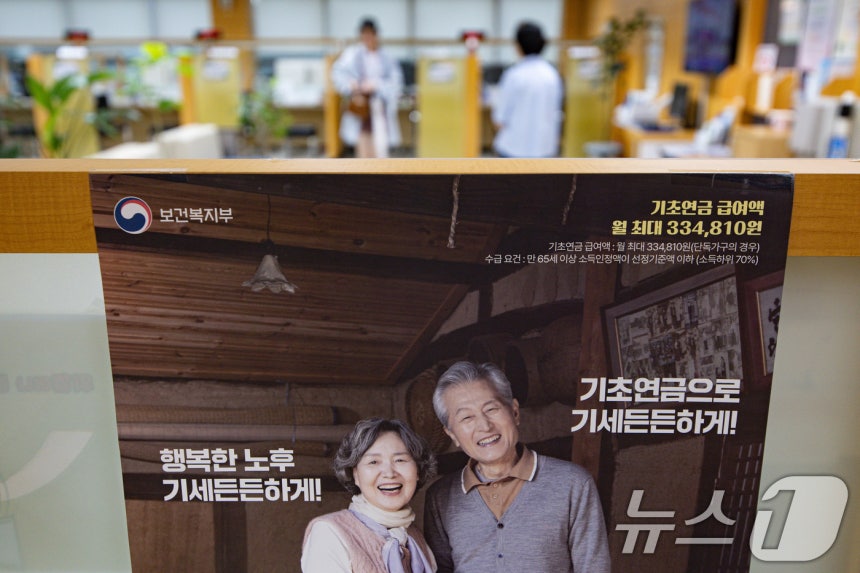
This year’s Basic Pension reference benefit amount is a maximum of 349,700 won a month for a single household. If both members of a couple receive it, each amount is reduced by 20%, for a combined maximum of 559,520 won a month. The total number of beneficiaries this year is about 7.79 million.
As of September last year, about 86% of Basic Pension beneficiaries had recognized income of less than 1.5 million won a month. The government is considering dividing income into bands and allocating more of the increase the lower the income.
The couples’ reduction and the restriction on occupational pension recipients are also targets for improvement. At present, if both members of a couple receive the Basic Pension, each pension amount is reduced by 20%. Recipients of occupational pensions such as the Government Employees Pension and the Private School Teachers Pension, and their spouses, are in principle excluded from the Basic Pension even if their income and assets are low.
The government is considering lowering the couples’ reduction rate in stages, starting with low-income groups, and paying the Basic Pension to occupational pension recipients and their spouses whose income and assets fall below a certain threshold.
Changing the eligibility criterion and the payment structure requires an amendment to the Basic Pension Act.
A government official said, “After the government proposal is announced, discussion of the reform will take place in bodies such as the National Assembly’s Special Committee on Pension Reform,” adding, “The goal is to complete the legislation within this year.”