A New Basic Pension Criterion — the “100% of Median Income” Option Gains Ground… Will Low-Income Groups Receive More? (2026.07.20.)
(The following is a press article on the government’s move
to reform the Basic Pension eligibility criterion, which now covers 70% of those aged 65 and over,
to 100% of the standard median income.
Until now the government and the ruling party
have called this Basic Pension overhaul a “structural reform” (!)
and on that basis brought the work of the advisory committee to the National Assembly Special Committee on Pension Reform to an end.
Now, however, in place of the position originally discussed —
that 50% of the standard median income
would be adopted as the new Basic Pension eligibility criterion —
press reports suggest
that the eligibility criterion will instead be changed
to 100% of the standard median income.
On encountering such reports,
the Pension Future Forum is overcome by a deep sense of dismay:
if that is where matters were headed,
why!
was so much fuss made about it all this time?
That is the question.
(Note)
The Pension Future Forum’s official Basic Pension reform proposal sets the line
not at 50% of median income but at
150% of the minimum cost of living (the livelihood benefit under the National Basic Living Security scheme),
that is, 1.23 million won a month.
It was proposed with the aim of decisively eliminating absolute poverty first.
Part of the press materials from the
National Assembly forum on the direction of Basic Pension reform,
held on May 7, 2026, is attached
as a file!)
President Lee Jae-myung has also said that “cutting a pension that is already being received is problematic,” which lends weight to the possibility of moving first to 100% of the standard median income. Lowering the criterion straight away to 70% or 50% of median income could disqualify a considerable number of beneficiaries. It is likely that a “more for the lower, less for the upper” approach — maintaining the benefit amounts of existing beneficiaries while widening the increase for low-income groups — will be pursued first.
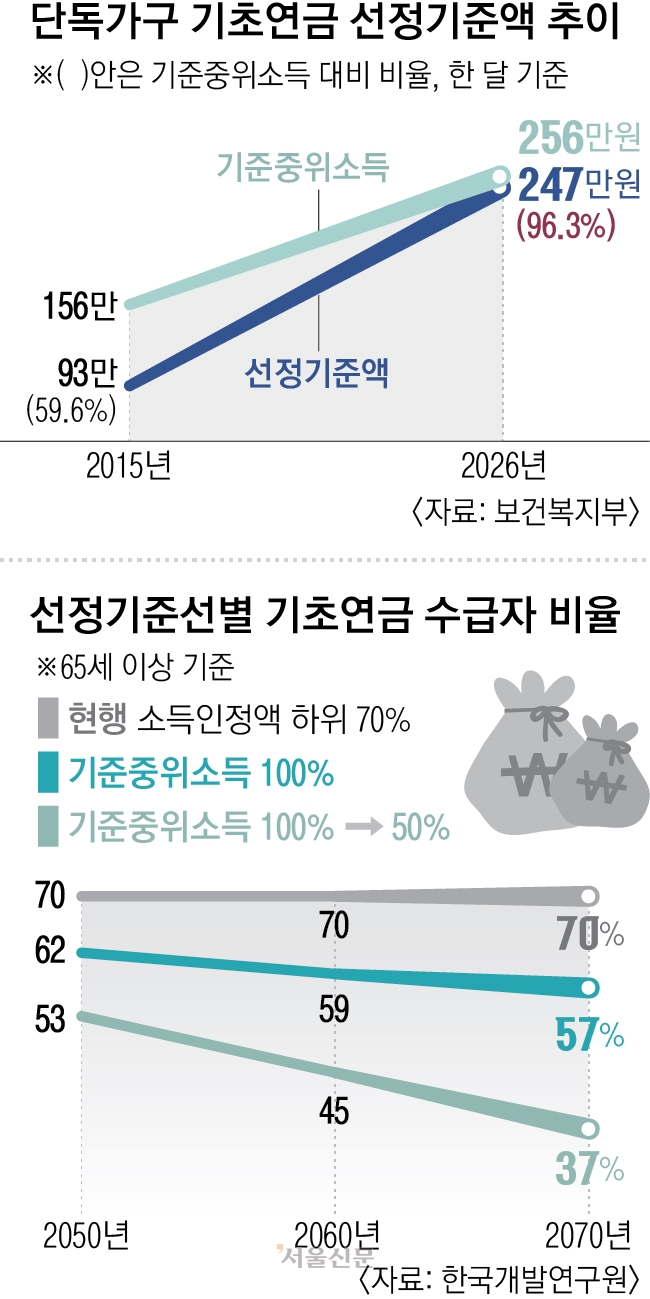
The Korea Development Institute (KDI) likewise proposed 100% of the standard median income as a starting point in its February report of last year, “Directions for Reforming the Basic Pension Selection Method.” KDI estimated that fixing the eligibility criterion at 100% of the standard median income would reduce the beneficiary population to 62% of all older people by 2050 and cut fiscal spending to 41 trillion won in present-value terms, 5 trillion won (11%) less than under the current arrangement. By 2070, it projected, the beneficiary share would fall to 57% and fiscal spending to 35 trillion won, 8 trillion won (19%) below the current arrangement.
KDI analyzed that if the long-term savings were used to raise benefit levels, the 2026 reference benefit amount could be increased to 387,000 won without raising total fiscal spending through 2070. This year’s reference benefit amount is 350,000 won a month.
Critics point out, however, that it takes more than 40 years for the take-up rate to fall to 57%, so that applying 100% of the standard median income alone has only a limited effect in concentrating support on low-income older people. In the National Assembly and in academia, proposals to lower the applied ratio in stages to 70% or 50% are also under discussion.
Yun Suk-myung, Research Fellow Emeritus at the Korea Institute for Health and Social Affairs, proposed protecting existing beneficiaries while applying the tightened criterion to those who turn 65 after a specified date. Yun said, “The baby-boom cohorts newly reaching age 65 include many who are wealthier than earlier cohorts of older people. From a specified point onward, a criterion of 50% or less of the standard median income could be applied to them.”
Yet this could invite a fairness controversy, since older people with the same income and assets would be treated differently depending on their year of birth. The government plans to prepare its Basic Pension reform proposal in the second half of the year.
![(동아일보. 유럽 청년 시위) [횡설수설/우경임] (입력 2026.10.21.)](/_next/image?url=%2Fuploads%2Feditor%2F2026%2F10%2Fba49256960d346bfb3f36249f19c291f-1792541429278.png&w=128&q=75)
![(Report on the Pension Future Forum Statement, Nocut News) [Column] Holding the 'Pension Fund Casino' to Account?… It May Be the Result of Choosing the 'Easy Way' (October 20, 2026)](/_next/image?url=%2Fuploads%2Feditor%2F2026%2F10%2Fc6f13b0799b440d0874a9f72413c6f58-0004200449_003_20261020063615439-1.jpg&w=128&q=75)