"A 15% National Pension Contribution Rate Increase Is the Optimal Choice for Fund Stability and Economic Efficiency" (July 7, 2026)
(The following is the Pension Future Forum's assessment of the National Pension Research Institute report as covered by Yonhap News.)
The models employed by the researchers at the National Pension Research Institute are likely based on a dynamic general equilibrium model.
A critical flaw in using this type of model to analyze the policy effects of the National Pension is that contributors are assumed to treat pension contributions as a tax.
In conventional mainstream economics, taxation is premised on generating welfare loss.
Consequently, the analytical results inevitably show that welfare loss increases as taxes rise.
Edgar K. Browning, the doctoral supervisor of Pension Future Forum's leader Yun Suk-myung, published papers addressing this very issue as early as the 1970s and 1980s.
The central finding is that the tighter the linkage between the payroll tax paid by contributors to the U.S. Social Security system—analogous to National Pension contributions in Korea—and the pension benefits received, the smaller the resulting welfare loss.
The implications of this body of research are considerable.
This is because, if contributors to the National Pension were fully confident that every won they contributed would be returned to them in full, welfare loss might not materialize at all.
The findings of the National Pension Research Institute, which appear to have been derived through a purely mechanical analysis that neglects these considerations, risk sending a seriously misleading signal regarding the direction of National Pension development and reform. Such findings must therefore be approached with critical scrutiny.
(The following summarizes the key content of the report assessed above by the Pension Future Forum.)
Although the government and the National Assembly enacted the "Third Pension Reform" in March 2025—raising the contribution rate from 9% to 13% and increasing the income replacement rate from 40% to 43%—research findings indicate that this measure alone is insufficient to ensure the long-term fiscal sustainability of the pension system.
Amid ongoing discussions of additional reform measures to stabilize pension finances, an analysis has been put forward indicating that a phased increase in the contribution rate to 15% would have the smallest and most efficient economic impact.
(omitted)
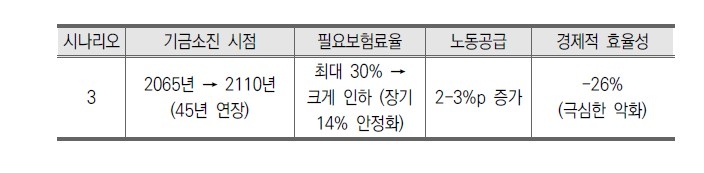
The option with the greatest fiscal impact was Scenario 3, which combined raising the contribution eligibility age to 64 with increasing the contribution rate to 15%. Under this scenario, fund depletion would be deferred by as many as 45 years, to 2110.
However, this option carries the problem of imposing a dual burden on the currently working generation—simultaneously extending the retirement age and raising contribution rates.
The hardship and decline in quality of life imposed on the current generation proved so severe that economic efficiency deteriorated by as much as 26%.
(omitted)
The report warned that, however sound individual policies may be, stacking multiple regulations on top of one another in an excessive manner causes the burden on the public to accumulate exponentially, maximizing adverse side effects.
![(A Column Sharing the Pension Future Forum's Position, Kookje Shinmun) [Lee Sang-yi Column] The 'Principle of Need' in Welfare and Populism (Posted October 15, 2026)](/_next/image?url=%2Fuploads%2Feditor%2F2026%2F10%2F2e14f0e21c8c4e828b8477e370b55be9-1792132943202.jpg&w=128&q=75)
![(Content the Pension Future Forum Finds Hard to Agree With, Kyunghyang Shinmun, Professor Woo Seok-jin) [Economic Straight Talk] We Won't Pay Your Pensions (October 13, 2026)](/_next/image?url=%2Fuploads%2Feditor%2F2026%2F10%2F5d8f006695804398b4ae104d5181dc9e-1792129375063.jpg&w=128&q=75)