[Open World] What It Means That Young People Have Taken to a YouTube Pension Broadcast (2026.07.22.)
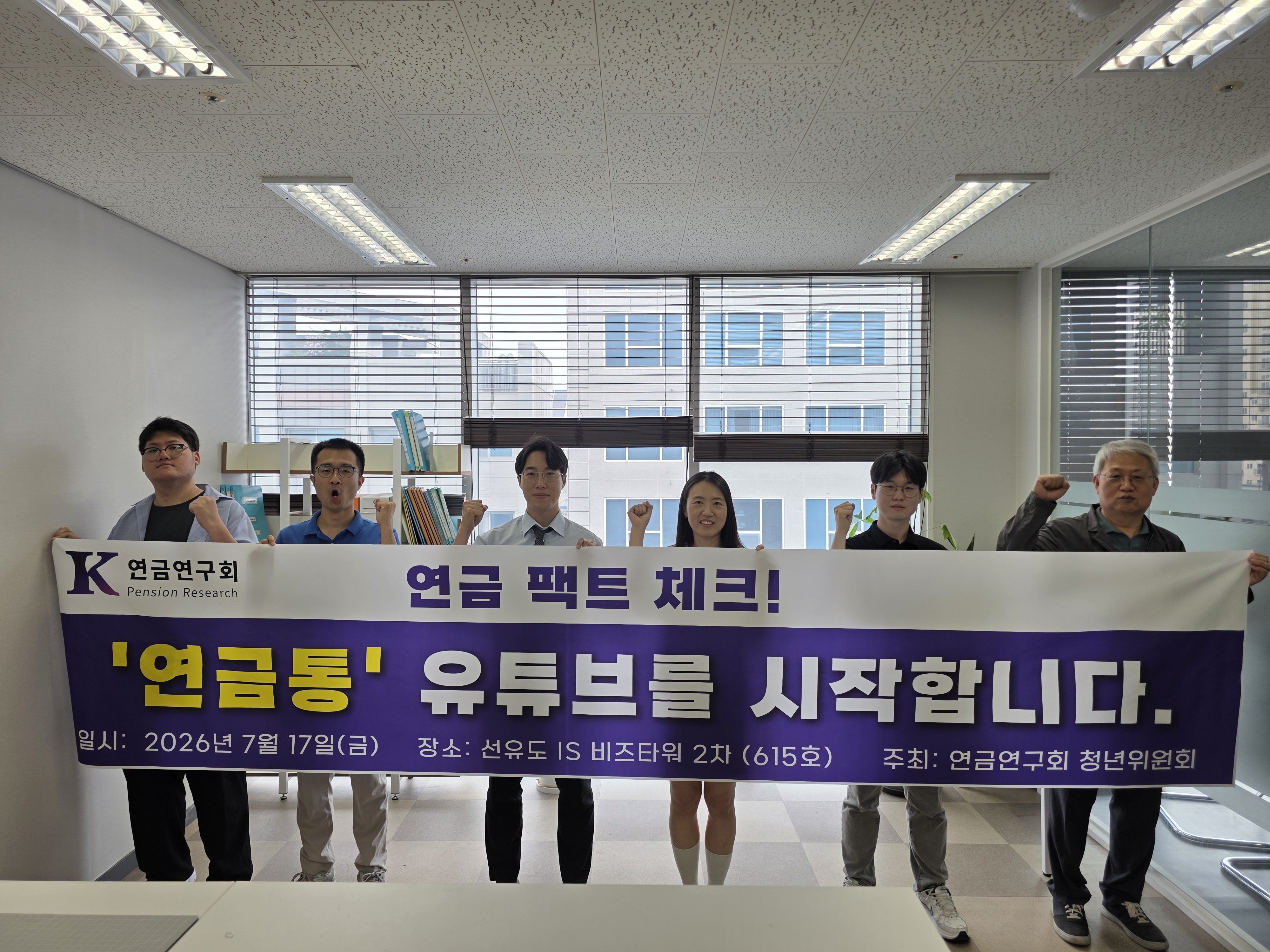
(How stifling must our reality have seemed
for the young people of the Pension Future Forum
to resolve to tell the facts properly
about pensions,
and to start the YouTube broadcast
“Yeongeumtong”!)
The Canada Pension Plan (CPP) has long been invoked in Korea, thanks to its exemplary fund management. Since the fourth financial projection for the National Pension in 2018, it has also been cited frequently in terms of scheme design, introduced as a country that carried out what is called a “pay more, receive more” pension reform. It was the case used as grounds, on March 20 of last year, for raising the National Pension’s income replacement rate to 43% — an increase of 3 percentage points, or 7.5% in percentage terms.
In step with the surging trend of the KOSPI index, voices grew louder that, even without structural reform, good fund management would mean no need to worry about depletion of the National Pension Fund before 2100. The CPP was mentioned as a case showing that, if the fund were managed effectively, the income replacement rate could be raised even beyond the current level of 43%. Given how often it is invoked, it seems necessary to understand what the Canada Pension Plan actually is.
Unlike Korea, which introduced the National Pension first and the Basic Pension later, Canada introduced its basic pension (Old Age Security, OAS) first and only then the CPP. In terms of path dependency in welfare policy, it has walked the road opposite to ours. Because an earnings-related pension built on the principle of one’s own contributions was added on top of a basic pension, the income replacement rate was set low at the outset. That is the background to a scheme that, until 2018, provided an income replacement rate of only 25% while levying contributions of 9.9%. This differs greatly from our National Pension, which at its introduction in 1988 provided a 70% income replacement rate while levying contributions of only 3%.
Kim Sung-joo, Chairman of the National Pension Service — opposition-party secretary of the Special Committee on Pension Reform in the 21st National Assembly — has since 2018 held up the CPP as a case of “pay more, receive more” reform: that is, of raising contributions by 2 percentage points to 11.9% while raising the income replacement rate to 33.3%.
There is a problem with this claim, because after the reform the CPP was divided in two: the pre-existing Base portion and an Additional portion.
The 2-percentage-point increase in contributions applies only to the Base portion, the pre-existing scheme. For the newly created Additional portion, a new contribution burden of 8 percentage points arose.
Even though this is the actual situation, mentioning only the 2-percentage-point contribution increase in the Base portion grossly distorts the essence of Canada’s pension reform.
Until the scheme was reformed, the CPP held 100% of the money needed to pay pensions even 150 years out.
The newly introduced Additional portion is likewise run on a 100% funded basis — that is, as a scheme that places no burden whatsoever on later generations.
It operates on an entirely different plane from our National Pension, whose unfunded liability — the amount by which it falls short of what is needed to pay pensions — reached 1,820 trillion won (National Assembly Budget Office, 2025) even after the amendment of the National Pension Act in March of last year.
And yet, citing the example of the CPP, wishful thinking is being spun that we too can do the same.
Given the recent tendency to place the emphasis on fund management rather than on structural reform, let us also look at how the CPP’s fund is managed. The Canada Pension Plan Investment Board (CPPIB) thoroughly excludes political intervention by the government. By contrast, the prevailing assessment is that political judgment has intervened deeply in the management of our National Pension Fund, particularly of late — through convening an unscheduled National Pension Fund Management Committee to change the allocation to domestic equities and defer rebalancing, and through using the National Pension as a means of defending the exchange rate under the name of a “new framework.”
Given such a vast gulf in the design principles of the two schemes and in the fund management environment, how are we to take the flood of media reporting to the effect that, if only we manage the fund as well as the CPP does, we need not worry about the future of our National Pension?
The answer seems to lie in the statement issued by the young people of the Pension Future Forum as they launched their YouTube broadcast, “Yeongeumtong.”
“First, a ‘mathematically honest pension’ that balances the money paid in and the money received is needed.
Second, the National Pension Fund must be managed independently, solely for ‘the benefit of the insured.’
Third, the young are taking up the microphone themselves in order to lay out for the public, in full, the distorted realities of the pension system.”
It is a declaration that, because pension issues — the CPP among them — are not being properly conveyed to the public and to the press, they will step forward themselves.
Yun Suk-myung, Research Fellow Emeritus at the Korea Institute for Health and Social Affairs