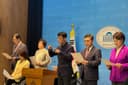
We Call for Reform of the Government Employees Pension, the Primary Driver of Mandatory Expenditure Growth!
- #연금특위
The three major news items of April 26, 2026 are as follows.
First, the April issue of the IMF's Fiscal Monitor report indicates that the pace of growth in pension and health insurance expenditures is rising very steeply.
According to the report, Korea's pension expenditure is projected to increase by 0.7% of gross domestic product (GDP) over the five-year period from 2025 to 2030, representing the steepest rate of increase among G20 advanced economies.
(IMF: Korea's pension expenditure to rise by 0.7% of GDP over five years — the highest rate among G20 advanced economies)
Second, Korea's potential growth rate is projected to fall to the mid-1% range next year, reaching a historic low. In contrast to short-term growth recovery driven by the semiconductor sector, the structural foundations of growth are assessed to be weakening.
Specifically, according to the Organisation for Economic Co-operation and Development (OECD), Korea's potential growth rate is estimated to decline as follows: △1.92% last year △1.71% this year (a decrease of 0.21 percentage points) △1.57% next year (a further decrease of 0.14 percentage points). It is projected to fall to 1.52% in the fourth quarter of next year, continuing a trend of setting new lows each year.
Third, according to the National Fiscal Management Plan for 2025–2029, mandatory expenditures are projected to amount to 415.1 trillion won out of total expenditures of 764.4 trillion won next year, accounting for 54.3%. As the rate of growth in mandatory expenditures (an annual average of 6.3%) is expected to exceed the rate of growth in total expenditures (5.5%), the share is projected to expand to 55.0% in 2028 and 55.8% in 2029.
More than half of these mandatory expenditures consist of statutory welfare outlays, including Basic Livelihood Security benefits, health insurance, the four major public pensions, and the Basic Pension. As the number of beneficiaries and benefit payments both increase with Korea's entry into a super-aged society, these outlays are estimated to exceed 200 trillion won next year and reach 237 trillion won by 2029.
(Half of public funds locked in mandatory expenditures — Basic Pension and education grants alone exceed 100 trillion won
Mandatory expenditures account for 25% of the "two major detonators" — "Without restructuring, the fiscal gap will be filled by debt")
Although there is a sense that this recognition comes belatedly, it is most welcome that the media are now reporting content that accurately conveys the gravity of Korea's fiscal situation. Given that such articles are appearing in the wake of presidential remarks regarding the need to reform the Basic Pension, they are likely to attract even greater public attention.
However, despite the fact that the Government Employees Pension already accounts for a significant share of mandatory expenditures, the deficit subsidy disbursed solely to cover the Government Employees Pension amounted to approximately 10 trillion won in a single year, yet this critical figure has received virtually no media coverage.
The figure for the unfunded pension liability of the Private School Employees Pension, estimated to have already exceeded 200 trillion won, has likewise not been disclosed. Even though an advisory committee member of the 22nd National Assembly Special Committee on Pension Reform requested this figure, disclosure was refused on various grounds. It is difficult to comprehend how the 22nd National Assembly's Special Committee could refuse to disclose figures that the 21st National Assembly's Special Committee had already made public at approximately 175 trillion won.
Despite Korea's circumstances being as described above, the 22nd National Assembly Special Committee on Pension Reform has entirely excluded from its deliberations any discussion of reform to the Government Employees Pension, the Private School Employees Pension, and the Military Pension. Such a manner of operating a special committee cannot be regarded as normal.
The Pension Future Forum demands that "the fiscal condition of the Government Employees Pension and the Private School Employees Pension be disclosed in sufficient detail for the public and the media to understand readily." The only figures that have thus far been released are the share of Government Employees Pension expenditures as a proportion of GDP and the ratio of the deficit subsidy relative to GDP.
Above all, on the most critical point, the Pension Future Forum demands that all relevant data regarding the fiscal condition of the Government Employees Pension, the Private School Employees Pension, and the Military Pension through the end of 2096 — the 70-year evaluation horizon applied to the National Pension's financial projection — be disclosed without omission.
This is because genuine reform of the Government Employees Pension — which already consumes approximately 10 trillion won of taxpayer money per year in deficit subsidies alone — is judged to be more urgently needed than structural reform of the Basic Pension.
It is also because broad public consensus in favor of genuine reform cannot be formed if the most significant drivers of rapidly escalating mandatory expenditures are excluded from the discussion.