A Condemnation of the Dysfunctional Operation of the Advisory Committee of the 22nd National Assembly Special Committee on Pension Reform
- #연금특위
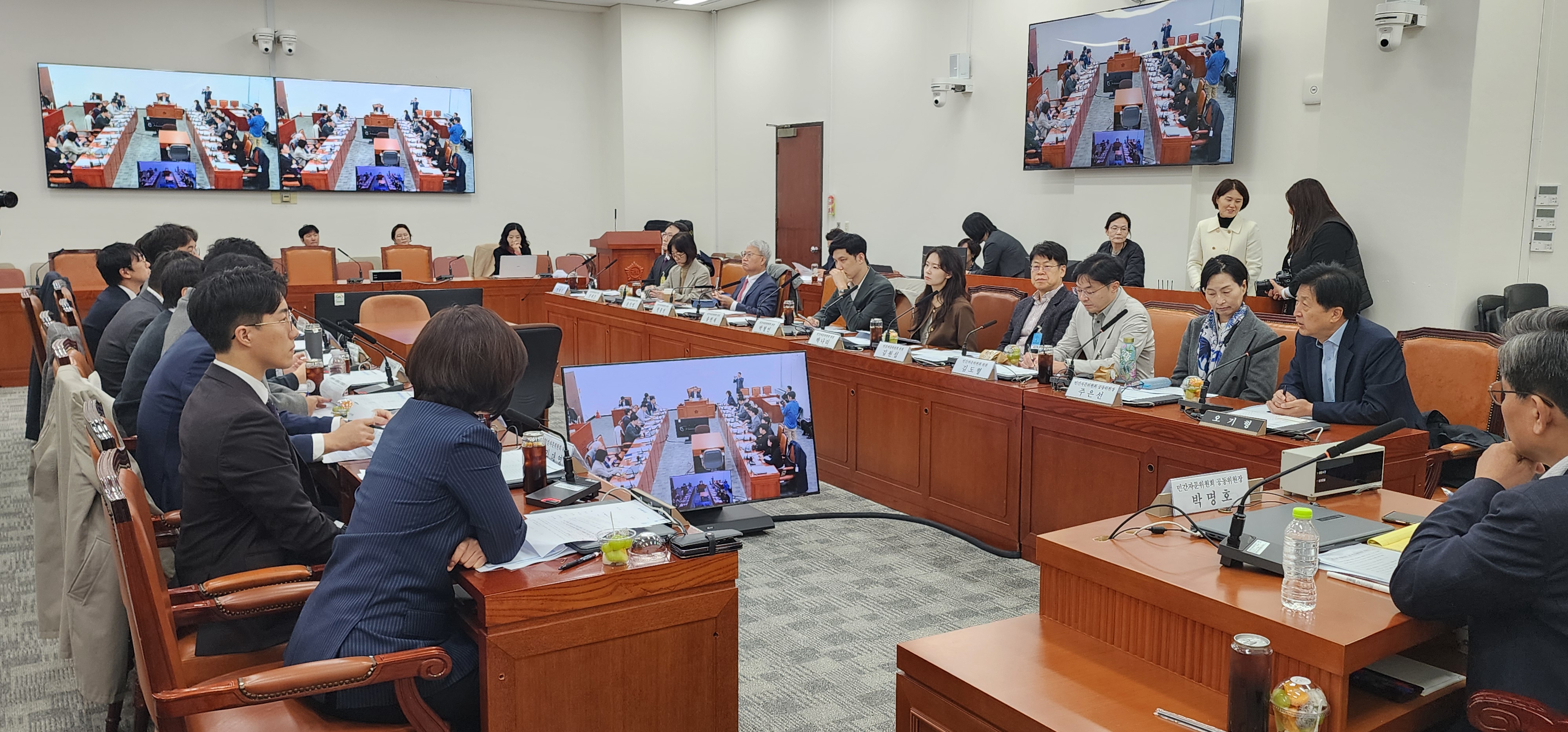
The following is a statement by the Pension Future Forum on the proceedings and conduct of the advisory committee of the 22nd National Assembly Special Committee on Pension Reform.
At the end of last year, the mandate of the 22nd National Assembly Special Committee on Pension Reform was extended by one year. Against a backdrop in which the Special Committee's deliberations had been making little progress, a decision was made to conclude the advisory committee's activities by the end of May.
The decision to hastily terminate the advisory committee's activities despite more than six months remaining in the Special Committee's mandate is one that any reasonable person would find difficult to comprehend or accept.
To this day, substantive and in-depth deliberation on structural reform — the very purpose for which the 22nd National Assembly Special Committee on Pension Reform was established — has never once taken place.
At the meeting held on April 24 concerning Basic Pension reform, three presentations were made. One presentation outlined specific proposals for restructuring the Basic Pension along with a roadmap for their implementation. By contrast, another presentation proposed introducing a separate scheme called a supplementary pension in lieu of Basic Pension reform. One must ask whether presentations of this nature can be said to be consistent with the purpose for which the Special Committee was established.
We pose a public inquiry: does the content of these presentations serve the stated purpose of the 22nd National Assembly Special Committee on Pension Reform, which was established to advance structural reform of the pension system?
On May 8, a presentation including the automatic adjustment mechanism is scheduled, and at the final meeting on May 29, presentations on overseas reform cases are planned. This will be the final meeting of the advisory committee of the 22nd National Assembly Special Committee.
A recurring pattern at each meeting has been that a considerable portion of the meeting time has been consumed by presenters' presentations and question-and-answer exchanges regarding those presentations. In effect, detailed and rigorous debate among advisory committee members on specific issues — that is, on highly sensitive topics and concepts that must be understood with precision — has been practically foreclosed.
In particular, it is difficult to deny that the presentation materials prepared for meetings to date have been substantially shaped by the personal predilections of particular presenters. To state the matter more bluntly, the presentations have in many instances amounted to little more than enumerations of the wishes and aspirations of certain committee members. The situation has reached such a point that a remark was made suggesting this forum is not a venue for reciting the lyrics of Byeon Jin-seop's song "Wishful Thinking."
If the meetings to date have been excessively dominated by abstract deliberation, then from this point forward,
the time has come to begin rigorous debate — organized by topic — on the correct understanding of key concepts and, beyond that, on concrete implementation measures for structural pension reform, which is the very purpose for which the Special Committee was established.
Now that we have arrived at precisely such a moment, what could possibly be the reasons and the background behind the decision to hastily terminate the advisory committee's activities?!
The Pension Future Forum demands a public explanation and accounting.
(The following reflects the Pension Future Forum's position on the conduct of the advisory committee meetings to date. Whenever certain committee members have attempted to speak, certain co-chairs have repeatedly interrupted and obstructed their remarks through a manner of chairing that effectively renders meaningful speech impossible. We pose a public inquiry: are these individuals performing their role as chair appropriately, and do they believe they are conducting meetings with at least a minimum standard of impartiality? The evidentiary basis for these concerns can be readily demonstrated through the meeting minutes.)