Reasons Why Structural Pension Reform Is Necessary (Remarks at the 5th Meeting of the Advisory Committee of the 22nd National Assembly Special Committee on Pension Reform)
- #연금특위
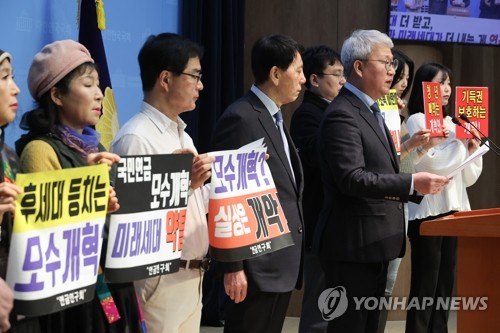
(The 22nd National Assembly Special Committee on Pension Reform was established to deliberate on genuine structural reform; however, the advisory committee has been proceeding without a clear sense of direction.
As a means of sounding the alarm, the author presents the key remarks delivered at the 5th meeting, held at the National Assembly on February 27, 2026.
It is anticipated that a considerable amount of time will elapse before the official meeting minutes are made public.
The following are the remarks of Yun Suk-myung, Honorary Research Fellow at the Korea Institute for Health and Social Affairs (KIHASA), who serves both as a leader of the Pension Future Forum and as an advisory committee member of the National Assembly Special Committee on Pension Reform.)
Since the latter half of last year, the KOSPI index has surged sharply, driving up the National Pension's investment return, and the President and the Planning Director of the National Pension Service (NPS) have consequently been appearing in the media with increasing frequency.
A representative example of such remarks—citing the rising fund investment return rate—is the claim that "we may no longer need to worry about the depletion of the National Pension Fund even through 2090."
The fund investment returns of major countries for last year, i.e., 2025, have been announced.
Korea's National Pension recorded a fund investment return of 18.8%, achieving the highest figure in the world.
The comparator countries of Norway (15.1%) and Japan (12.3%) also posted high returns.
By contrast, Canada (7.7%) and the Netherlands (−1.6%), which are frequently cited for comparison, recorded markedly poor results.
The Netherlands' ABP even recorded a negative fund investment return.
As this illustrates, pension fund investment performance varies considerably depending on the environment and conditions of each respective country.
There is now a point that demands attention in the context of pension reform.
This is because the countries commonly cited for comparison operate pension systems in which "contributors pay substantially more while receiving substantially less in benefits—to a degree that is difficult to compare with our own system."
Let us begin with the example of Norway.
Norway operates the world's largest sovereign wealth fund, valued at approximately 3,250 trillion won—more than twice the size of Korea's National Pension Fund (21.3 Kroner as of end-2025).
Given that Norway's population is approximately one-tenth that of Korea's, this means that on a per-capita basis, Norway holds reserves more than 20 times larger than those of Korea's National Pension Fund.
Despite this, Norway maintains a contribution rate of 18.1% while providing an income replacement rate of 42%.
These figures were provided directly by Dr. Herman Kruse, a statistician at Statistics Norway who was responsible for projecting Norway's pension finances.
Canada's CPP, which is frequently cited as a benchmarking model for fund management, requires a contribution rate of 11.9% while providing an income replacement rate of 33.3%.
What of Japan, from which Korea has drawn lessons in pension system design? Japan maintains a contribution rate of 18.3% while providing an income replacement rate of 32%.
The National Pension, which carries a contribution rate of 9.5% in 2026, will see that rate raised by 3 percentage points (7.5%) at once this year, while providing an income replacement rate of 43%.
One might counter that by OECD standards the rate is approximately 31%;
however, if—as in Norway, Canada, and Japan—structural reform of the National Pension were to convert it into a fully earnings-proportional pension, the income replacement rate of the National Pension for all income brackets would become 43%.
It is now time to ask a fundamental question.
Why do these countries operate such pension systems?
Given that all of these countries are advanced pension nations from which Korea should be learning how to manage its own pension system,
and given that they hold large pension reserves comparable to Korea's own, this question is especially pertinent.
Despite Korea's circumstances being what they are, there are calls to further enhance benefit levels under the National Pension and the Basic Pension.
This is why such proposals are judged to be little more than a list of "wishful thinking" that fails to account for Korea's actual conditions.
The argument that constructing housing for youth happiness and the like would increase the birth rate and thereby extricate Korea from its difficult situation also does not accord with the facts.
Because Korea's pension system operates as one in which "beneficiaries receive more than they have contributed,"
as long as the current system is maintained, increasing the birth rate and thereby expanding the number of National Pension contributors would,
paradoxically, worsen the long-term fiscal position of the National Pension.
At a minimum, deliberations on pension reform within the advisory committee must proceed on the basis of a shared understanding of these fundamental facts.
(For reference, all of these countries adopted the automatic adjustment mechanism—whose introduction is so strenuously opposed by Korea's entrenched interest groups—long ago.)
The day before the regressive National Pension amendment was passed on March 20, 2025,
the author attaches the YTN broadcast segment that emphasized the urgency of introducing an automatic adjustment mechanism.
https://youtu.be/OMkeHrYRClo?si=u8VrVgyzbSLvSQyk![(A Column Sharing the Pension Future Forum's Position, Kookje Shinmun) [Lee Sang-yi Column] The 'Principle of Need' in Welfare and Populism (Posted October 15, 2026)](/_next/image?url=%2Fuploads%2Feditor%2F2026%2F10%2F2e14f0e21c8c4e828b8477e370b55be9-1792132943202.jpg&w=128&q=75)
![(Content the Pension Future Forum Finds Hard to Agree With, Kyunghyang Shinmun, Professor Woo Seok-jin) [Economic Straight Talk] We Won't Pay Your Pensions (October 13, 2026)](/_next/image?url=%2Fuploads%2Feditor%2F2026%2F10%2F5d8f006695804398b4ae104d5181dc9e-1792129375063.jpg&w=128&q=75)