
The Basic Pension Provided to 70% of the Elderly: What Reform Options Exist Amid Fiscal Concerns? (2026.02.20.)
- #연금특위
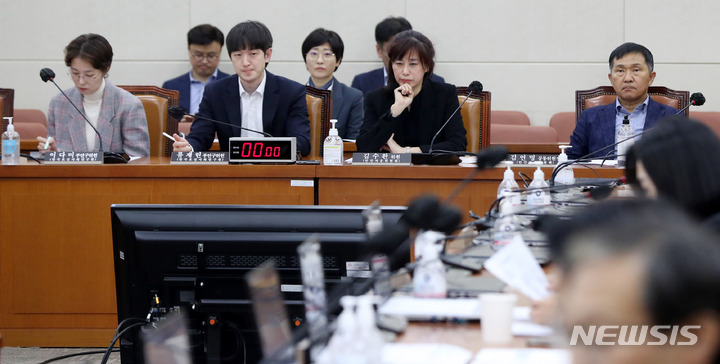
(According to a Newsis report, "the Basic Pension, which stood at 200,000 won in 2014, is scheduled to be increased to 400,000 won next year, and the number of beneficiaries is estimated to rise from 7.79 million this year to 8 million next year.
The Basic Pension budget for this year amounts to a total of 27 trillion won, and projections indicate that this figure will grow to 46 trillion won by 2050."
Despite the enormous fiscal resources being expended, how long will we continue to repeat, parrot-like, that Korea has the highest elderly poverty rate among OECD member countries?
Is it not this very outcome that results from disbursing the benefit on a near-universal basis and dividing it equally among all recipients?
Between the positions of the Pension Future Forum and those of the 'Citizens' Action for Strengthening Public Pensions,'
readers are encouraged to assess which set of arguments is more persuasive.)
As the government reviews reform options for the Basic Pension — which is paid to elderly individuals in the bottom 70% of the income distribution — various proposals addressing fiscal burden and elderly poverty have come under discussion.
According to government sources on the 20th, the relevant authorities are reviewing reform measures concerning the Basic Pension's eligibility threshold and the method for calculating recognized income.(omitted)
Yun Suk-myung, Honorary Research Fellow at the Korea Institute for Health and Social Affairs (KIHASA), stated that "the current government's move to reform the Basic Pension's calculation criteria is ultimately linked to fiscal concerns,"
adding that "under a structure in which the Basic Pension is paid to 70% of the elderly — excluding only the top 30% of the income distribution — long-term fiscal sustainability is impossible."
Given the strong resistance to altering the eligibility criteria for those already receiving the Basic Pension, opinion is also emerging that a "two-track approach" — distinguishing between newly entering cohorts and existing beneficiaries — would be the more realistic course of action.Honorary Research Fellow Yun argued that "the Basic Pension should be understood as a form of social compensation for the generation that passed through the period of high economic growth, and that a different model of old-age income security needs to be designed for subsequent generations,"
adding that "stricter eligibility criteria than those currently in place should be applied to cohorts newly entering the age of 65, thereby reducing the number of eligible recipients.
Converting the Basic Pension into a time-limited program applicable only up to a specified birth-year cohort could also serve as one viable option."
(omitted)
Nam Chan-seop, Professor of Social Welfare at Dong-A University, noted that "while Basic Pension expenditures amount to approximately 27 trillion won, this figure must be viewed in conjunction with the fact that it represents roughly 1% of Korea's gross domestic product (GDP) and that the elderly population accounts for approximately 20% of the total population,"
adding that "European countries spend more than 10% of GDP on elderly-related expenditures even when their proportion of elderly residents is lower than Korea's, whereas Korea's combined Basic Pension and National Pension spending falls short of 5% of GDP.
(Readers are encouraged to compare Professor Nam's argument with the findings presented by Honorary Research Fellow Yun Suk-myung at the advisory committee meeting of the National Assembly Special Committee on Pension Reform in the 22nd National Assembly in November 2025.
According to those materials, the National Pension alone is projected over the long term to exceed 10% of GDP. This figure excludes the Basic Pension — estimated to reach approximately 2.5% of GDP over the long term — as well as expenditures on the Government Employees Pension, the Military Personnel Pension, and the Private School Teachers Pension.
These items are omitted from the figure cited above.)
It is difficult, therefore, to regard the aggregate total alone as an excessive burden."
There are also calls for a fundamental debate — one that must precede any reform — concerning the extent to which the state should intervene in addressing elderly poverty in an aging society.
Jegal Hyeon-suk, Professor of Social Welfare at Hanshin University,
argued that "structural deliberation is needed concerning the scope of the state's responsibility for guaranteeing a minimum standard of living for the elderly, with the year 2050 — when the elderly population will have grown sharply — in view."
![(연금연구회 성명서 보도. 노컷뉴스) [칼럼] 연기금 카지노 책임론?…'쉬운길' 선택의 결과일 수 있다 (2026.10.20.)](/_next/image?url=%2Fuploads%2Feditor%2F2026%2F10%2Fc6f13b0799b440d0874a9f72413c6f58-0004200449_003_20261020063615439-1.jpg&w=128&q=75)
![(연금연구회 성명서 보도. 중앙일보) [취재일기] 국민 노후보다 코스피를 지킨 국민연금 (2026.10.19. )](/_next/image?url=%2Fuploads%2Feditor%2F2026%2F10%2F7e92f70b0ec843bbb869a4cf46b01f72-0003558751_001_20261019052229249.jpg&w=128&q=75)