(KBS 1TV, Sunday Diagnosis Live) Raising the Elderly Age from 65 to 70? — A Public Discussion to Be Pursued. February 17, 2019 (8:10 a.m.)
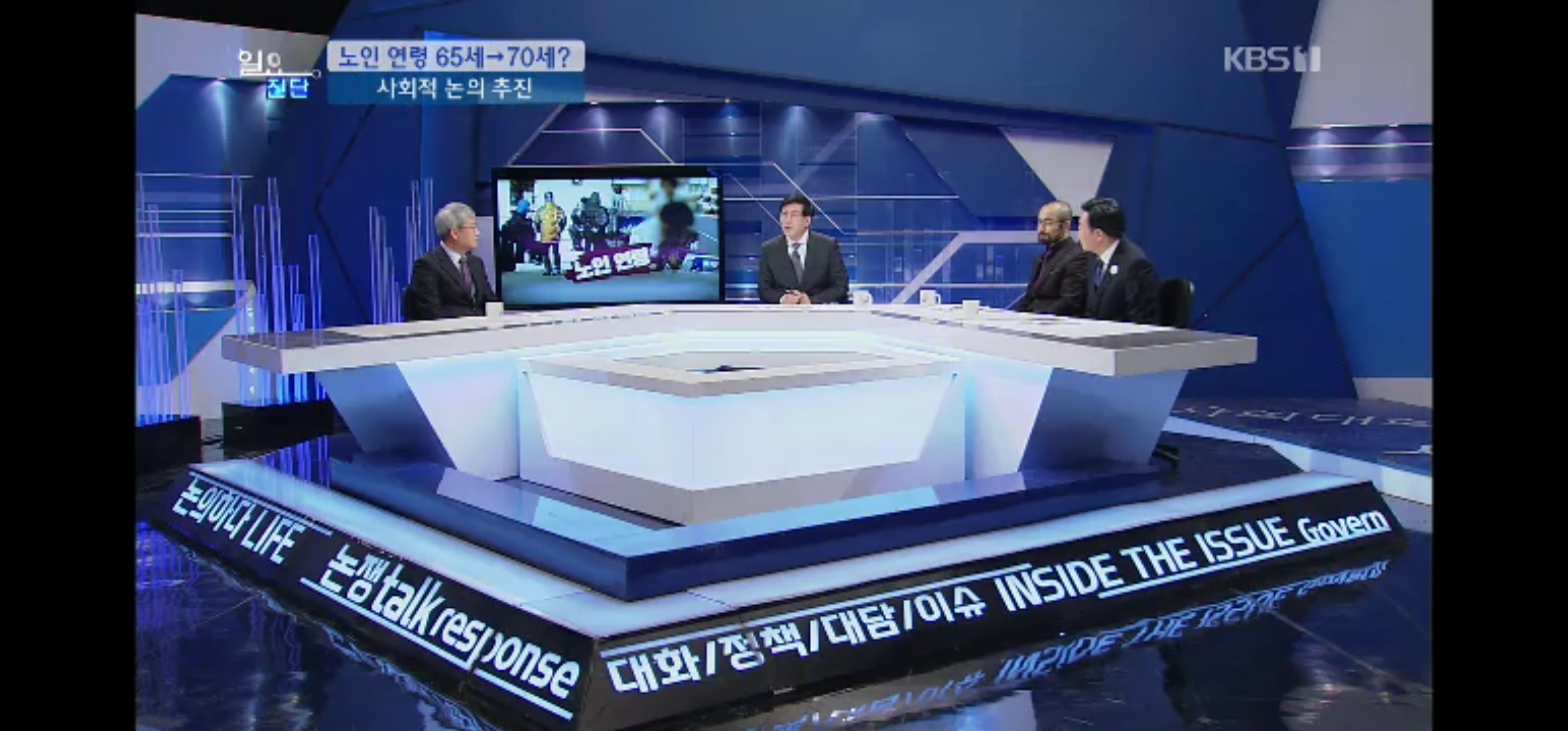
■ Host: Kim Jin-soo
■ Panel: Yun Suk-myung, Research Fellow, Korea Institute for Health and Social Affairs; Ko Hyun-jong, Secretary General, Senior Union; Joo Myeong-ryong, President, Korea Association of Retired Persons
https://news.kbs.co.kr/news/mobile/view/view.do?ncd=4140270
-The era of 100-year lifespans is becoming a reality.
Korea is aging at the fastest pace in the world, so much so that life expectancy has risen by a full 28 years over the past 50 years.
With the country set to become a super-aged society in a few years, the government is pursuing a public discussion on raising the age at which people are classified as older people from the current 65 to 70.
But the elderly age is intricately linked not only to a range of welfare benefits for older people but also to the retirement age and to jobs, which makes it a difficult problem to solve.
Today on KBS Sunday Diagnosis Live, we have three experts with us to look at whether the elderly age needs to be raised and what tasks that would involve.
-Welcome.
Our society became an aged society in 2017, did it not?
And now it is said that we will become a super-aged society by 2025. I would like to begin with Committee Member Yun explaining what exactly an aging society, an aged society, and a super-aged society mean.
-Well, the criterion is defined by the ratio, that is, by what percentage of the total population is made up of people aged 65 and older.
An aging society is one where that ratio is 7%; in Korea’s case, that was in 2000.
Next, an aged society is one where the share is 14%.
That year was 2017.
As the host said a moment ago, according to the current Statistics Korea projections, a super-aged society is expected to arrive around 2025, so it is expected to take about eight years.
That is coming about one or two years earlier than originally projected.
-So if the share of people aged 65 in the population exceeds 7%, it is an aging society; 14% is an aged society; and 20% is a super-aged society.
I imagine there is some meaning behind setting it at 7%, 14%, and 20% like this.
I am curious about the explanation, about what concept lies behind dividing it with these particular ratios.
-There is some controversy even among demographers.
Before appearing on this program, I checked with population experts and with people who have worked at international organizations, and I am told that even the UN side finds this concept of 7%, 14%, and 20% that we commonly use a little puzzling.
But because we use this concept so much, Japan also often cites our case.
I will not say more, because I think viewers might find it a little confusing, but it does seem that these figures of 7%, 14%, and 20% carry a very symbolic meaning.
In the past, when Bismarck, Germany’s Iron Chancellor, first introduced social security schemes, he set the pension eligibility age at 65.
But at that time, Germany’s life expectancy, perhaps because so many people died young, is reported to have been 45 or below.
So there is no unified view, but 7%, 14%, and 20% are used very widely. Looking at it overall, at around 7%, 14%, and 20%, there is the ratio relative to other age groups in that society, and in particular 20% means, more than anything academic, that during ordinary social activities outside working hours—for example, when we ride the subway or look at the people walking down the street—the ratio may be 20%, but the share we can actually see with our own eyes may be something like more than half.
In reality.
Even though in figures it is only 20%.
So it seems that researchers in general set it at 7%, 14%, and 20% in that way.
-So in any case, it seems there is nothing clear-cut about it.
Broadly speaking, symbolically, there is a need to draw that kind of distinction and build some kind of scheme on it.
It seems there is that kind of general, if not clear-cut, consensus.
-In this field, too, when it comes to policy for older people and policy as a whole, this criterion is in any case almost.
-Because there has to be a criterion.
-It seems to have been set as the criterion and is being used that way.
-President Joo, what do you think?
2025 is not far away now.
-That is right.
Seven or eight years.
-About seven years, six years, something like that, are left.
-Six years.
-What do you think?
In a super-aged society at 20%, one in five people will be 65 or older.
-That is right.
-What do you think?
What kinds of changes can we expect in such a society?
-First, the various problems we feel at the policy level will be imposed in real life on older people and also on young people.
What we can easily imagine is that as the working-age population shrinks, the social burden grows, so within that, the burden on the state and on the public will increase.
Social policy will have to be well implemented.
In connection with this, I would like to add to what Dr. Yun said.
Why, as it were, we must treat this problem of population aging so seriously.
This is something I use when I give orientations to the members of our association.
In our society, over the 29 years from the end of the Korean War until the replacement fertility rate of 2.1 collapsed, no fewer than 24 million people of the baby boomer generation were born.
If we divide this by period—we argue a little differently from scholars on this—counting first boomers, second boomers, and third boomers, on average it comes to about 800,000 a year.
Some 800,000 or more a year were born and are now growing old.
So this is called the pig in the python.
The population is depicted as a pig.
In advanced countries.
So in the process of this being digested as it moves through the snake’s belly, we are at the entrance stage.
So we have gone beyond aging as something in progress, and two years ago we already became an old country.
The many problems we face in this situation are ones that, even after taking all of these political issues into account, we must think about very seriously, and that those who govern must steer well.
That is what I want to emphasize.
-I see.
Let me put the same question to Secretary General Ko as well.
In about six years from now, a super-aged society.
The population structure will change so that one in five people is 65 or older. What changes do you expect?
-First of all, the biggest change is that the working-age population will shrink.
Then, among the young, for example, if today five young people support one older person, by then it will be, say, one to one.
One young person supporting one older person—that is in fact the biggest risk inherent in a super-aged society.
But raising the elderly age has come up in the past as well.
As recently as seven years ago and as long as ten years ago, so why has the idea of raising the elderly age resurfaced now?
In fact, back in 2012, under the Lee Myung-bak administration, a mid- to long-term strategy report was issued.
There was talk in it of raising the elderly age from 70 to 75, but in the end there was a presidential election that year, and because of the votes of older people, the issue eventually died down.
Then again in 2015, under the Park Geun-hye administration, in May 2015, the Korea Senior Citizens Association raised the issue once more.
Let us raise the elderly age a little.
That is what they said.
But the social background at that time was that there was a great deal of controversy over Government Employees Pension reform.
In other words, the Government Employees Pension is too generous, cut it, cut the benefit amount.
While that kind of talk was in full swing, the Korea Senior Citizens Association said, in effect: then we will raise the elderly age for ourselves and cut the welfare benefits we have been receiving, such as the Basic Pension; since we older people are also willing to bear some pain, we would like civil servants to accept cuts too.
I think that was more or less the intent.
But that too stirred up various social controversies and then quieted down.
So why has the Moon Jae-in administration suddenly brought this issue up again? Frankly, I find that very puzzling.
-I see.
That is the part we are going to talk about now.
Let us talk about it while keeping that puzzle in mind.
What also puzzled me while you were speaking is this: why is the Korea Senior Citizens Association leading the push to raise the elderly age?
Is it not, in a sense, an organization that advocates for the rights and interests of older people?
-That is right.
-In that case.
-As for who first raised the issue, among scholars, in fact, this kind of talk had been around since 2005.
-I see.
But while preparing for this and hearing various things, I have questions about the Senior Citizens Association leading on this.
-May I say a few words?
So the first time raising the elderly age threshold of 65 came up was when there was a great deal of controversy over the Basic Pension under the Park Geun-hye administration.
From the time of the presidential transition committee on, over whether or not to link the Basic Pension with the National Pension contribution period, there was even an incident in which the then Minister of Health and Welfare resigned.
At that time, one strand of the extensive controversy was that while the elderly poverty rate is very high, the number of older people is growing rapidly, so a great deal of money is going to older people.
On that point, the older generation said that they were not just looking out for their own share, that they too were thinking of young people, of the generations after them.
It was in that spirit, I believe, that Lee Sim, then President of the Senior Citizens Association, first raised the idea.
-So, in a way, that was quite forward-looking, and not at all a matter of simply looking after their own interests.
-At first, that is how it got started, at any rate.
-I think I need to add a little explanation on that.
There was also a bit of social controversy at the time.
That is, when the Korea Senior Citizens Association raised the issue, as I mentioned earlier, there was controversy over Government Employees Pension reform, was there not?
-That came afterward.
Secretary General.
-That period.
-This was in 2013 and 2014.
-In 2015.
Because Government Employees Pension reform was in 2015.
At that time, President Lee Sim, whom I mentioned earlier, raised the issue, and afterward he applied to be a proportional representation candidate for the then Saenuri Party.
So I think there was also a sense that his intentions, the genuineness of it, were somewhat in doubt.
-In any case, let us leave it at that.
In any case, the Korea Senior Citizens Association did have a side that did not think only of the rights and interests of older people, but there may also have been some personal political aspirations.
Let us leave it at that.
I may have dragged things out by bringing up something unnecessary.
Be that as it may, the question that Secretary General Ko raised.
Why is this administration bringing up again something the previous two administrations could not do because they were mindful of votes?
Not long ago, the Minister of Health and Welfare put a proposal of sorts to our society, saying that perhaps it is time to start discussing raising the elderly age.
But in fact, there is a lot of talk about what would happen if the age were raised further when, in areas such as jobs for older people and welfare for older people, things are not sufficient even now.
Let us go through it calmly, one point at a time.
Committee Member Yun, shall we start by looking at how the elderly age threshold of 65 was set?
-In 1981, we enacted a law on welfare for older people, and when you enact a law, you have to take the surrounding conditions into account, do you not?
In 1981, Korea’s life expectancy was around 66.1 years.
So it was set at 65, close to 66, but that was 1981 and this year is 2019, so already about 38 years have passed.
-That is right.
-In the current situation, we put life expectancy at around 82.5 years, but while men’s life expectancy is a little under 80, women’s is about 85.
So in terms of biological age, there has been a very large change over nearly 40 years, and among OECD member countries, Korea’s life expectancy, that is, the pace of its increase, is the fastest, so for one thing the absolute numbers are very large.
As for fertility, was our total fertility rate last year not among the lowest in the world, ranking first or second?
If this is left as it is, the old-age dependency ratio will deteriorate considerably.
So I think that is why the Minister of Health and Welfare brought the subject up.
Across our welfare system, the elderly poverty rate is high and things have not been properly organized, but the problem lies in the details. Because the pace at which things are unfolding is so fast, if we sit on our hands now because things are difficult, then when we actually become a super-aged society in 2025, various problems even harder to solve than today will emerge in combination. In that sense, I think the minister put this forward as a social agenda, difficult though it is.
-So in 1981, when life expectancy was 66, it was set at 65, but now it is close to 83.
-That is right.
-Whether 65 is really appropriate in this situation.
It is an issue linked to various welfare and employment questions, and that is why the government brought this up.
What do you think?
President Joo, what is the Association of Retired Persons’ position on starting the discussion?
-Our position is to go with a dual track.
Excuse me.
On raising the elderly age, the Korea Association of Retired Persons has opposed it in principle for more than ten years.
Even so, we felt that the standard values for international standards should be unified.
As a body under the UN, we felt that responsibility, and in 2012 we were the NGO chairman of ESCAP.
We sent an official document there.
With talk of raising the elderly age emerging in our society, in Korea, and in view of this situation in Korea, which is at the cutting edge of population aging and running ahead of others, we asked whether it might be advisable to raise the elderly age in the OECD standard criteria, or further still, in the UN criteria.
We made that proposal, saying that this kind of public opinion was emerging here.
In that situation, we have opposed it, but as I said, in 2017—two years ago, nearly two years now—we became an old country; the in-progress phase of becoming an aged society has ended and we are now in it.
In this situation, right now, per hour—every single hour.
About 74 people—you will probably be surprised when I give you this figure.
About 74 people are turning 64 or 65.
And between the ages of 65 and 69 there are no fewer than 2.42 million people.
So even with the various welfare benefits for these 2.42 million people in place, I conducted a simple survey of our members in three regions.
One thing was really surprising.
I gave a two-hour lecture to groups of 27 and 45 people who were retiring on March 30 at the retirement age of 60, and then I took an opinion survey, and I was very surprised.
These are people retiring at the retirement age early this year.
They all say, do it.
Do it, all of them.
But in every case there is a proviso attached, a proviso.
And the same goes for the members of our association.
What does this mean?
Raising it to 70 in a symbolic sense is fine.
We look younger, we gain self-esteem, and rather than idling about, just going hiking and so on, it is good that the working age is extended in some way.
But the so-called social welfare age that many people currently receive benefits under.
That must not be touched.
In that sense, I say raise the age on a dual basis; if you cut other welfare benefits according to that age, or raise that age too, you will run into considerable opposition.
That is how we see it, and we are emphasizing that we should go with a two-track approach.
-I see.
Secretary General Ko.
Then let us make the discussion a little more concrete. The schemes that could be affected by this increase include the Basic Pension and long-term care insurance.
-That is right.
-And there is also free subway travel, is there not?
There are these kinds of welfare benefits.
In a way, an increase seems somewhat unavoidable, so what do you think should be done with these schemes?
-Basically, I think a public discussion on raising the elderly age is necessary. But the problem is this: previous administrations kept talking about it too, and what has consistently been said is that, as President Joo said, there are prerequisite tasks, and also that it should be split into two tracks.
In other words, I think there is also a need to try separating the raising of the age from social security policy. But previous administrations, too, kept talking only about raising the elderly age. And then there are the accompanying issues, such as extending the retirement age, and the welfare people have been receiving being reduced or taken away.
Alternatives on these issues need to come forward, but without those alternatives, the Moon Jae-in administration, too, has once again raised the idea of raising the elderly age.
Only three months earlier, at that.
In October 2018.
The Ministry of Health and Welfare and the Presidential Committee on Ageing Society and Population Policy said they would not take up the issue of raising the elderly age.
They said they would not discuss it for the time being, because there are too many prerequisite tasks and too much controversy, and then three months later they suddenly brought it out like this.
But when they brought it out and we looked, there were no alternatives at all.
The discussion has made no progress.
That is why, while I think discussing it is fine, I wonder whether a real discussion can actually take place.
That is the concern I have.
-I see.
There are various institutional changes, expected changes, that come with raising the elderly age, as I mentioned, are there not?
I am bringing this up now so that we can examine one of them concretely.
For example, take the Basic Pension. If the elderly age is raised, say to 70, then the Basic Pension would be paid from age 70, would it not?
-There may be some controversy depending on how this is interpreted legally, but the Basic Pension is financed by taxes, and the current Basic Pension Act covers Korean nationals aged 65 and older; it is not paid to all of them, but to the bottom 70% by income.
So the top 30% with higher incomes do not receive it, but under the Basic Pension Act, the eligible recipients are older people aged 65 and over.
What I mean is that raising the elderly age threshold does not translate one-to-one into this.
-That is right.
-But the reason we are discussing raising the elderly age now is that if a degree of social consensus is reached later and the age becomes 68 or 70, then, since the elderly age threshold has been raised, we would consider linking the Basic Pension eligibility age to it as well, and ask whether there is a need for institutional improvement—“improvement” may not be the right word—whether there is a need to modify the scheme somewhat. I think the discussion would proceed along those lines.
-I see.
So the two are not necessarily tied together.
-And one more thing, in my case.
-Even if it can have an effect.
-Because our population is aging so fast—the Secretary General mentioned this earlier too—the reason the Minister of Health and Welfare suddenly brought this subject up after saying it would not be discussed is that our population is aging that fast; there was no choice but to do it.
Now, as I said earlier, even if the elderly age threshold rises to 68 or 70, depending on our discussion, within the age group of 65, the differences between income brackets are very large and income polarization is severe, is it not?
Even so, there may be vulnerable groups for whom we could keep the age at 65.
Even five or ten years from now.
So if we raise the elderly age threshold, it does not mean that everything changes uniformly all at once; we can discuss what we can change, as a society, and leave as they are the things that are difficult at this stage. If we hold this discussion from that perspective, it can be a far more productive discussion.
-I see.
So in any case, because everything, in fact, including the National Pension starting age, could be affected.
Among these, in my judgment the Basic Pension issue may in a sense be the most important, so I would like to hear about it.
President Joo, what is your position?
So your position would be that even if the elderly age is raised, payment at 65 must continue, would it not?
-That is right.
We are especially very worried about the Basic Pension.
With the Basic Pension—well, the definition of an older person as 65 is only vaguely set internationally, but in each country the ages for social welfare schemes are clearly defined.
In our society, the Basic Pension is currently being implemented within a firm framework of age 65.
It is paid to 70% of older people aged 65 and over, every month.
It is currently 250,000 won, is it not?
That is how it is being paid, but they are not managing to pay the full 70% currently covered.
It is very difficult to calculate.
Because it has to be done according to income.
So in that respect, it is being paid to about 67 or 68%.
Then, as things proceed this way, as Dr. Yun said, the age will be raised at some point; it would have to rise gradually.
Once it has risen, does the Basic Pension age rise along with it?
If that were done, our association itself would probably be out protesting in front of the Ministry of Health and Welfare every day.
So that is very unlikely to happen, and besides, these days every social issue goes through a body called social dialogue.
To take the National Pension as a representative example, in pursuing National Pension reform, they held debates and the like touring 16 cities and provinces across the country starting in the second half of last year.
Going through that kind of process, I do not think at all that this will be decided by a few specialist officials, scholars, or other people concerned.
So within all this, what I hopefully support and think is the way to go is this—and I stress it again—that all current schemes continue as they are, and when times get better, the age could rise gradually, step by step, could it not?
But it will take a very long time.
That is how I see it.
-Secretary General Ko, just a moment, please.
Committee Member Yun.
In a sense, the National Pension is of the greatest interest, and when we actually enter a super-aged society in 2025, with a 20% population share, the fiscal burden looks to be considerable.
So in a way, this may become the most contentious part.
-As you said, on income security, we say the elderly poverty rate is very high, but there is also a great deal of it that has not properly surfaced.
Last year, based on the results of the Fourth National Pension Financial Projection, the government, after much deliberation, had no choice but to put forward four options for the National Pension overhaul plan, because the public’s expectations differ so widely on the gap between the adequacy of old-age security and securing fiscal soundness.
But I will come back to the National Pension a little later and talk about the Basic Pension first.
The Basic Pension is a scheme under which the government collects taxes every year and pays out as much as is needed, so the more the share of older people in the population grows, the more sharply the burden on future generations in that year will inevitably increase.
In other words, unlike the National Pension, nothing at all has been set aside.
So when the Moon Jae-in administration took office, the Basic Pension required about 10 trillion won a year, but if things proceed as they are, without any further increases, just according to the Moon Jae-in administration’s campaign pledges, the Basic Pension alone is projected to require about 28.5 trillion won in 2027.
And the part where a great outcry, a scream, is coming from local governments.
-28 trillion won?
-It is over 28 trillion won, and the central government does not bear all of the 28 trillion won; local governments bear 25%.
With local governments’ finances already in poor shape, having to bear 25% in matching funds leaves them with no money to spend.
So recently the head of Buk-gu District in Busan even wrote a letter to the President.
-That is right.
-That once we pay out the Basic Pension funds, we have no money to spend on anything else, so we ask the President to give us some consideration.
So things have already reached the stage where the Ministry of Health and Welfare and the President’s aides have been told to look into it.
For now, the Basic Pension is the urgent part, and as for the National Pension you mentioned.
The National Pension has no direct relationship with raising the elderly age threshold.
We check its financial condition every five years for the sustainability of the scheme, and at present, as of this year, the eligibility age is 62.
The eligibility age will be extended to 65 in 2033, but some other countries have already extended it to 67 or beyond.
So the elderly age threshold needs to be adjusted to some degree so that later—not right now—and last time, when there was talk that the eligibility age might also be reviewed a little, it caused an uproar, as if we had stirred up a hornet’s nest, did it not?
So if these go together, could we not, from a long-term perspective, not right now but 20 or 30 years from now, have a social discussion about pushing it back beyond 65?
For now, I think you can understand it as being at about that stage.
-I was going to ask Secretary General Ko earlier as well, but I thought your opinion might be the same as President Joo’s. We would be taking on this kind of fiscal burden, would we not?
Even so, payment of the Basic Pension must be kept at 65.
Is that your position?
-That is my position.
So my view is similar to President Joo’s, but the difference is this: we usually say the retirement age is 60, do we not?
But the only places where people actually work until 60 are the civil service and public institutions.
In private companies, they try to push people out once they reach their fifties—no, even their late forties.
They recommend voluntary retirement, then if people do not go along with that they suggest a contract position, and if people still do not listen after being offered a contract position, they use work audits and all sorts of audits so that people cannot stay on.
So when people leave, say in their early fifties, they cannot receive the National Pension either, so in the end they live on their severance pay.
But what can you do with severance pay?
You just go into self-employment.
You open a fried-chicken restaurant, or a restaurant, or a coffee shop.
But when you do that, it does not last a year.
When it fails within a year, then you have to work, but the work available in our society is security guard jobs for men and cleaning jobs for women.
Only simple manual labor like that.
And even those jobs are not plentiful.
So how are these people supposed to make a living? That is the point.
So after barely getting by, when you turn 65, there is the Basic Pension and other welfare benefits.
You can take part in the job program for older people, so if you put those together you earn about 500,000 won, and you can manage to make a living.
So in a way, when we talk about raising the elderly age, people have indeed become much younger, but in a sense economic aging has started much earlier.
So there is no mechanism to make up for this, and if the age is simply raised, it will be very hard.
In my own case, I am now in my mid-fifties, and I have been thinking that once I retire, I will receive the Basic Pension and try to live well on it.
It is not much, but I thought that if I lived frugally on it I could plan my old age well, and if I think it will be pushed back another five years, that is very disheartening.
So people are very anxious right now.
The roughly 2 million older people between 65 and 70—well, for those who are receiving it now, it does not matter.
Dr. Yun said that, but people always get anxious when that kind of talk comes up.
Because they do not know what will happen right away.
I think something needs to be done to ease these concerns.
-Listening to you, the situation is frustrating in any case.
Looking at it from the government’s side as well, this administration took office in 2017, and the 10 trillion won it was spending on the Basic Pension then will become 28 trillion won in just ten years—double.
-Triple.
-It now has to spend nearly triple that, and even so, that is fine?
-No, it is not.
-That much.
Of course, I understand.
Your explanation is that things are that difficult, and that unless something like jobs improves dramatically, if the current situation continues, there is no choice even if the government bears such a burden.
President Joo.
-Let me add a little more explanation.
Whenever such discussions come up at our association, good opinions emerge from experience, even from people who are not scholars.
Among older people, even among those aged 65 and over, we tacitly distinguish between the young-old and the old-old.
People in their 60s and 70s are generally called the young-old.
Those past 70, in their 80s and 90s, are called the old-old.
In this situation, if we look at the young-old in terms of the baby boomer generation now coming through, are they not now reaching 65?
This 65-year-old generation is better educated than the old-old, has generally worked until the retirement age before leaving, and is in every respect much better off economically.
And they know how to make their own voices heard.
In this situation, should we not set the direction of the Basic Pension anew?
That is what I think.
As it stands, the Basic Pension is in the end being paid out universally.
To the rich and the poor alike, and in this situation, a debate is now emerging over 80% or 90% rather than 70%.
It is spreading even more widely.
So sometimes, when a debate breaks out, I say, “Look, let us lay the Basic Pension down for everyone as the first tier, that is, as the first universal pension scheme,” and then I fall into worrying about where the money will come from. In this situation, how would it be to distinguish between the young-old and the old-old and—Dr. Yun will no doubt research this—give the old-old something more concentrated?
Concentrated support, that is.
Furthermore, what comes up every time we have this discussion is the elderly poverty rate.
I do not know whether the elderly poverty rate will come up later today, but whenever I go to meetings of countries such as the OECD or gatherings of international retiree associations, and a few of us gather to talk at a bar or somewhere in the evening, I am sometimes asked this question.
“Korea is an economic powerhouse, a big, rich country ranked tenth or eleventh—why is your poverty rate always so high?”
That is what they say.
So one day I told them this.
“Let us not measure the relative poverty rate; let us measure the absolute poverty rate. Measured as absolute poverty, we would be at around 30%, would we not?”
Then last year, Dr. Yun Suk-myung of the Korea Institute for Health and Social Affairs put out a very definitive statement.
He put forward an opinion, and I say it should be adopted nationwide.
When Korea measures the relative poverty rate, it looks only at disposable income, as they say in English—the income one can spend right away.
Yet looking at our members, many of them own homes, and many own three or four homes.
I mean that many of them have homes and savings, and their children have done well and give them pocket money.
Yet none of that is counted at all when the poverty rate, the relative poverty rate, is measured.
Another thing is that, among people aged 65 and over, most of those at the very poor end work, because they have to do something.
If they work, their income is higher than that of older people who do nothing.
Because the poverty rate is calculated from the median of such incomes, it cannot help but come out high.
So when experts corrected these points and produced a figure, I simply did the calculation for Korea.
As Dr. Yun has now published, it drops to 21%.
Going from the current 45% or 46% to 21% would make us the same as the United States or Israel.
It would make us a rich country.
So should the government authorities and research scholars not study these points seriously, together with raising the age?
That is what I want to stress.
-To summarize briefly what you just said: income differences even among older people.
-That is right.
-Age differences even among older people.
-That is right.
-You are saying that a finely tuned approach is needed that differentiates somewhat and pays on a graduated basis, and along with that, you raised a question about the elderly poverty rate.
What we commonly hear now is the elderly poverty rate, and that ours is around 46%.
-They say it is the highest.
-Compared with the OECD countries’ twelve-point-something percent.
-It is more than three times higher.
-It is said to be more than three times higher, and it seems there could be considerable errors in designing any scheme on that basis.
But is what President Joo just said correct?
I mean, of course, that.
What Committee Member Yun said...
-I might be wrong.
-I am truly moved that President Joo brought this up on such an important program.
The background to my doing that research is that I have attended many meetings of international organizations such as the UN, the ILO, and the OECD, and have also worked on their projects.
The background to this research is that a friend named Tata, who was head of the social protection team at UN ESCAP, called me by name over dinner after a meeting in Songdo, Incheon, and said that Korea’s elderly poverty rate looked strange to him.
When he came and looked, Korean people seemed to live very well, so why was the poverty rate so high?
And then he asked me what share of older Koreans owned their homes.
So I said I was not certain.
“I am not sure.
But would it not be about 70%?”
This friend said, “Definitely, then Korea’s elderly poverty rate seems to be wrong.”
That motivated me, and I did the research.
Right now, regarding the elderly poverty rate, are we not very worried that some 7.2 million baby boomers are not prepared for old age?
Some say the National Pension needs to be strengthened, but behind that is the fact that severance pay, at 8.3%, could form a very substantial old-age income security system, and it is not being run well.
For one thing, the rate of return is so low that it does not amount to much, but people prefer real assets so much that they take interim settlements of their severance pay and buy homes or real estate; and what the OECD-standard elderly poverty rate is, as President Joo said earlier, is based on disposable income.
Based on disposable income, when people aged 65 and over are ranked in order, the median income is the one right in the middle; say, for example, that it is about 1.5 million won, or about 2 million won.
-2 million won.
-Anyone below 1 million won, which is 50% of 2 million won, is judged to be poor.
But there may be several errors in this.
Older people’s disposable income.
When they hold a great deal of real estate or other assets besides cash flows, there is a part that is not counted as income; and there is also the trap of averages, as there are people who receive good pension benefits, are there not?
Those who receive the Government Employees, Private School Teachers, or Military Pension have quite a lot of cash, do they not?
There are twenty or thirty percent at these two extremes, and there are the people we often see on TV and in the media who live in great hardship, collecting wastepaper with handcarts.
As President Joo also said earlier, these people may come to around 30% in terms of absolute poverty.
They are at the two extremes, and when you average them, the figure comes out at around 46%.
But what our society takes away is that people aged 65 and over seem, on average, to be poorer and worse off than other age groups.
Because it is approached this way, arguments that the Basic Pension should be paid to all, 100%, of those aged 65 and over come up at every election, and that seems to make the discussion very difficult.
As our society’s fertility rate falls, welfare resources are limited; there is no objection to giving a lot of support to older people who are struggling right now, but from a forward-looking perspective, we must also use much of our welfare resources for young people and for raising the fertility rate, yet even at the last National Pension reform, the public strongly disliked raising contributions by even 1 percentage point, did they not?
That means it is not easy to build a welfare system, and if what has been built with such difficulty goes largely to a particular age group, even where that group has come to be reasonably well off, then for young people and future generations, is there not an intergenerational problem?
It could become a source of social conflict rather than of social harmony.
So I am not saying that we should withhold the benefits due to older people, but that we should assess older people’s actual circumstances more accurately, along with equity with young people.
Young people today cannot find jobs and find it hard to buy homes, so they do not even dare to think of marriage, do they?
Should we not hold a social dialogue in the sense of discussing all of that comprehensively?
Looked at that way, I think we can approach this issue with a more open mind.
-I agree that we should have such a discussion now.
But I would like to sort out the elderly poverty rate a little: is basing it on disposable income an international standard?
-It is the OECD standard.
-Are financial assets and real estate assets not included there?
-Financial assets are included, because they are cash flows in disposable income.
What I said was.
-Real estate is not included?
-If there is no rental income or the like from real estate, then even if, for example, someone owns property worth 700 million or 1 billion won, without any cash income from that real estate, it effectively is not counted in disposable income.
-I have discussed this point with other scholars.
“It is included,” they said.
That is what they told me.
So.
-It is included in recognized income.
In recognized income.
That is, it is included in the recognized income used to select Basic Pension recipients, but under the concept of actual disposable income, even if it is included, it is greatly underestimated.
There is a great gap between officially assessed land prices or standard prices and the market, is there not?
And because a substantial basic deduction applies, under the Basic Pension eligibility criteria about 100 million won is deducted, based on officially assessed prices, in large cities, so there is a great gap from reality.
-I would like us to look at this part once more.
In any case, that we are at 46% while the OECD average is around 13% is hard to believe even just looking at the numbers.
-There is one thing I really want to stress about that.
As the host also said earlier, the Basic Pension budget, which was 10 trillion won when the Moon Jae-in administration took office, is projected to reach about 28.5 trillion won by 2027, is it not?
The seriousness of the problem lies partly in the large resources required, but also in the fact that, even after spending those resources, if the current Basic Pension scheme is maintained and the current poverty indicator is used as it is, the elderly poverty rate is projected to remain about three times the OECD average even then.
Then how should we view this problem?
Should we not look again, step by step, at why such results come out?
That is what I want to stress.
-That is right.
-But it seems there was something like this.
That is, the elderly poverty rate that Dr. Yun raised as an issue internationally.
I think it is meaningful and needs to be examined, but internationally, there also seem to have been reasons why our society has set relative poverty at 50% of median income.
For example, Korea’s per capita national income is now 30,000 dollars, but its social welfare spending is only about 10%.
The OECD is basically at 21%, and if you look at European countries, they generally spent 10 to 15% on welfare when their national income was 10,000 dollars and 30 to 35% when it was 20,000 dollars, but we spent about 7% at 10,000 dollars, about 8% at 20,000 dollars, and barely 10% at 30,000 dollars.
So in a way, is the reason we are this poor and that people feel this insecure in old age not that, in any case, our social welfare spending is somewhat small in fiscal terms?
It seems connected to things like that as well.
So, when it comes to raising the age, if people could work longer in the labor market and earn income, then delaying the pension eligibility age would really not matter.
But the reason the pension eligibility age matters so much now is that people cannot work for long in the labor market.
-Because there is no work.
-Because I can only live if I receive at least that early, and these days there is also the saying that a grandfather sends his grandchild to university.
Because nowadays it is a society where you are not respected even as a grandfather if you have no money, I think we need to give some thought to these things.
-If I could add just one thing.
-Go ahead.
-I agree with most of what the Secretary General said.
It is an important point.
But there also seem to be aspects here that we need to look at objectively.
Korea alone cannot use an indicator of its own for the elderly poverty rate; the main indicator, the reference indicator, has to be the OECD indicator.
But the intention is to look at it alongside, as a supplement, saying that there are also these aspects reflecting Korea’s particular characteristics, so I hope there is no misunderstanding about that.
One thing I really want to stress is this: as reports in political circles say, many claims are being made that Korea, although an OECD member, has very low social spending—that is, social security spending relative to GDP—and that this is why we have so many social problems overall; as I see it, that is partly valid and may be partly problematic, and I want to stress that.
Because the reason our social security spending is so low is that other countries—I mentioned Germany earlier, did I not?
Because Germany introduced its pension system before 1900, great-great-grandfathers and great-great-grandmothers have been receiving pensions—ones they paid into themselves.
But ours was introduced in 1988, and since the scheme was introduced for the whole population only in April 1989, the great majority are only paying contributions and not receiving pensions.
Right now, things are hard.
So whether by strengthening the Basic Pension or by other means, we must at least lift those in elderly poverty out of absolute poverty.
Even if it is hard.
But once we design a scheme wrongly, there is what is called path dependence, and it can overshoot badly.
It can go wrong and lead into a phase that is hard to bring under control.
In that respect, looking at around 2050, even if we carry on with our current scheme as it is, our social security spending comes out far above the OECD average.
So this is a road we have not traveled, and right now we are discussing all of the scheme design based only on what is visible now.
So social security spending exceeding the OECD average after 2050 is, in the end, a burden on the current young generation and on generations not yet born, is it not?
It seems necessary to approach this from the perspective of thinking about that together.
-In any case, I see the point that our social welfare spending is considerably lower than in other OECD countries as quite meaningful.
What Committee Member Yun just explained, though, is that the welfare framework we have put in place is a structure in which, as time goes on, we will spend far more than other OECD countries.
That is what you are saying now, right?
-It is projected to exceed the average.
-Then are you also taking into account the increases in other OECD countries?
Or are you not comparing only against the current state?
-Basically, it is the current state.
But in two respects these countries will not increase much from where they are now; in fact, in the case of pensions, some countries will see a decrease relative to GDP.
The reason is that, because these countries introduced their schemes long ago, the great majority of their older people receive pensions and population aging has entered a fairly stable stage, whereas for us, when the next generations who will receive the National Pension in earnest retire, they may come like a flood.
And as the contribution period becomes longer than now, the amounts also grow, so at a very fast pace compared with these countries.
-At a fast pace.
-Because the absolute amounts and the number of recipients are increasing.
-I see.
-There is that aspect.
-I understand that the pace is fast.
But if you are projecting a society in 2050, say about 30 years from now, I said that because I would like you to also look at the model of other OECD countries 30 years from now.
We have now been talking at length mainly about the Basic Pension, but as was raised earlier, is the National Pension not also affected in terms of the eligibility age?
In fact, that is also something people do not want right now, is it not?
Its being delayed.
-That is right.
If it goes that way, depending on age.
But the eligibility age under the National Pension reform is already fixed now.
It is now 62, and by the early 2030s it is set to be 65—that sequence has been fixed.
What I think matters here is that, with the eligibility age already fixed, the so-called benefit amount, the benefit rate.
It would be the benefit rate.
The benefit rate is becoming the problem.
Within the scope of lowering it, there are now four plans that this administration intends to pursue.
Which of the four plans will be chosen now?
But the overall mood is that the approach of paying less and receiving more, as under the previous administration, simply will not work.
Because this is a matter of the pension’s sustainability.
So should we not go in the direction of paying a little more and receiving more?
But this will take quite a long time.
Still, the National Pension is different from the Basic Pension.
The Basic Pension basically uses the taxes we pay to provide for older people who are struggling, whereas the National Pension, though not a tax, has that character, and we draw on what we have paid in.
In that situation, I do not see it becoming a great burden.
-Committee Member Yun, what do you think?
It seems the National Pension would be far less affected by raising the elderly age than the Basic Pension; what do you think?
-As for the National Pension itself, as I said earlier, its long-term financial condition is reviewed periodically every five years.
So, looking comprehensively at the circumstances surrounding the National Pension—economic conditions, the fertility rate, figures on rising life expectancy—discussions arise about how far the scheme has to be adjusted to achieve fiscal stabilization, and it is a scheme that can be changed only when a social consensus is reached after much pain.
Even if our elderly age threshold—please do not misunderstand, I am not saying it will go that way—were raised to 70.
-For example.
-That has nothing whatsoever to do with the eligibility age.
So it would be better not to worry.
What I want to say clearly is that the Minister of Health and Welfare raised the idea of adjusting the elderly age threshold upward because, left as it is, our society could suffer greatly and intergenerational conflict could arise, so the point is to think in a forward-looking way; nothing has been decided about the benefits we are receiving.
The point is to put our heads together seriously and hold a social discussion on what would be best for the future of our society in that regard.
It has nothing to do with the National Pension.
-That is right.
-Because the Basic Pension is funded by collecting taxes, there may be more discussion about that.
-Clearly, the National Pension is much less related to raising the elderly age than the Basic Pension.
It seems we can see it that way.
-That is right.
Because among the current generation of older people, only about 30% receive the National Pension.
And the amount is very small too, around 300,000 won.
So naturally, when it comes to raising the elderly age, the current generation of older people is not much interested in the National Pension.
Of course, those who receive the National Pension do say this.
“I contributed to the National Pension for ten years or more and now receive a little, so they cut my Basic Pension.”
They are dissatisfied about that.
But the great majority are not enrolled in the National Pension, so they do not receive the benefit.
On the other hand, there is the current baby boomer generation.
And the generations below them may be somewhat sensitive.
Because, well, normally the National Pension was supposed to be paid from 61, but with pension reform it became 62—it is 62 now—and then 65.
But will I really be able to receive it at 65?
If they say there is no money again, will they not push it to 67, 68, all the way to 70?
Then I will die without ever receiving the National Pension.
So it seems some distrust of the National Pension is arising as well.
-I see.
-Because it is so sensitive, let me say a bit more.
The host keeps raising the topic of the National Pension, and the figure that our average National Pension benefit is 380,000 or 390,000 won is a fallacy of averages.
Because, when the National Pension was introduced, people had no opportunity to enroll, so a special old-age pension scheme was introduced under which a pension is paid even after only five years of contributions.
It is because the amounts those people receive are small.
-That is right.
-Many of the baby boomers who have contributed since 1988 receive 1 million won, or as much as 1.4 or 1.5 million won.
-That is right.
Up to 1 million won.
-These people cannot help but be very sensitive.
“They say it is 62 now and will become 65 later; will they not use the elderly age threshold to change it to 70 later?”
-That is right.
-But I am telling you again and again that it has nothing whatsoever to do with that.
-It is almost time to wrap up today’s discussion, and listening to you, it seems that everything our government has put in place is very uniform.
Based on age.
But going forward, however the age is adjusted, it seems clear that we should differentiate so that more welfare benefits can be concentrated on those who are considerably worse off.
Then what direction, or what funding, shall we say?
We really do not have much time left, so please think of it as about 20 seconds each, and we will hear a word from each of you, starting with Committee Member Yun.
-We now tend to approach the problems of older people too much on average; if we break down the difficulties and welfare measures for older people by income bracket and by age and approach them in a more tailored way, I think we can expect much greater effectiveness for the input.
Next, welfare is important in the end, but as life expectancy rises, we must create social conditions in which people can work longer.
On that, it seems necessary for older people themselves, the government, and businesses to put their heads together and pool our wisdom toward what gives the greatest effect for the cost of input.
-Secretary General Ko.
-In fact, the most important issue with raising the elderly age right now is jobs.
It is a question of how long people can be kept in the labor market, but the important thing about welfare, I think, is this.
Rather than dividing people uniformly by age, it should follow the needs of the person concerned; for example, there are people who are older but have other welfare needs.
And there are also people who are young but have certain needs.
I think it would be very good if our society provided welfare according to those needs.
-President Joo.
-The elderly age should be raised.
It should be raised someday.
But the related social welfare policies should be improved gradually while keeping the current state.
That is how I see it.
In addition, in that process, it should not be only the policymakers and scholars involved; the middle-aged and older people concerned should take part directly, and I stress that.
-Thank you for your remarks.
We will stop here with today’s three guests.
Considering the rapidly rising share of older people amid low fertility and the burden on the younger generation, the discussion of the elderly age threshold is not something that can be put off indefinitely.
However, as the social safety net after the retirement age is lacking and elderly poverty is also serious, I hope this public deliberation on the elderly age threshold will lead to a reasonable conclusion, and with that, we will close today’s Sunday Diagnosis Live.
Thank you, viewers.