
[National Pension Reform] ⑩ “We Have to Be Honest about Raising Contributions” (September 10, 2018, 11:08 a.m.)
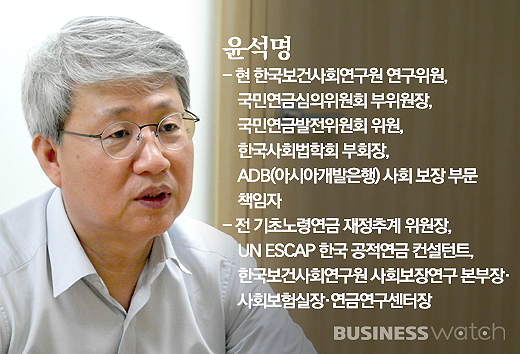
▲ Yun Suk-myung, Research Fellow at the Korea Institute for Health and Social Affairs, answers reporters’ questions at the Business Watch office on the 7th.
Interview with Yun Suk-myung, Research Fellow at the Korea Institute for Health and Social Affairs
Contributions must be raised now to lighten the burden on future generations
Writing the payment guarantee into law makes reforming the system even harder
“If you are eating steak (the pension you receive), you have to talk about the price of the steak (the contributions), and if you are eating jajangmyeon, you have to talk about the price of jajangmyeon.”
Yun Suk-myung, Research Fellow at the Korea Institute for Health and Social Affairs, presented two figures from overseas pension systems, the income replacement rate and the contribution rate, and pointed out how absurd the National Pension’s current income replacement rate and contribution rate are.
He presented two sets of figures. Finland, a leading welfare state, guarantees an income replacement rate of 60% while its insured members pay a contribution rate of 24.4%, whereas Canada’s contribution rate (9.9%) is low, and so is its income replacement rate (24%). By contrast, he stressed, the National Pension has its members pay little and receive a lot, which is why the threads of reform keep getting tangled.
“The pension system badly needs to be modernized,” Research Fellow Yun said. “When the social environment, including the population structure, changes, the pension system has to change to match it, but we keep wanting a level of pensions that could only be enjoyed in an economic boom.”
He stressed that in the end the only way to solve the National Pension’s fiscal problems is to raise the contribution rate. But for the National Pension alone to perform the old-age income security function, contributions would have to be raised correspondingly steeply, which would become a burden on the public, so it must be backed up by additional systems such as the Basic Pension and retirement pensions, he explained.
On the 7th, we met Yun Suk-myung, Research Fellow at the Korea Institute for Health and Social Affairs, at the Business Watch office and heard his views on how to reform the National Pension.
- Anxiety and distrust are widespread, with people fearing they may never receive their National Pension. How did the National Pension, the public’s old-age income security system, end up in this state?
▲ The National Pension was modeled on the system of Germany, which introduced its pension system after the end of World War II, when social conditions were good. When Germany introduced its pension system, its income replacement rate was 70%. The root cause of the fiscal instability can be seen as the failure, when the German pension system was brought in, to adequately reflect Korea’s demographic, economic and social variables at the time the National Pension was introduced (1988).
- Germany’s pension system is running stably. What is the reason?
▲ Unlike the National Pension, Germany’s pension system introduced an automatic adjustment mechanism. When social and economic variables emerge, such as a falling economic growth rate or fewer children being born, it automatically reflects them and adjusts the income replacement rate. This applies not only to those insured at the time of the adjustment but also to beneficiaries who are receiving pensions. However, because Germany has already set a ceiling on the contribution rate, it adjusts by cutting the income replacement rate instead of raising the contribution rate.
- So are you saying the National Pension was designed wrongly from the start?
▲ To match an income replacement rate of 70%, the contribution rate that would theoretically have to be paid is 28%. That is the contribution rate needed to receive as much as you paid in without placing a burden on later generations. Finland levies a contribution rate of 24.4% for an income replacement rate of 60%. Even now, Finland’s fertility rate is much higher than Korea’s. In the financial projections as well, Finland’s fertility rate is higher than ours as of 2070. Even so, Finland has decided to lower its income replacement rate in stages to 44.3% and projects that the contribution rate must be raised to at least 28%. Finland’s current fertility rate is 1.45, yet are we not expecting ours to fall even further from 1.05?
That the design was flawed was already pointed out by the National Pension System Improvement Planning Team set up in 1997. At the time, the Planning Team judged that, just 10 years after the system was introduced, rapid aging and a trend of low growth made it impossible to maintain the system as it was. Even then, there was talk that the income replacement rate had to be lowered to 40%. In the end, the first reform in 1998 lowered the income replacement rate from the original 70% to 60%.
- So in the end, whether the income replacement rate or the contribution rate is adjusted, the public will inevitably have to share the pain from the current level?
▲ Even setting aside all other conditions, such as macroeconomic variables and the falling fertility rate, life expectancy was 61 when the National Pension was introduced in 1988 and is 81 as of this year. By simple arithmetic, the period over which pensions must be paid has grown by 20 years. With 20 more years, spending naturally has no choice but to grow. A pension system is a matter of money coming in and going out. The only question left is whether the current generation bears it or future generations do.
- So this fourth financial projection presented Plan (A) (an income replacement rate of 45% and a contribution rate of 11%) and Plan (B) (an income replacement rate of 40% and a contribution rate of 13.5%) as alternatives.
▲ In fact, Plan (A) means doing nothing. The income replacement rate was originally set to fall to 40% by 2028, but it would stop that at the current level of 45% and raise the contribution rate only enough to cover the extra 5 percentage points received. In effect, it offers no answer at all to the fund’s depletion in 2057.
Plan (B), at least, contains a solution for fiscal stabilization. Because it lowers the income replacement rate to 40% as originally planned and raises the contribution rate to 13.5%, the burden is lighter in fiscal terms, for now. If, through consensus afterwards, the pension eligibility age is raised or the income replacement rate is further adjusted through a life expectancy coefficient (an automatic cut in pension amounts as life expectancy rises), I believe the National Pension can be reformed in a way that lightens the burden on future generations.
- Public opinion on raising the contribution rate is not good. People are demanding back the contributions they have paid so far, and some are even calling for the National Pension to be abolished.
▲ The outlook for macroeconomic variables released in the fourth financial projection shows the figures getting worse as time goes on. The economic situation will only become more difficult. If so, it means that now is, relatively speaking, a better time than the future, and that if we do not raise the contribution rate now, it will be even harder to raise it later. Contributions should be raised as soon as possible.
- That sounds like saying the current generation should bear some of the burden to lighten the burden on future generations.
▲ If we do not raise the contribution rate now, future generations will have to bear all of it later. In Japan, the payment rate for public pensions has now fallen sharply. The current elderly generation receives its pensions very securely, but young people are not confident that they will be able to receive a pension later. As a result, there is a strong tendency to avoid paying into the pension by any means. If this continues, it will end up destroying public pensions.
- The public has to be persuaded that the contribution rate must be raised.
▲ When I asked a Japanese pension expert, I was told that Japan set the direction of its pension reform and repeated the same message to the public for two to three years. They stressed that otherwise the pension system itself could not be sustained. The National Pension now says it will hold dialogues with the public, but it must give the public accurate information. It has to tell people that if they eat steak (the pension they receive), they must pay the price of the steak (the contributions), and if they eat jajangmyeon, they must pay the price of jajangmyeon.
- Some analysts say the government is trying to gain momentum for raising the contribution rate by writing the National Pension payment guarantee into law.
▲ I think it would be better not to reform at all than to write the guarantee into law and then raise the contribution rate. Other countries reformed their pensions without writing a payment guarantee into law. The government and those responsible for National Pension reform must say honestly that there is no way other than raising the contribution rate. There is only one way, and I think that talking about other things only makes reforming the system harder.
- Why should we be cautious about writing the payment guarantee into law?
▲ If the National Pension payment guarantee is written into law, it becomes a latent liability of the state. To maintain the current income replacement rate of 45% without burdening future generations, the contribution rate would have to be raised to 18%. But the current contribution rate is 9%. In the end, the remaining 9% would be counted as a latent liability.
- Some argue that, unlike the Government Employees and Military Pensions, the National Pension is not paid by the state as an employer, so no exchange transaction exists and it is not recognized as a liability.
▲ With the National Pension, the company pays half of the contributions, but that is where it ends; the company is not the entity that pays the pension. The National Pension is a system for which the National Pension Service, delegated by the state, is responsible. It is only right to recognize it as a latent liability that the state must bear.
- If things go according to Plan (B), which raises the contribution rate to 13.5%, can the National Pension function properly as an old-age income security system?
▲ Under Plan (B), the contribution rate goes up, but the income replacement rate falls to 40%. And if fiscal stabilization runs into problems later, there could also be policy changes that raise the contribution rate again or lower the income replacement rate below 40%. In that case, it would in fact be difficult to provide old-age income security through the National Pension alone. That is why the pension system has to be viewed from a multi-tiered perspective. We need to move to a structure in which those with middle incomes or below are covered by the National Pension and the Basic Pension, and those with middle incomes or above are backed by the National Pension and retirement pensions.
- Some also point out that proper old-age income security is difficult because of the government’s fiscal burden from the Basic Pension as the elderly population grows, and because the retirement pension system is immature.
▲ Currently, the Basic Pension is paid even to older people who are reasonably well off, and this should be changed to focus on those in absolute poverty (elderly households below the minimum cost of living). As for retirement pensions, since the system was introduced not long ago, I believe it will mature once some time has passed.


