
(KBS TV, Economic Inside) [Economic Inside] What Is at the Core of the National Pension Overhaul Plan? December 17, 2018 (6:16 p.m.)
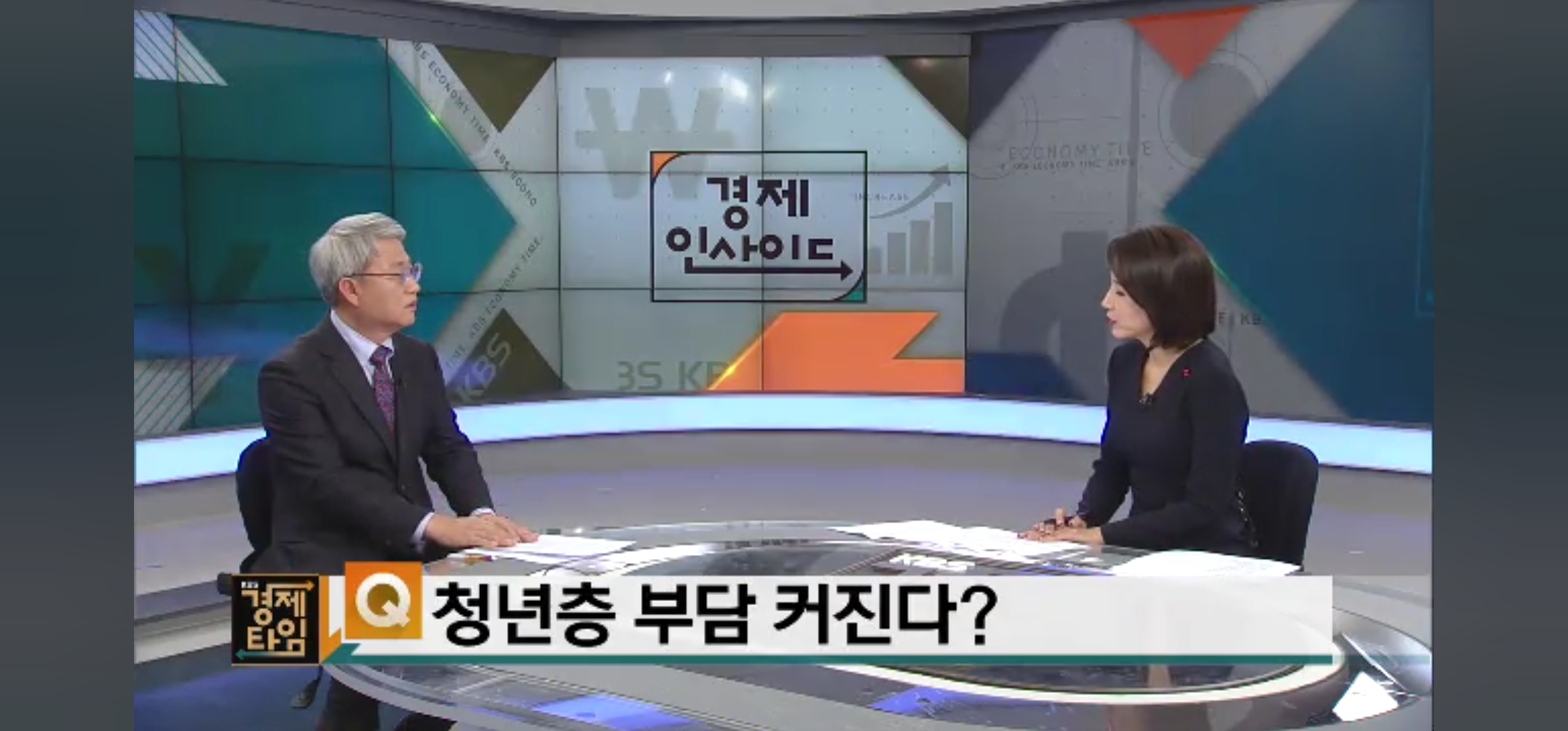
Anchor
Last Friday, the National Pension overhaul plan came out.
Rather than finalizing and announcing a single option, it put forward a wide range of choices, from maintaining the current system to strengthening old-age income security by linking it with the Basic Pension.
We go over the key points of the National Pension overhaul plan with Yun Suk-myung, Research Fellow at the Korea Institute for Health and Social Affairs.
The government has put forward four options for overhauling the National Pension.
First, please explain Options 1 and 2, in which the income replacement rate and the contribution rate do not change.
Answer
Answer
Options 1 and 2 both keep the National Pension income replacement rate and contributions as they are now; Option 1 raises the Basic Pension to 300,000 won, as the Moon Jae-in administration pledged, and Option 2 goes further and raises the Basic Pension to 400,000 won.
Anchor
Anchor
So Options 3 and 4 raise the income replacement rate?
Answer
Answer
Option 3 raises the National Pension income replacement rate by 5 percentage points to 45% while raising contributions by 3 percentage points, whereas Option 4 raises the income replacement rate by 10 percentage points to 50% while raising contributions by 4 percentage points
Anchor
Anchor
There have been persistent concerns, have there not, that raising the income replacement rate requires raising contributions, that this would shift the burden onto future generations, and that young people who must pay the taxes might resist?
Answer
Answer
How much of the burden is shifted onto future generations depends on how the income replacement rate is raised and how contributions are raised.
Put simply, if the income replacement rate is raised a little and contributions are raised a lot, the scale of the burden shifted onto future generations shrinks.
Options 3 and 4 this time contain no fiscal stabilization measures in response to the National Pension financial projection that the fund will be depleted in 2057.
Since they contain only the contribution increases needed to raise the income replacement rate by 5 or 10 percentage points, shifting the burden onto future generations is unavoidable.
Options 3 and 4, the plans to strengthen old-age income security, could be said to carry an inherent intergenerational conflict, in that the burden on future generations could grow heavier over the long term.
Anchor
Anchor
The Basic Pension is going up—are there no fiscal problems that come with that?
Answer
Answer
Raising it has a positive side, because the benefit goes right away to older people who are struggling, but because this is a scheme run on taxes collected in the same year, the size of the funding burden could become enormous as the number of older people aged 65 and over grows.
If the second option, which strengthens the Basic Pension, is followed, the funding the Basic Pension requires is expected to be about 40 trillion won around 2028 or 2030.
And it does not stop there: Korea’s first baby-boom generation, born between 1955 and 1963, numbers about 7.2 million people.
They will be crossing into age 65 before long, will they not?
The number of people eligible for the Basic Pension will grow exponentially.
If this does not stay at 40 trillion won but could go to 50, 60, even 70 trillion won, it has to be covered from that year’s taxes; with the National Pension’s fiscal stabilization measures not properly in place, how will future generations accept this growing Basic Pension burden? That, too, seems to be no easy question.
Anchor
Anchor
This adjustment plan also includes support for half of the contributions of vulnerable groups, the unemployed, and people whose businesses have failed.
Does this mean supporting people who had never been able to pay into the National Pension at all?
Answer
Answer
Of what the government announced this time, I see this part as the most important and meaningful.
If genuine strengthening of public pensions means helping those who, for various reasons, cannot pay pension contributions to receive pension benefits, then this measure, under which the state supports the contributions of people left without income by unemployment or business failure and so provides a financial incentive to join the National Pension, is highly significant.
This government measure is to support 50% of contributions for so-called exempted non-payers, especially vulnerable people who had been paying contributions but for one reason or another can no longer pay them.
Whether people who have never once paid contributions will also be covered seems to need further discussion.
Anchor
Anchor
This overhaul plan includes a push to write the National Pension payment guarantee into law.
When you appeared last time, Dr. Yun, you said that, from an expert’s standpoint, writing the payment provision into law was somewhat worrying.
Answer
Answer
The idea is to write the payment guarantee into law on the basis of polls showing that a majority of the public wants it;
while this has the positive effect of dispelling distrust of the National Pension, it is highly likely to become an obstacle to future National Pension reform.
Because the National Pension scheme is designed to pay out more than people pay in, a reform to balance what is paid in with what is paid out is unavoidable at some point.
If an overhaul plan is drawn up asking people to pay more in contributions to strike that balance, they will ask: the state guaranteed payment, so why put the burden on the public, the subscribers?
They are highly likely to demand that the state bear all the responsibility, which could complicate matters.
Anchor
Anchor
So you are saying that even if the government tries to overhaul the scheme in step with social change, once the guarantee is written into law, overhauling it becomes difficult?
Answer
Yes, that is right.
Even when the case for overhauling the scheme arises, people are highly likely to invoke the state payment guarantee provision and demand that the state take full responsibility.
In 2014, during the reform of the Government Employees Pension, which has a payment guarantee provision, government employees’ unions and others already raised exactly this objection.
Anchor
Anchor
Four options have come out—which do you think is the most likely? Answer
Answer
It is not easy to predict, but of the four options, I think politicians will prefer Option 2 the most.
Because it does not raise the National Pension contributions the public dislikes while paying 150,000 won a month more in Basic Pension than now, politicians and the public, older people above all, seem likely to favor it.
Option 2 brings large benefits to the current generation, especially the middle-aged and older, while the burden on young people and future generations could grow almost unbearable; so I think the overhaul discussion needs to proceed in a way that builds social consensus while giving the public full information on the strengths, weaknesses, and ripple effects of each alternative.


