(KBS) 1+1=1 or 1.2 — The “Strange” National Pension (March 26, 2015)
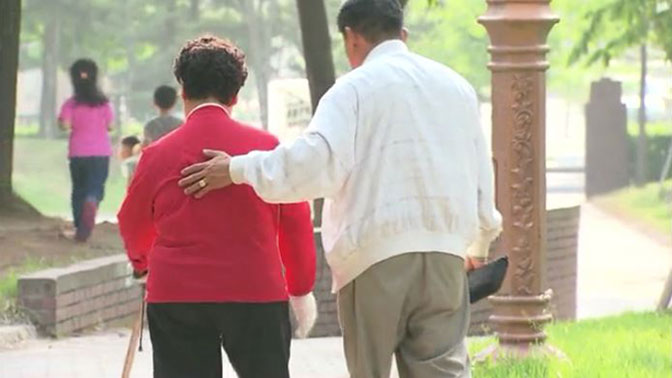
There is a field in which the strange formula 1+1=1 holds true. Sometimes 1+1 even equals 1.2. We are talking about the National Pension. This happens when a married couple who both enrolled in the National Pension are receiving old-age pensions in retirement and one of them dies.
The number of couple beneficiaries—married couples who both enrolled in the National Pension and in which husband and wife each receive their own old-age pension in retirement—is rising every year. As of December last year, they numbered 214,456 couples.
As the National Pension scheme, introduced in January 1988, has come into full swing, couple beneficiaries have increased steeply at an average annual rate of 24.3%, from 108,674 couples in 2010 to 146,333 in 2011, 177,857 in 2012, and 194,747 in 2013.

What, then, happens to the National Pension a spouse was receiving if that spouse dies while the couple are both receiving it as couple beneficiaries?
According to the National Pension Service on the 26th, when both spouses are receiving old-age pensions and one dies first, the surviving spouse acquires the right to receive the deceased spouse’s survivors’ pension.
The problem is that the survivor cannot receive both his or her own old-age pension and the survivors’ pension arising from the spouse’s death. He or she must choose whichever of the two is more advantageous. This follows the National Pension’s so-called “rule on the adjustment of overlapping benefits.”
Under this rule, those who choose the survivors’ pension receive only the survivors’ pension. They cannot receive a single won of the old-age pension they paid into. 1+1 becomes 1.
Those who instead choose their own old-age pension can receive only 20% of the survivors’ pension on top of the old-age pension. 1+1 becomes 1.2. The government has decided to raise this ratio slightly.
The Ministry of Health and Welfare plans to submit to the April session of the National Assembly an amendment to the National Pension Act that raises, from the current 20% to 30%, the overlapping payment rate of the survivors’ pension paid to a beneficiary entitled to both an old-age pension and a survivors’ pension who chooses the old-age pension, and, after the legislative process, to implement it as early as the end of this year. In other words, it intends to raise 1+1 from 1.2 to 1.3.
According to the government’s explanation, unlike private pension products that pay out as much as one has paid in contributions, the National Pension is a social insurance that provides protection against each insured person’s old-age risks, such as disability, old age, and death. For this reason, it explains, the scheme has an overlapping-benefit adjustment mechanism that, for the sake of equity across society as a whole, requires a person who becomes entitled to two or more pension benefits to choose only one.
Yet the insured are far from satisfied. Canada, France, the United Kingdom, and others pay both of the overlapping pensions in full. Germany, Belgium, and others set a ceiling on the combined amount of the two pensions and cut beyond it. In other words, they do not cut unconditionally as Korea does.
Yun Suk-myung, Research Fellow at the Korea Institute for Health and Social Affairs (KIHASA),
said, “At a time when even the pensions of two people are not enough to prepare for old age, the National Pension cuts too much when benefits overlap,” adding, “The criteria should be relaxed by limiting the reduction to wealthy asset holders or, as in Germany, by reducing benefits only when the combined amount of one’s own old-age pension and the survivors’ pension exceeds a certain level.”
There are other cases in which overlapping pensions are cut.
Overlapping pensions are also cut between industrial accident compensation insurance and the National Pension. A worker injured on the job can receive a disability compensation benefit from the Korea Workers’ Compensation and Welfare Service and a disability pension from the National Pension. In this case, the disability pension is cut by half. Some 43,000 such cases arise each year.
Experts point out that the criteria and extent of cuts to overlapping pensions need to be adjusted in light of foreign cases.
◆ Old-age pension: This refers to the ordinary pension received at age 60 by those who have paid pension contributions for 10 years or more. Those with less than 10 years can receive a lump-sum refund all at once, or can receive a pension if they keep paying contributions after turning 60 until they complete 10 years. The pension amount is determined by taking into account the money one has paid in and the average income of all insured persons.
◆ Survivors’ pension: This is a pension paid to the bereaved family members who shared a livelihood with a pension beneficiary or insured person when he or she died. Priority goes, in order, to the spouse, children, parents, grandchildren, and grandparents.