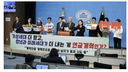
(Report on the Pension Future Forum’s Position) [Pension Funds’ Dark Chapter ②] The Stock Market’s “UN Commander” — The “Three Hats” Dilemma (November 18, 2026)
The controversy over political pressure from the Lee administration is at the core, but
like a commander who must weigh armistice management, Korea’s defense, and even U.S. strategy,
pension funds face a similar structure of “conflicts of interest”
“Responsibility must be made clear when flexibility is exercised”
[Dailian = Reporter Kang Hyun-tae]
The presence of pension funds, which have played the role of “relief pitcher” whenever foreign selling intensified, is not what it used to be. Since the launch of the Lee Jae-myung administration, as the drive to boost the stock market has grown stronger, some have also suggested that the public’s retirement savings are being used as a policy instrument. Concerns are also being raised that pension funds, wavering among three goals—securing returns, stabilizing the market, and acting as a strategic investor—may go down in history as a dark chapter. We compare the scale of net purchases over the past month, overseas response strategies, and more, and examine the issues surrounding the role of pension funds. [Editor’s note]

View original This image was created with AI.
As the domestic stock market correction continues amid dumping by foreign investors, complaints are pouring in from inside and outside the securities industry that pension funds have done little as a “breakwater.”
In particular, analysis is gaining weight that the National Pension, which dreams of entering the retirement pension market, failed to secure room to maneuver because it fell into step with the Lee Jae-myung administration, deciding, among other things, to defer rebalancing (the mechanical adjustment of asset allocations) and to expand its allocation to domestic equities ahead of this year’s local elections.
Others point out, however, that the “dilemma” of interests inevitably colliding in the pursuit of different goals also deserves consideration.
The observation is that, just as the Commander of the United Nations Command, who concurrently serves as Commander of U.S. Forces Korea and Commander of the ROK-U.S. Combined Forces Command and thus wears “three hats,” can be torn among ▲managing the Armistice Agreement ▲defending Korea ▲U.S. strategic interests, pension funds, too, can face conflicts of interest among their different roles.
A pension fiduciary and a breakwater for the capital market
that also plays the role of strategic investor
Because pension funds manage the public’s retirement savings, they must, as “pension fiduciaries,” pursue the goals of the highest returns and fiscal stability.
Given the sheer size of the assets they manage, however, they also take on the role of a “capital market breakwater,” such as stabilizing the domestic capital market and cushioning market shocks.
In addition, their presence as patient capital that contributes to national strategy and social responsibility—that is, as “strategic investors”—is also considerable.
In the case of the National Pension, which deferred rebalancing and raised its domestic equity allocation after the Lee Jae-myung administration took office, the controversy over political pressure is the core issue, but the possibility of conflicts of interest among its roles also needs to be examined.
Kim Sung-joo, Chairman of the National Pension Service and a former two-term Democratic Party of Korea lawmaker, stressed the legitimacy of the decision at the National Assembly’s parliamentary audit last month, saying, “Had we not deferred rebalancing, large-scale selling would have dealt a severe shock to the market.”
The argument is that, had rebalancing gone ahead as scheduled, the National Pension would have had to sell about 800 billion won every day, making a market shock and a decline in its profitability unavoidable.
The point is that in the first half of this year it wore the hat of the capital market breakwater and was faithful to that role, but this is also a declaration that it abandoned the goal of the highest returns as a pension fiduciary.
Turn Chairman Kim’s logic around, and one could also criticize the National Pension for having amplified its losses by adding to downward pressure during the foreign exodus, because it began rebalancing in July, once the deferral had wound up.

View original Earlier, in January, when the domestic stock market was soaring, the National Pension Fund Management Committee decided to defer rebalancing until the end of June even if its domestic equity holdings deviated from the target. In May, with the local elections close at hand, it also raised the domestic equity target allocation from 14.9% to 20.8%. The National Pension Service’s Seoul Northern Regional Headquarters in Seodaemun-gu, Seoul (file photo). ⓒNewsis
“Had pension funds rebalanced on principle
when the KOSPI topped 8,000,
they might have bought heavily in the downturn”
Earlier, in January, when the domestic stock market was soaring, the National Pension Fund Management Committee decided to defer rebalancing until the end of June even if its domestic equity holdings deviated from the target.
In May, with the local elections close at hand, it raised the domestic equity target allocation from 14.9% to 20.8%.
Driven in part by single-stock leveraged and inverse (single-stock leverage) products on Samsung Electronics and SK Hynix, launched at the end of May after a hasty rollout, the KOSPI broke through the 9,000 mark in June but faced a steep decline once July began. It was the result of deteriorating global investor sentiment toward semiconductors combining with the volatility of single-stock leverage.
In the aftermath, the National Pension’s fund assets, which had reached 1,865.576 trillion won at market value at the end of June, shrank by about 181 trillion won to 1,684.173 trillion won at the end of July.
This is why some observe that, had it mechanically adjusted its asset allocations and realized gains during the first-half rally, it could have defended against further foreign outflows in the second-half downturn with stronger buying than it is doing now.
An official at a securities firm said, “It is regrettable that pension funds failed to sell when the KOSPI topped 8,000,” adding, “Their (domestic) equity allocation grew far too much at that time. Had they sold on principle, they could have bought a lot now (in the downturn).”
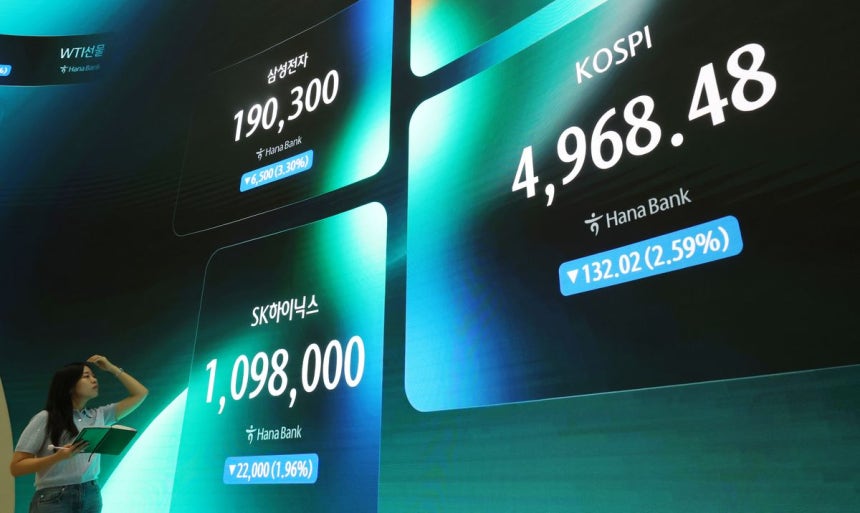
View original The KOSPI, which closed down 132.02 points (2.59%) from the previous trading day at 4968.48 on the 17th, is shown alongside the closing prices of Samsung Electronics and SK Hynix on the display board in the dealing room of Hana Bank in Jung-gu, Seoul (file photo). ⓒNewsis
Lee Chan-jin five years ago: “Without a reasonable basis,
principles must not be undermined”
The National Pension will not even release its minutes
Separately from the controversy over political pressure, critics point out that because pension funds can put on a different hat depending on the situation and claim legitimacy, safeguards must be put in place so that principles can be changed, or flexibility exercised, only on sufficient grounds.
Earlier, Financial Supervisory Service (FSS) Governor Lee Chan-jin, while serving as a member of the National Pension Fund Management Committee in 2021, had asked, “How will anyone take responsibility for the problem of undermining principles without a reasonable basis?” and expressed the view that “we should leave the target allocation alone.”
Although the grounds for the decisions to expand the domestic equity allocation and to defer rebalancing need to be verified, the National Pension is refusing even to release the minutes of the Fund Management Committee.
In a statement, the Pension Future Forum
said, “Rebalancing is not a means of improvisation but a discipline designed to uphold long-term asset allocation principles even amid market fluctuations,” and
pointedly added, “To change or defer the principle as an exception, far stricter grounds and procedures than for ordinary investment decisions must be required, and that judgment must without fail be put on record and subjected to verification afterward.”
In particular, it stressed, “There must not be a structure in which results are actively publicized when performance is good, while those responsible vanish when results turn bad,” adding, “The authority over major investment decisions and those accountable for them must be made clear.”
The point is that a rule should be institutionalized requiring that, whenever strategic asset allocation or rebalancing principles are changed or deferred, the reasons and the results of the review of alternatives be recorded and disclosed afterward.
Reporter Kang Hyun-tae ([email protected])
Copyright ⓒ Dailian. All rights reserved. Unauthorized reproduction and redistribution prohibited.