(Seoul Sinmun) The National Pension’s Stock Market Defense Line, Bound by Outdated Rules (November 12, 2026)
The National Pension’s Rebalancing Dilemma
Domestic stock sales deferred during the surge early this year
“Market volatility was high; a different decision was difficult”
Fund has doubled, but risk management is unchanged
Far from a relief pitcher, it even suffered 125 trillion won in losses
“Investment standards need overhauling, and decisions need independent verification”
“Even if we went back to that time now, it would be hard to make a different decision.”
An official who was involved in the National Pension’s decision in the first half of this year to defer the “rebalancing” (readjustment of asset weights) of domestic equities, and who attended meetings on fund management, said this on the 11th.
The point is that, with share prices soaring at the time and an “expected decline” hard even to mention, the decision to put off selling in view of the shock it would deal to the stock market was unavoidable.
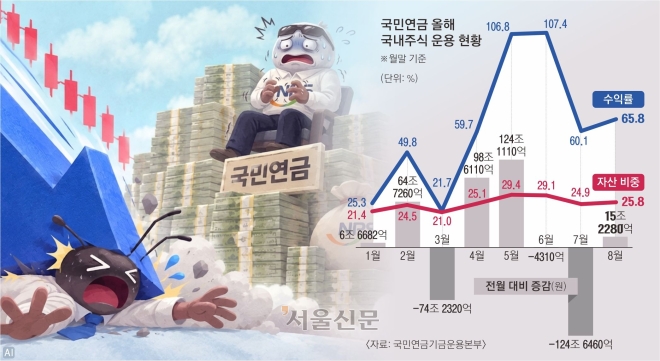
Afterward, the domestic equity allocation in the National Pension’s asset portfolio swelled to 29.4% in May, and the return soared to 107.4% in June.
Up to that point, investors praised the National Pension’s deferral of rebalancing. (Pension Future Forum comment: Almost alone in Korea, the Pension Future Forum strongly denounced these decisions, issuing statements on several occasions.)
But the price of missing the moment was harsh.
In the plunge that struck right after, in July, 125 trillion won evaporated from the domestic equity assets held by the National Pension, and the return tumbled to 60.1%.
Far from acting as the stock market’s relief pitcher, the National Pension ended up badly stuck in collapsed stocks, just like individual investors.
This year, the National Pension’s moves have been completely different from the past.
In 11 of the 14 stock market downturns since 2000, it was a net buyer, fully playing its part as a “relief pitcher.”
During the 2008 financial crisis, it bought 5.968 trillion won worth of shares over the two months of September and October, defending against the fall in share prices.
This year, by contrast, its net purchases in the June–July plunge amounted to only 500 billion won, and in the September–October plunge it was a net seller of about 200 billion won.
Rebalancing, which means selling when share prices rise and buying when they fall to maintain asset allocations, is a key risk-management mechanism.
In January, however, the National Pension’s Fund Management Committee deferred selling until the end of June even if the domestic equity allocation exceeded the permitted range, and raised the target allocation from 14.4% to 14.9%.
In May, it raised this sharply to 20.8% and even reduced the maximum daily selling limit.
With share prices rising at the same time, the domestic equity allocation stood at 25.8% as of the end of August, above the target.
A participant at the time said, “Opinions converged on watching for a while because market volatility was high, and there were no particular objections.” According to this account, no single person drove the decision, and there was no outside pressure.
Kim Sung-joo, Chairman of the National Pension Service, also said at last month’s parliamentary audit, “Had we not deferred rebalancing, we would have had to dump more than 800 billion won every day, over 10% of the KOSPI market’s trading value.”
The problem is that existing rules were not overhauled in time while the fund was growing rapidly.
In 2019, when the current rebalancing standards were set, the fund stood at 713 trillion won; it has since more than doubled.
It is caught in a dilemma: selling under the old rules would heighten the shock to the market, while putting off sales means taking on the risk of falling share prices.
The National Pension also took a direct hit from the plunge in share prices.
In July alone, the valuation of its domestic equities fell by about 125 trillion won. It is not a realized loss, but it shows the scale of the fund’s exposure to share price swings.
The National Pension Act sets maximizing fund returns and the long-term stability of pension finances as its investment principles.
That is the background to criticism that the decision to delay selling in order to head off a short-term shock to the stock market increased the downside risk to retirement savings.
The grounds for the decision are also hard to verify from outside. The government has not disclosed any specific analysis comparing the market shock from selling with the risk of deferral.
Yun Suk-myung, Research Fellow Emeritus at the Korea Institute for Health and Social Affairs (KIHASA), said, “It makes no sense to announce the policy of deferring sales while withholding the minutes on the grounds of investment confidentiality,”
and pointed out, “Even if sensitive investment information and the names of speakers are blacked out, it is possible to disclose on what grounds the members voted in favor.”
An official in the financial investment industry said, “Only by updating investment standards in line with market changes and putting in place a system to independently verify the grounds for investment decisions can political wrangling be reduced.”
Sejong — Reporter Lee Hyun-jung
Copyright ⓒ Seoul Sinmun. All rights reserved. Unauthorized reproduction, redistribution, and AI training and use prohibited.