(Chosun Ilbo) Government Runs a 900 Billion Won “Hole” This Year in Medical Aid Payments Owed to Hospitals and Pharmacies (Posted November 17, 2026, 12:46 a.m.) Original Article
With the standard median income raised by the largest margin ever,
more low-income people are receiving Medical Aid
Medical institutions not being paid by the government
may have to take out loans to cover operating costs
Three-Line Summary
·Medical Aid treatment-cost budget 900 billion won short
·Welfare expansion adds 1.71 million beneficiaries
·Pharmacies and hospitals covering operating costs with loans
As a result of the government raising the “standard median income,” the yardstick for determining beneficiaries of various welfare policies, by a record margin year after year,
the national budget has turned out to be 900 billion won short of this year’s Medical Aid treatment costs owed to hospitals, clinics, and pharmacies.
Medical Aid, introduced to support medical expenses for low-income people, covers those at or below 40% of the standard median income; when the government raised the “2026 standard median income” by 6.5% (for a four-person household) last year, people with a monthly recognized income of 2,598,000 won or less became eligible this year.
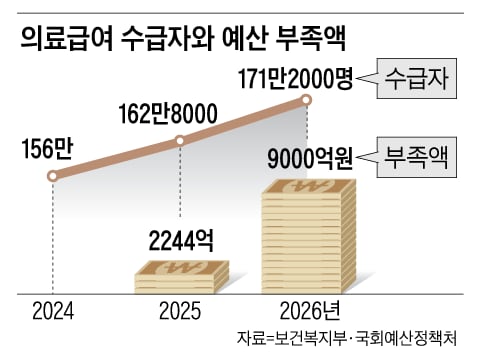
The number of beneficiaries alone rose from 1,628,000 last year to 1,712,000 this year (as of October).
This has drawn criticism that “the cost burden of expanding welfare is being shifted onto frontline medical providers.”
Graphic: Yang In-seong
The government had already secured 9.84 trillion won in the main budget for Medical Aid this year, plus an additional 282.8 billion won through a supplementary budget in April. This comes to about 10.1 trillion won, 1.3 trillion won more than last year. But according to the Ministry of Health and Welfare on the 16th, national funds are expected to fall short by about 900 billion won by the end of the year. This is largely due to the standard median income setting record highs, with increases of 6.4% last year and 6.5% this year. The number of beneficiaries rose from 1.56 million at the end of 2024 to 1,628,000 at the end of last year and 1,712,000 in October this year. The government had projected an annual average of 1,607,000 beneficiaries this year and secured funding for 50,000 more through the supplementary budget, but this fell short of the increase. Ordinarily, Type 1 Medical Aid beneficiaries pay only 1,000 won at a neighborhood clinic and 500 won at a pharmacy (for covered items). Hospitals, clinics, and pharmacies claim the remaining costs from the Health Insurance Review and Assessment Service. After review, they are normally paid by the National Health Insurance Service within a month.
The problem is that even when the budget runs dry, hospitals, clinics, and pharmacies must keep providing treatment and dispensing. University hospitals with many high-cost treatments are hit as well, but small hospitals and clinics must cover operating costs even if it means borrowing money. Pharmacies also buy medicines in advance and pay for them with the Medical Aid payments they receive, so when payments are delayed, their cash flow is cut off. An official at the Korean Medical Association said, “It is no different from handing over a promissory note and not paying, and they do not even pay statutory interest,” adding, “It is a situation in which the creditor has to wait without saying a word.”
The Ministry of Health and Welfare explained that this “budget hole” was due to beneficiaries increasing faster than expected.
On top of the increase in eligible people from the higher standard median income, the criteria were also relaxed so that people can qualify for Medical Aid even if they have supporting family members. In addition, the rate of applying for benefits is rising, and fewer people are leaving the beneficiary rolls.
An official at the Ministry of Health and Welfare said, “An unusual situation has continued in which the number of beneficiaries has increased every month since January 2024,” adding, “We plan to reduce this year’s unpaid amount by securing reserve funds and other resources, and to clear all of it within January next year if at all possible.”
However, concern remains high that budget shortfalls will recur next year.
Of next year’s government budget proposal for Medical Aid (12.2973 trillion won), 582.9 billion won must already be used to pay this year’s overdue treatment costs.
Yet next year’s standard median income will rise by 6.7%, an even larger margin than this year, and the number of beneficiaries is expected to grow further.
On top of this, the support-obligor criterion for households with severely disabled members has also been abolished, increasing those eligible by about 30,000 more.
Yun Suk-myung, Research Fellow Emeritus at the Korea Institute for Health and Social Affairs, said,
“While planning to expand the number of welfare recipients, the government did not allocate the budget accordingly, so frontline medical providers are bearing the damage,” adding, “A more accurate budget needs to be secured.”
☞ Standard median income
An amount the government sets each year based on the income of the household in the very middle when all households nationwide are lined up from lowest to highest income. It is used as the standard for determining who is eligible for 80 welfare programs, including the livelihood and Medical Aid benefits and national scholarships. When the standard median income rises, more households receive welfare benefits.
☞ Medical Aid
A system that, unlike health insurance, supports the medical expenses of low-income people with taxes rather than contributions. It mainly covers people whose recognized income is 40% or less of the standard median income and who meet the support-obligor criterion and other requirements. As a rule, for covered items, Type 1 beneficiaries pay no out-of-pocket hospitalization costs, pay 1,000 to 2,000 won for outpatient treatment, and pay 500 won at pharmacies. Type 2 beneficiaries pay 10% of hospitalization costs.
Reporter Cho Sung-ho [email protected]
Copyright ⓒ Chosun Ilbo. All rights reserved. Unauthorized reproduction and redistribution prohibited.