(Chosun Ilbo, The Editorial Board’s Reading of the News) Stock Market Boom Fills the National Pension’s Coffers for 70 Years — Expert Who Ran the Projection: “Even I Was Surprised” (June 5, 2026)
How Much Will the Stock Market Boom Delay Fund Depletion?
Compounding Pushes Depletion Back Substantially
Stable until 2095 at a 5.5% Return
An 11-Year Delay Even at 4.5%
“Young People Should Make Use of the Pension Instead of Worrying”
Professor Kim Yong-ha of Soonchunhyang University
has produced a projection that if the National Pension Fund keeps accumulating returns at the current pace and reaches 1,850 trillion won by the end of this year, the date of fund depletion will be delayed by up to 24 years.
Professor Kim said, “Even I was surprised when I saw the results.”
No one can know what economic conditions lie ahead, but it is clearly encouraging that, when estimated with figures that are not unreasonable given the current situation and the outlook, the date of National Pension fund depletion could be delayed by 11 to 24 years.
In March last year, the National Assembly passed an amendment to the National Pension Act raising the contribution rate (the share of income paid in) from 9% to 13% and the income replacement rate (the share received) from 40% to 43%. The Ministry of Health and Welfare projected that under this amendment, the date of fund depletion would be 2064 at an average annual return of 4.5%, extending to 2071 if the average return were set 1 percentage point higher, at 5.5%. On top of this, the National Assembly Budget Office projected that raising the long-term return target to 6.6% would delay depletion until 2090. Those were the projections of the depletion date that came out right after last year’s National Pension reform.
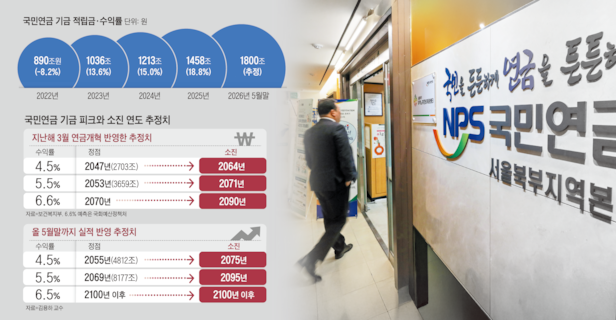
Photo: Reporter Park Sung-won
◇ Fund Grew by 422 Trillion Won in Two Years
National Pension revenue consists of the contributions collected every month and the fund’s reserves. As of last year, contribution revenue was 62 trillion won and pension expenditure was 50 trillion won. Contribution revenue is larger for now, but with low fertility and population aging it is only a matter of time before expenditure exceeds contribution revenue.
But as stock markets at home and abroad improved, National Pension Fund reserves grew by 422 trillion won in two years, from 1,036 trillion won at the end of 2023 to 1,458 trillion won at the end of last year. Around 2020, investment income was in the range of 70 trillion won, and in 2022 it even recorded a loss of 80 trillion won, but from 2023 the fund began posting investment income of more than 100 trillion won.
When First Vice Minister of Health and Welfare Hyun Su-yeop reported this at the Cabinet meeting on the 20th of last month, President Lee Jae-myung asked when depletion was now expected. Vice Minister Hyun answered that it would be delayed by seven years from the original projection of 2071, to 2078.
Checking with the Ministry of Health and Welfare, I was told that this was a simplified projection that took into account only the fund’s growth through the end of 2025 (422 trillion won over two years). Other variables used the figures from last year’s pension reform as they were, and the return was assumed to be 5.5%. On hearing this, President Lee asked, “Reports say it will be extended by 20 to 30 years; please look into it.”
Professor Kim Yong-ha, however, calculated on the premise that the National Pension Fund will accumulate to 1,850 trillion won by the end of this year, and found that if the average return from next year is 4.5%, the fund peaks in 2055 (at 4,812 trillion won) and depletion is delayed by 11 years, to 2075; if the average return is set at 5.5%, the fund peaks in 2069 (at 8,177 trillion won) and depletion is delayed by 24 years, to 2095.
In particular, if the average return after next year is 6.5%, the fund keeps growing, with both the peak and depletion pushed beyond 2100. Professor Kim said, “Because of the compounding effect, raising the return by just 1% has a large impact on the date of depletion.”
However, the model Professor Kim used differs somewhat from the one the Ministry of Health and Welfare uses, so the results may also differ to some degree.
Professor Jeong Se-eun of the Department of Economics at Chungbuk National University said, “It is hard to predict economic conditions ahead, but it is true that building up the fund early on makes it easier to grow the fund substantially.”
Until recently, the government assumed an average annual return of 4.5% when calculating National Pension returns. Yet from the establishment of the National Pension in 1998 through the end of last year, the average investment return was 8.04%. Accordingly, in last year’s pension reform, the government said it would raise the average return to 5.5% through investment diversification. Then the domestic stock market soared explosively, ushering in a new phase.
However, these calculations are simple estimates that leave out other factors such as the growth rate, so they may be less accurate than the National Pension financial projection, the official projection conducted every five years.
The next, 6th financial projection is due in 2028. In addition, since the fund’s reserves are a book valuation, they can shrink at any time if stock prices fall. And because no one knows what economic conditions will come, it is also uncertain whether the National Pension can earn an average return of 5.5% a year.
Still, it is true that the situation raises hopes that the National Pension problem, one of the nation’s thorniest challenges, has shown a possibility of being solved through an unexpected stock market windfall.
There is a figure that gives a sense of how large the National Pension’s recent valuation gains have been. In the work plan for this year that it reported to the Ministry of Health and Welfare in January, the National Pension Service projected that, assuming an average annual return of 5.5%, the fund would reach 1,882 trillion won in 2040. But with the explosion of the domestic stock market, it has become possible to reach by the end of this year an amount similar to the figure that was to be reached 14 years from now.
◇ “Young People Should Make Good Use of the National Pension”
Right after last year’s National Pension reform, young people voiced strong dissatisfaction, saying the National Pension would be depleted. At the time, eight ruling and opposition party lawmakers in their 30s and 40s criticized the reform, saying, “(With this amendment,) the older generations enjoy the enhanced benefits first, while the burden has once again fallen to future generations.” Some university student councils also voiced opposition to the National Pension amendment, saying it had been overhauled to the disadvantage of the younger generation.
But the windfall in returns has changed the situation. If the average return of 5.5% assumed by the Ministry of Health and Welfare is maintained, the pension fund will remain until 2095, 70 years from now. Given that a 25-year-old who has just found a job this year and begun paying into the National Pension typically pays contributions for 40 years and receives a pension for 20 to 30 years, such a person can receive a pension without difficulty.
Jeon Myeong-suk, Director of the Pension Policy Division at the Ministry of Health and Welfare,
said, “The increase in fund returns is positive, but because a state payment guarantee provision was included in last year’s pension reform, young people need not worry that they will not receive their pensions,”
adding, “I also hope people will take into account that, with a benefit-to-contribution ratio of 1.7 times, the National Pension is incomparably more profitable than personal pensions or retirement pensions.”
Yun Suk-myung, Research Fellow Emeritus at the Korea Institute for Health and Social Affairs, however,
said, “The National Pension is assessed on a 70-year cycle, and over that span there are warm days, windy days, and days when typhoons blow,”
adding, “That is why steady rebalancing and reform are essential. I do not know what they intend to do when a crisis hits after being intoxicated by temporarily surging, unrealized investment gains.”
The National Pension, Already a “Whale in a Fishbowl,” Must Find an Exit Strategy from the Domestic Market
At the end of last month, the government convened the National Pension Fund Management Committee and decided to raise this year’s target allocation for domestic equities from the existing 14.9% to 20.8%. The National Pension’s target allocation for domestic equities for this year, as originally decided in May last year, was 14.4%; after raising it to 14.9% in January this year, the committee raised the target allocation again only about four months later.
As the domestic equity limit was expanded for the second time this year, criticism is also emerging that it is inappropriate to run the pension in step with short-term market conditions in this way. The argument is that over the long run the principle of risk diversification will weaken, and that market shocks and the burden of losses could grow when assets are later moved overseas in earnest. There is also considerable criticism that “the National Pension is now a ‘whale in a fishbowl’ in the domestic stock market, so how long will it be kept confined at home?” Korea’s weight in the global benchmark MSCI All Country World Index (ACWI) is only around 2%.
Yun Suk-myung, Research Fellow Emeritus at the Korea Institute for Health and Social Affairs,
said, “Large global pension funds abroad rebalance steadily; I do not know how they plan to cope if an economic crisis should come.”
He said, “Where is the guarantee that stocks will keep trending upward?”
adding, “In the past 30 years alone, we have experienced stock market crashes with the 1997 IMF crisis, the collapse of the IT bubble in the 2000s, and the 2008 global financial crisis.”
Moreover, it is also pointed out that if a situation arises in which the National Pension must start selling stocks to pay pensions, the domestic stock market could take a blow it cannot withstand. That is why there are calls to prepare an exit strategy through sufficient discussion rather than resorting repeatedly to makeshift allocation adjustments.
Professor Kim Yong-ha of Soonchunhyang University, however,
said, “Because the fund’s contribution revenue still exceeds its expenditure, there is time to quietly exit the domestic market by gradually increasing the share of overseas investment with the difference.”
Kim Min-chul, Editorial Writer
https://www.chosun.com/opinion/2026/06/04/ONF2EZRGFRGJVNIFHSHKNT3OTQ/