
(MBC TV, Newsdesk) Does the National Pension Pay Back Less Than You Pay In? — “Far Superior to Private Pensions” (August 14, 2018, 8:37 p.m.)
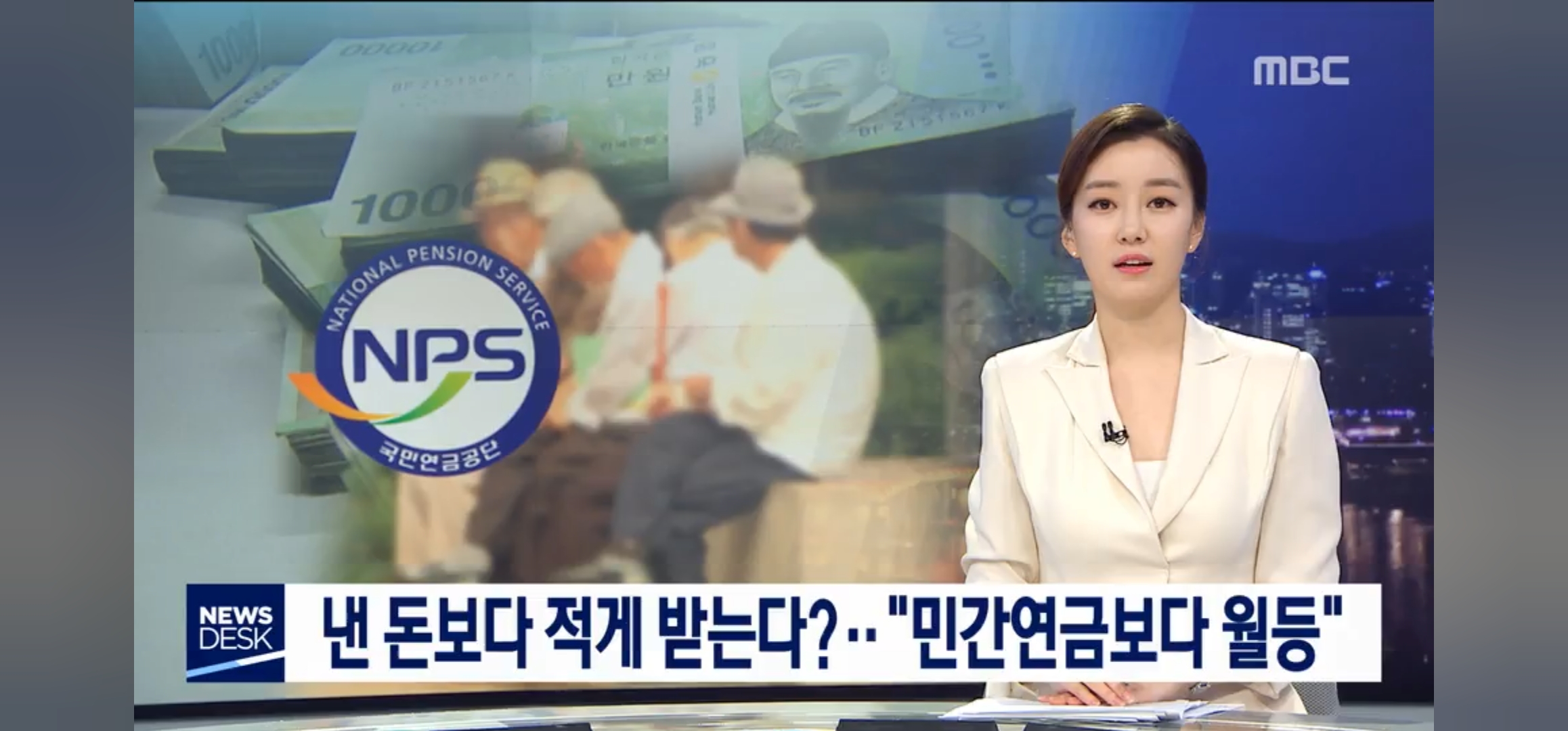
Anchor
Following yesterday’s report, today we again take a close look at the National Pension.
Now, the National Pension.
Its returns are fairly well assured compared with private insurance, so much so that the numbers of voluntary contributors and of people paying arrears are rising.
But because it is a structure in which you get back in proportion to what you pay in, there are people who cannot enjoy even this; in other words, coverage gaps exist.
Reporter Choi Yu-chan reports.
Report
A, an office worker in their 30s, has been paying National Pension contributions for 114 months.
The average monthly contribution is about 390,000 won, so if A pays without missing a month until age 60, the total paid will come to about 160 million won.
A will then receive about 1.2 million won a month from age 65 at today’s prices, and after passing age 75 will have received more than what was paid in.
[Workplace-based contributor]
“With private insurance or pensions like that, it is hard to get proper information every time the terms are renewed. The National Pension is a program guaranteed by the state and run by the state, so….”
As of last year, the National Pension’s average benefit-to-contribution ratio ranged from 1.4 to 2.9.
At most, people receive nearly three times what they paid in, so the returns are better than those of private pensions.
People pay less than the OECD average while the share they receive is similar, so the returns are favorable compared with other countries’ national pensions, too.
Because of this, the number of students and homemakers paying into the National Pension even though they are not required to join rose from some 170,000 in 2013 to 320,000 last year, and the number of people making additional payments to lengthen their coverage period increased fivefold over the same period.
But this may be a story about people who are relatively well-off financially.
B, a self-employed person in their 30s who pays 130,000 won a month in contributions, will receive only about 450,000 won a month after age 65.
It is an amount that will not help much in old age, yet simply paying contributions steadily is a burden in itself right now.
[Individually insured contributor]
“You might take a short break from work, right? In such cases, a bill comes flying in telling you to pay. That is really awkward. It is already a burden as it is….”
People who applied for a payment exemption because they could not pay contributions owing to job loss, leave, and the like: 3.68 million.
People with long-term contribution arrears also number as many as 1.02 million.
These are the so-called coverage gaps in the National Pension.
But rather than trying to meet this need with the National Pension alone, measures are needed to secure old-age income in multiple tiers by making use of the Basic Pension, retirement pensions, and the like.
[Yun Suk-myung / Research Fellow, Korea Institute for Health and Social Affairs]
“I think the appropriate direction is for the middle-income group to firm up its old-age security mainly through the Basic Pension and the National Pension, and for the upper-middle-income group to strengthen its old-age income through the National Pension plus retirement pensions, with those who can afford it also adding personal pensions….”
Minister of Health and Welfare Park Neung-hoo said at a press briefing today that the government has never considered pushing back the National Pension payment age to 68.
This has been Choi Yu-chan, MBC News.
ⓒ MBC & iMBC. Unauthorized reproduction, redistribution, and use (including AI training) are prohibited.
https://imnews.imbc.com/replay/2018/nwdesk/article/4758538_30181.html
Attachments
- Screenshot_20261122_183528_Samsung Browser.jpg(789.0 KB)ViewDownload
- Screenshot_20261122_183558_Samsung Browser.jpg(712.1 KB)ViewDownload
- Screenshot_20261122_183615_Samsung Browser.jpg(683.0 KB)ViewDownload
- Screenshot_20261122_183629_Samsung Browser.jpg(702.5 KB)ViewDownload
- Screenshot_20261122_183634_Samsung Browser.jpg(651.0 KB)ViewDownload
- Screenshot_20261122_183644_Samsung Browser.jpg(863.9 KB)ViewDownload
- Screenshot_20261122_183656_Samsung Browser.jpg(943.4 KB)ViewDownload
- Screenshot_20261122_183701_Samsung Browser.jpg(516.6 KB)ViewDownload
- Screenshot_20261122_183714_Samsung Browser.jpg(636.8 KB)ViewDownload
- Screenshot_20261122_183726_Samsung Browser.jpg(646.4 KB)ViewDownload
- Screenshot_20261122_183734_Samsung Browser.jpg(780.1 KB)ViewDownload
- Screenshot_20261122_183748_Samsung Browser.jpg(767.1 KB)ViewDownload
- Screenshot_20261122_183753_Samsung Browser.jpg(641.0 KB)ViewDownload
- Screenshot_20261122_183806_Samsung Browser.jpg(617.1 KB)ViewDownload
- Screenshot_20261122_183808_Samsung Browser.jpg(807.0 KB)ViewDownload
