
(Shin Dong-A) “Rental Housing with My Retirement Savings?” — Is the National Pension a “Slush Fund”? (November 2, 2026)
[Focus]
Taming Housing Prices at the Cost of Old-Age Security? Politicians Lay Hands on the National Pension
Kim Dae-young, Chair of the Pension Future Forum’s Future Generations Network; Certified Tax Accountant
Government Targets 4%, Pension Fund Demands 7% — A 540 Billion Won Gap in Expected Annual Returns
“Fund Depletion Delayed by 15 Years” — On the Premise of a Return 1 Percentage Point Higher
Pension Reform? Unchanged for Those Born in 1970, a Plunging Benefit-to-Contribution Ratio for Those Born in 2005
The More It Tilts toward Domestic Stocks, the More Both Paychecks and Retirement Savings Are “Shaken” along with the Korean Economy
Domestic Stock Limit Raised Ahead of Elections — Minutes Withheld until 2030
Benefits for the Voters in Front of Them, the Bill for Future Generations Who Cannot Vote
Is it acceptable to deepen old-age insecurity in the name of easing housing insecurity? This is about the idea of investing 1% of the National Pension Fund in public rental housing. It was a card the government and the ruling party played in August, accompanied by the plausible explanation that it would expand the supply of public housing while also guaranteeing the pension a stable return. At the time, the fund’s reserves stood at about 1,800 trillion won; 1% of that is 18 trillion won. The most important question was left out: who owns this money, and who will be responsible if it does not earn as much as expected?
The National Pension is neither the government’s general account nor a budget for politicians to fulfill their campaign pledges. It is the public’s retirement savings, built from the contributions paid by the insured and their employers plus investment returns. Of course, young people’s housing insecurity today is serious, and the housing supply must also be increased. But the claim that the National Pension should bear that cost because housing welfare is important is a separate matter. The mere words “public interest” cannot erase the boundaries between funds meant for different purposes.
Government Targets 4%, Pension Fund Demands 7% — A 540 Billion Won Gap in Expected Annual Returns
In the course of the discussions on investing in public housing, the government side is reported to have mentioned a return in the 4% range a year and the National Pension side a return of at least 7%. Of course, the project structure has not yet been finalized, and the appropriate rate of return may vary depending on the investment period and risks, whether there is a government guarantee, the conditions for recovering the funds, and so on. Even so, the 3 percentage point difference between the returns the two sides put forward cannot be taken lightly. Applied to the expected investment of 18 trillion won, the expected loss alone reaches 540 billion won a year.
If, for example, it takes the form of a rental housing REIT, one must examine how rent regulation and vacancies would affect income. It is also necessary to weigh how large the maintenance costs, construction costs, and interest burden would be, and whether the investment could later be recovered by selling the housing. If principal protection is promised, it must be spelled out who guarantees it and to what extent, and what burden that guarantee would place on state finances. If support is needed because profitability falls short, the National Assembly should allocate the relevant budget and explain the reason to the public. The cost of a policy project must not be hidden by lowering the National Pension’s expected rate of return while ignoring this entire process.
Of course, investing in public housing is not in itself illegal. Article 102 of the National Pension Act allows the fund to be used for public-sector investment and welfare-promotion projects. But conditions are attached. The same article requires that returns be maximized for the long-term fiscal stability of the fund and that welfare-promotion projects be pursued only to the extent that they do not undermine fiscal stability. The relevant provisions must not be reread as an order that “if politicians want it, the fund must invest.”
The long-term fiscal stability of the fund is already under severe pressure. Last year, politicians packaged the amendment of the National Pension Act as “the first pension reform in 18 years.” From the standpoint of future generations, however, it was closer to “a deterioration in the guise of reform.” Contributions were to be raised, but the income replacement rate was raised at the same time, so the burden that later generations will have to shoulder was not resolved. Under the 2025 amended Act, the contribution rate rises by 0.5 percentage points a year starting from 9.5% in 2026 and reaches 13% only in 2033. The income replacement rate, by contrast, applies at 43% immediately to contribution periods from 2026 onward. That is 1.5 percentage points higher than the 41.5% of 2025, but since the rate had originally been scheduled to fall to 40% by 2028, the effective increase reaches 3 percentage points. The contribution burden is being raised over eight years, while the benefit rate was raised at once.
The “15-year extension of fund depletion” that the government touted as an achievement of pension reform also comes with a hidden condition. According to data from the National Pension Service, applying a 13% contribution rate and a 43% income replacement rate while keeping the investment return at 4.5% a year as before delays the projected date of fund depletion by eight years, from 2056 to 2064. To push the date of fund depletion back to 2071, as the government announced, the investment return must also rise by 1 percentage point, to 5.5%. Emphasizing only expressions such as “a 15-year extension of fund depletion” without properly conveying these assumptions easily misleads the public.
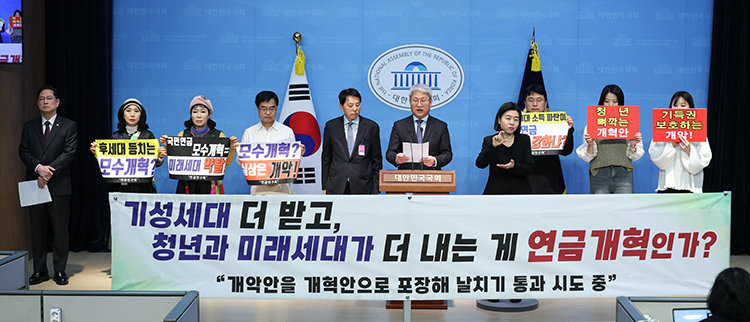
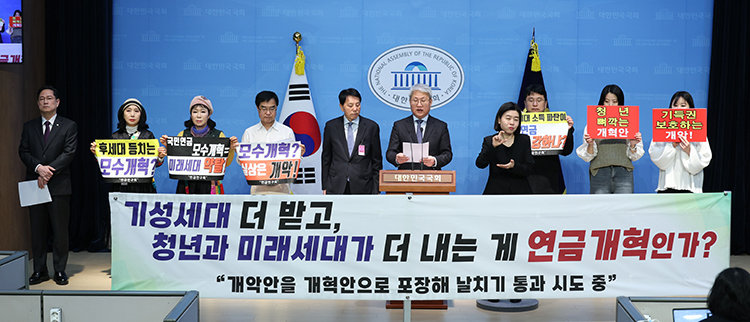
Pension Future Forum officials hold a press conference on pension reform at the National Assembly Press Center in Yeouido, Seoul, on March 20, 2025. News1
Pension Reform? Unchanged for Those Born in 1970, a Plunging Benefit-to-Contribution Ratio for Those Born in 2005
After the fund is depleted, an even heavier burden is expected to await. According to the National Pension Service’s financial projection, covering the pensions to be paid in 2079 solely with the contributions collected that year would require a contribution rate of 39.2%. The gap with the 13% contribution rate to be reached in 2033 is staggering. The structural imbalance between the money collected and the money to be paid out does not disappear just because the date of fund depletion is delayed by a few years.
The unfunded liability, too, is enormous. The unfunded liability is the present value of how far the current reserves and future contributions fall short of the pensions to be paid in the future. According to Ministry of Health and Welfare projections, assuming an investment return of 4.5% a year, the National Pension’s unfunded liability reaches 1,447 trillion won. The amount can vary depending on the assumptions about new entrants and on the projection period and discount rate, but it cannot be said that the funding shortfall has been resolved.
The National Assembly Budget Office’s analysis by generation is even more painful. Assuming an average earner contributes for 40 years, the “lifetime benefit-to-contribution ratio,” the ratio of the pension received to the contributions paid, barely changed for those born in 1970, from 2.93 times before the amendment to 2.90 times after it. For those born in 2005, by contrast, it plunged from 2.28 times to 1.75 times. Under the same reform, only the future generation’s benefit-to-contribution ratio falls sharply. In this way, even the so-called pension reform is being carried out in a way that deepens intergenerational imbalance. That is why measures are urgently needed on the extent of each generation’s net burden and on how the system will be financed after fund depletion.
Even so, politicians are trying to saddle the National Pension with other policy roles as well. A prime example is the repeated increase in its domestic equity allocation this year. On January 26, the National Pension Fund Management Committee raised the target allocation for domestic equities from 14.4% to 14.9%. It also temporarily deferred rebalancing, under which shares are bought and sold to adjust the allocation when it moves outside the permitted range. On May 28 it raised the target allocation again, to 20.8%, and even reduced the scale of daily rebalancing. That is a full 6.4 percentage points higher than at the start of the year. That day fell six days before the June local elections.
Of course, these facts alone do not establish that measures to prop up stock prices were taken with the elections in mind. The Fund Management Committee also explained that, with the domestic equity share having risen to 24.5% by the end of February on the back of rising stock prices, it was necessary to reduce the market shock from large-scale selling.
The intent of managing market shock is understandable. But if the target is raised to follow the holdings every time their share rises, what meaning would the principle of asset allocation have? That is why demands to disclose the basis for the decision to change the target allocation should not be seen as a political attack.
The wages and jobs of National Pension contributors are already tied to the Korean economy. In this situation, if the reserves too are excessively concentrated in domestic equities, both labor income and retirement savings could be shaken together when the economy turns down. Reducing domestic equity investment does not mean a lack of patriotism, nor does increasing it benefit the public. That is why, regardless of which administration is in power, risk must be managed according to the principle of diversification.
Good short-term returns cannot substitute for fiscal reform. According to the relevant disclosures, National Pension reserves fell from 1,865.6 trillion won at the end of June 2026 to 1,684.2 trillion won at the end of July. Of course, the cumulative investment return for January through July is still positive, at 14.84%. The decline in reserves cannot be taken as an investment loss as such, nor should the loss of the fund as a whole be estimated from the October stock decline alone. Even so, the message of the current high volatility is clear: the long-term finances of the pension must not be entrusted entirely to the movements of the stock market.
Benefits for the Voters in Front of Them, the Bill for Future Generations Who Cannot Vote
An even bigger problem is the opacity of the decision-making process. On January 26, the Fund Management Committee decided to defer until 2030 the disclosure of the detailed minutes concerning the adjustment of the domestic equity allocation. Article 103-2 of the National Pension Act was used as the basis. The article makes it the rule to disclose the committee’s minutes one year after a meeting, but provides that where disclosure could affect the fairness of fund management or the stability of financial markets, the minutes are disclosed four years later following a resolution.
However, this merely allows an exception to protect investment secrets and the market; it is not an exemption clause created to avoid scrutiny of suspicions. Particularly since the controversy erupted ahead of the elections, the reasons for and process of deferring disclosure should have been explained all the more rigorously. The National Pension Act requires the minutes to be submitted on a confidential basis when the competent standing committee of the National Assembly requests them. Protecting investment secrets and democratic oversight can coexist.
Elected politicians focus only on the election in front of them, and appointed officials leave when their terms end. But the price of the investment decisions they make remains in the old age of the insured decades later. That is why how much they propped up stock prices or how many homes they supplied must not become the yardstick. They should be judged on whether they managed the insured’s money under an appropriate level of risk and earned returns commensurate with it. If the National Pension is repeatedly saddled with policy missions while the reasons for decisions go undisclosed, the giant pension fund risks degenerating into a political tool for which no one is accountable.
The more fundamental problem is that the generations who will pay the price of political interference are excluded from the decision-making process itself. The generation that will come of age when the fund is depleted could exert no influence whatsoever over this pension reform and investment policy. According to the medium-term outlook of the National Pension Research Institute, the number of contributors will fall from 21.81 million at the end of 2025 to 20.51 million at the end of 2030. The number of pension beneficiaries, by contrast, will rise to about 10.06 million in 2030. Fewer people will pay in, and more will draw out. Fund depletion may not mean an immediate halt to payments, but once the reserves run dry, the system will have no choice but to rely on the contributions and taxes collected that year. A responsible attitude is needed that examines who will have to pay how much more in the future.
Can one claim to be acting for young people while tying up retirement savings in low returns to ease housing insecurity, or even changing the principle of long-term investment for the sake of immediate market stability? Promising more housing, higher stock prices, and fatter pensions to the voters in front of them while passing the cost on to future generations who do not even have the right to vote: this is the “pension populism” we must guard against.
Investing in public rental housing must be premised on the National Assembly and the government making their fiscal responsibility clear. Above all, an independent investment review must determine whether the investment can earn returns commensurate with its risk. The grounds for changes to asset allocation should be disclosed so that they can be verified after the fact, and the financial projections should also set out the unfunded liability and the burden on each generation. Moreover, the 2025 pension reform, too, must not be judged only by how many years it delayed fund depletion. It must be examined whether the burden across generations is fair and whether the system can be sustained over the long term. The National Pension is not a slush fund to brighten politicians’ today but retirement savings to protect the tomorrow of future generations.
https://shindonga.donga.com/economy/article/all/13/6438184/1

