
(Baeksae Sidae) Former Korean Pension Association President Yun Suk-myung: “Paying the Basic Pension to All Older People Amounts to Saddling the Young with Debt” (September 6, 2024)
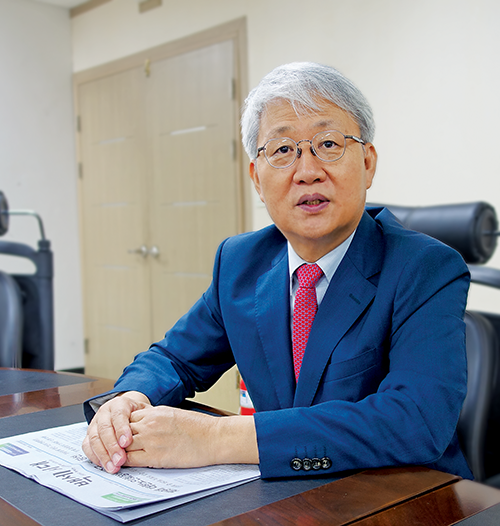
One of Korea’s foremost pension experts… devoted his whole life to pensions alone
National Pension benefits are small because contribution periods are short… the retirement age should be abolished
[Baeksae Sidae = Reporter Oh Hyun-ju]
Yun Suk-myung (63), former President of the Korean Pension Association, is one of Korea’s most authoritative pension experts. He has devoted his whole life to pensions alone.
Former President Yun graduated from the Department of English Language and Literature at Korea University and earned a Ph.D. in Economics from Texas A&M University in the United States. Over nearly 30 years of research as a Research Fellow at the Korea Institute for Health and Social Affairs (KIHASA), he has served as Korea’s representative at OECD meetings of pension experts for the past 15 years, as a member of the first through fifth National Pension financial projection and System Development Committees, as chair of the Basic Old-Age Pension financial projection committee, and as President of the Korean Pension Association, among other posts.
Asked how he came to specialize in pensions, he said, “While studying in the United States, I saw pension problems filling the newspaper pages every day and thought that the pension problem would one day become serious for us too, so I came to study the American pension system,” adding with a laugh, “Back then, if you said you were studying pensions, people around you would take pity on you, asking, ‘Can you make a living with that?’”
On August 30, former President Yun also received the “2024 Senior Hero Award” at the 2nd World Senior Citizens Day event organized by senior citizens’ groups including the Korean Association of Retired Persons and the Korea Association of Senior Welfare Centers.
- What was your impression of this government plan, with a contribution rate of 13%, an income replacement rate raised to 42%, and the mandatory contribution age raised to 64?
“It falls far short of stabilizing pension finances. To avoid increasing the debt any further, contributions of 20.8% would have to be collected. Reviewing an increase in the age was very well done, but it should not stop at review; it should be actively implemented together with labor market reform.”
- What kinds of pensions are there?
“There is the National Pension for the general public, the special occupational pensions for civil servants, teachers, soldiers, and others, and, though its members are few, the Special Post Office Employees Pension. Then there is the Basic Pension, which, once people turn 65, ranks them by income and assets and is paid to the bottom 70%.”
- The deficits of the Government Employees Pension and the Private School Teachers Pension are being covered with taxes. Can these not be merged with the National Pension?
“Professors and civil servants would push back hard to protect their vested interests. And if the Government Employees Pension and the Private School Teachers Pension, which carry enormous deficits, were to be merged with the National Pension, the National Pension’s insured, who hold reserves of close to 1,200 trillion won, would not sit still either, so a merger is difficult. The key is simply to change the National Pension into an earnings-related pension.”
- What does “change it into an earnings-related pension” mean?
“For example, a civil servant earning 8 million won a month receives a pension that reflects that amount, whereas a National Pension contributor earning 8 million won receives a much smaller pension. What I mean is that, instead of this, National Pension contributors should likewise receive benefits in line with their earnings.”
- Why is there a difference?
“It is a complicated matter, but in the National Pension, 50% of the pension amount is calculated in proportion to one’s own earnings, and the other 50% is set by the average earnings of all National Pension contributors.”
- In the early days of the National Pension system, the income replacement rate of 70% was cut to the 40% range. Because of this, the public distrusts the state’s pension policy.
“I was not involved when the National Pension was launched in 1988. People trust the National Pension now, but as recently as 2005 many people suspected that ‘we might not receive the National Pension.’ It seems the income replacement rate was set high in light of that mood. Setting the contribution rate low, at around 3%, was the big problem. To pay 70% of income, the contribution rate would have to be in the 30% range. Even so, had that been done, there might not have been many National Pension contributors. If it had been not 30% but even just 15%, things would not be as serious as they are now.”
- The prevailing view is that the Basic Pension should be given to all older people.
“As many as one-third of Basic Pension recipients are older people who are not poor. That fact is being hidden. The political sphere raises the Basic Pension amount every year, and if it is eventually paid at 1 million won, an older couple will receive 2 million won. If it is paid out that way, before long the nation’s finances will collapse, and the young generation will shoulder that debt in full. One of the important conditions for the Basic Pension is sustainability.”
- What about other countries?
“Finland pays 330,000 won, as we do, to only 4.8% of older people aged 65. Most welfare states, including those in Europe, run it by selecting and concentrating on the truly disadvantaged.”
- Older people receiving pensions worry that their pensions may be cut.
“Nothing has been decided, but the President has mentioned an automatic adjustment mechanism, and I do not know what kind of automatic adjustment mechanism will actually be introduced. In Japan, beneficiaries’ pensions are cut as well.”
- What is an automatic adjustment mechanism?
“It is something I first proposed to the government 25 years ago: a system in which pension increases, freezes, or cuts occur automatically in line with life expectancy, the fertility rate, and so on, without the government having to intervene. Even when cuts occur, they are not large. During the five years from 2015 to 2020, when the Government Employees Pension’s finances were in very bad shape, Government Employees Pension benefits were frozen.”
- There is also talk of setting all this aside and giving every citizen 2 million won each.
“Impossible. That would be becoming a communist country. If the hardworking and the lazy are paid exactly the same, who would work hard?”
- It is said that Dubai is doing it.
“We are not an oil-producing country.”
- It might be possible if the state reduced the administrative costs of the pension payment process, such as tracking changes in recipients’ assets.
“Such costs are smaller than you might think.”
- Are announcements such as “the fund will be depleted in 30 years” not a kind of fear marketing?
“Look at Argentina, which was one of the ten most advanced countries of the 20th century. What about it now? It has fallen into the ranks of underdeveloped countries. Japan will be able to pay one year’s worth of pensions even 100 years from now, and Canada will have money to pay even 150 years from now. The money the government has promised to National Pension contributors is 3,000 trillion won. Yet the money currently on hand is less than 1,200 trillion won. The remaining 1,825 trillion won is debt. To use the analogy of the Titanic, it is the iceberg beneath the surface that sank the ship.”
- Korea’s elderly poverty rate is among the highest in the OECD. With the average National Pension benefit of 600,000 won, it seems hard to solve elderly poverty.
“Korea’s elderly poverty rate is calculated on disposable income alone, so it differs considerably from reality. Our elderly poverty rate is still high among OECD countries, but this stems from the ‘trap of averages’ (where an average value obstructs judgment of the actual situation). It used to be 45%, but now it has fallen to 38% even on a cash basis alone. If real estate is included, the figure falls to around 19%. That is the result of a calculation I did in 2017.”
- What is a desirable pension system that embraces all generations?
“The problem with the National Pension is that contribution periods are short, so benefits are small. The answer is to reform the labor market, abolish the retirement age, and lengthen the period of paying into the pension.”
At the end of the interview, former President Yun said, “The media often show photos of older people collecting scrap paper while saying that Korea’s elderly poverty rate is high,”
“but how many older people collecting scrap paper are there in Korea, really? It is a kind of gaslighting (words and actions that subtly undermine the other person’s autonomy).
The genuinely struggling group of older people is 25% of all older people. Whether through the livelihood benefit of the National Basic Living Security System (NBLSS) or the Basic Pension, they must be paid enough to lead at least a minimal life.”


