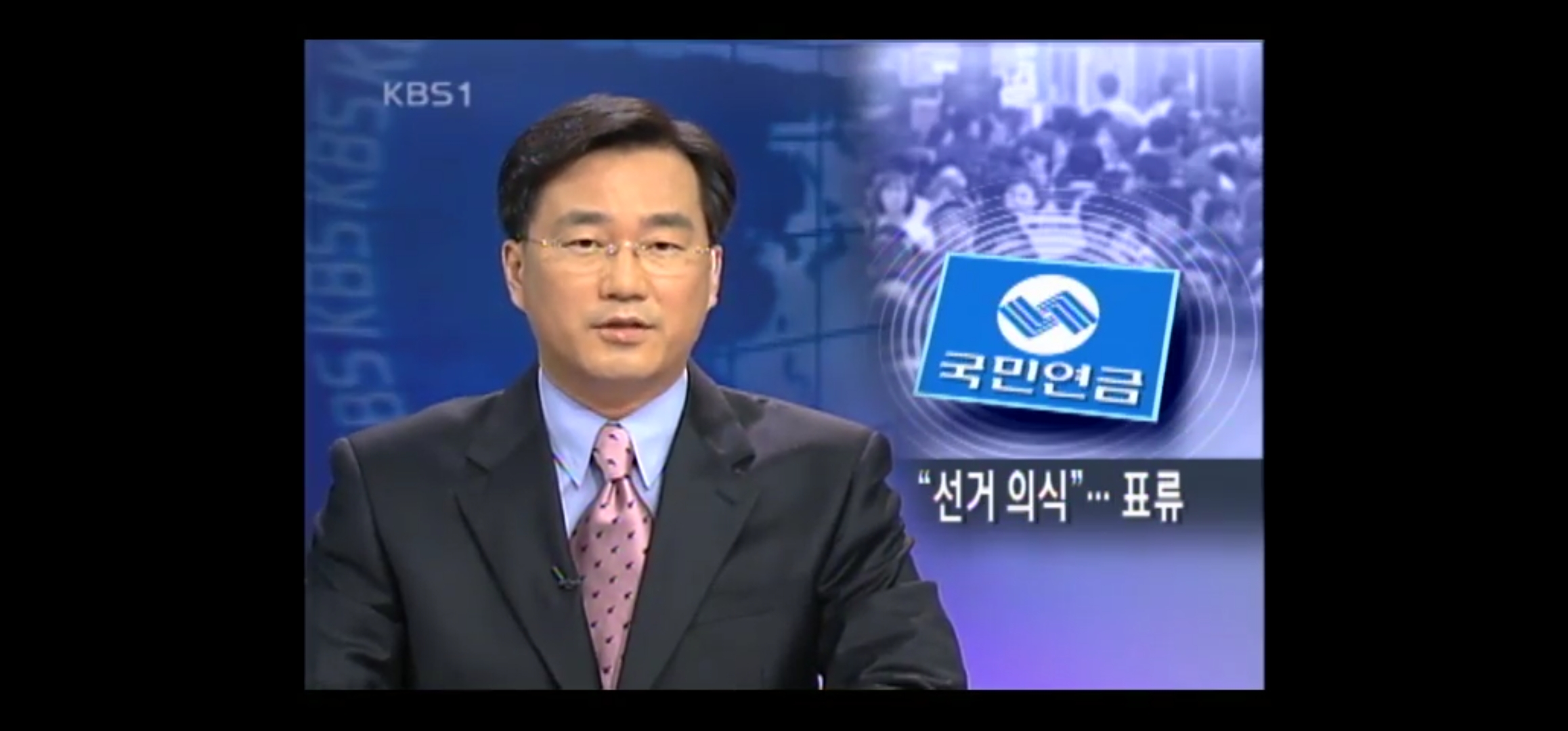
(KBS 1 TV, A Very Important Historical Record) What Will Become of National Pension Reform? Posted December 24, 2003 (9:00 p.m.), Updated August 29, 2018 (3:00 p.m.)
(Pension Future Forum comment:
In this KBS broadcast,
the interviewees speak of
pension reform;
the words are the same,
but we point out that what they concretely mean
may be exact opposites.
This is because, at the time,
that is, in 2023–2024,
Committee Member Yun Suk-myung was stressing that the National Pension fiscal stabilization bill
be passed, whereas
Professor Kim Yong-ha
was arguing for a Basic Pension for all older people,
financed through taxes,
to be introduced.
That is why we are attaching, side by side,
two OhmyNews columns from what was
the defining debate of the time.)
Anchor:
An amendment to stabilize National Pension finances failed to pass the National Assembly yesterday, perhaps out of concern for voter sentiment ahead of the elections.
Lawmakers must know full well that the longer the legal amendment is delayed, the heavier the burden will inevitably become.
Here is an in-depth report by Reporter Jo Seong-hun.
The core of the government’s National Pension amendment is, contrary to the present system, to raise the contributions people pay and reduce the money they will receive later.
That is, the contribution rate, now 9% of income, would be raised to 15.9% by 2030, and the pension received in old age would be cut in stages from 60% to 50% of lifetime average income.
The National Pension, launched in 1988, is a pay-little, receive-much system and, with rapid population aging, is on the verge of fiscal collapse.
In the end, the government estimates that under the current system the pension finances will run dry by 2047.
⊙Yun Suk-myung (Research Fellow, National Pension Corporation):
Our National Pension scheme is designed so that, unless we hurry to reform this low-burden, high-cost system, a great deal of liabilities will pile up.
However, this plan, prepared after long study and discussion, has been left adrift without even being deliberated, owing to opposition from Grand National Party lawmakers.
Some point out that this may be out of concern for public opinion, which is unenthusiastic about a pension reform plan under which people pay more and receive less.
⊙Kim Yong-ha (Professor of Economics, Soonchunhyang University):
Even though it is a much-needed amendment, the politicians, mindful of next year’s elections, have put off deliberation on the National Pension Act amendment...
Experts worry that, as the legal amendment is postponed, finances will inevitably deteriorate further and the burden of covering this will inevitably snowball.
In fact, analyses show that if the amendment is made now, contributions need only be raised to 15.9%, but if it is delayed by five years, they will have to be raised to 17.1%, and opposition to pension reform from those entitled to benefits will grow fiercer.
⊙Kim Jin-soo (Professor of Social Welfare, Yonsei University):
In the end, the later it gets, the greater the burden, the harder the planning, and the heavier the load on our descendants; problems like this keep arising.
Passing the pension bill within the year has effectively become difficult, but one more chance remains before the term of the current 16th National Assembly ends at the end of May next year.
This is Jo Seong-hun, KBS News.
https://news.kbs.co.kr/news/mobile/view/view.do?ncd=521171
(Sites of the OhmyNews columns
that covered the debate over the Basic Pension
at the time)
Professor Kim Yong-ha’s column site
https://pensionfutureforum.net/ko/posts/802
Committee Member Yun Suk-myung’s site
https://pensionfutureforum.net/ko/posts/805
Committee Member Oh Gun-ho’s site
Attachments
- Screenshot_20261115_023814_Samsung Browser.jpg(418.9 KB)ViewDownload
- Screenshot_20261115_023820_Samsung Browser.jpg(401.3 KB)ViewDownload
- Screenshot_20261115_023835_Samsung Browser.jpg(417.2 KB)ViewDownload
- Screenshot_20261115_023841_Samsung Browser.jpg(563.8 KB)ViewDownload
- Screenshot_20261115_023903_Samsung Browser.jpg(583.9 KB)ViewDownload
- Screenshot_20261115_023948_Samsung Browser.jpg(421.1 KB)ViewDownload
- Screenshot_20261115_023959_Samsung Browser.jpg(432.5 KB)ViewDownload
- Screenshot_20261115_024006_Samsung Browser.jpg(635.8 KB)ViewDownload
- Screenshot_20261121_205813_Samsung Browser.jpg(684.9 KB)ViewDownload