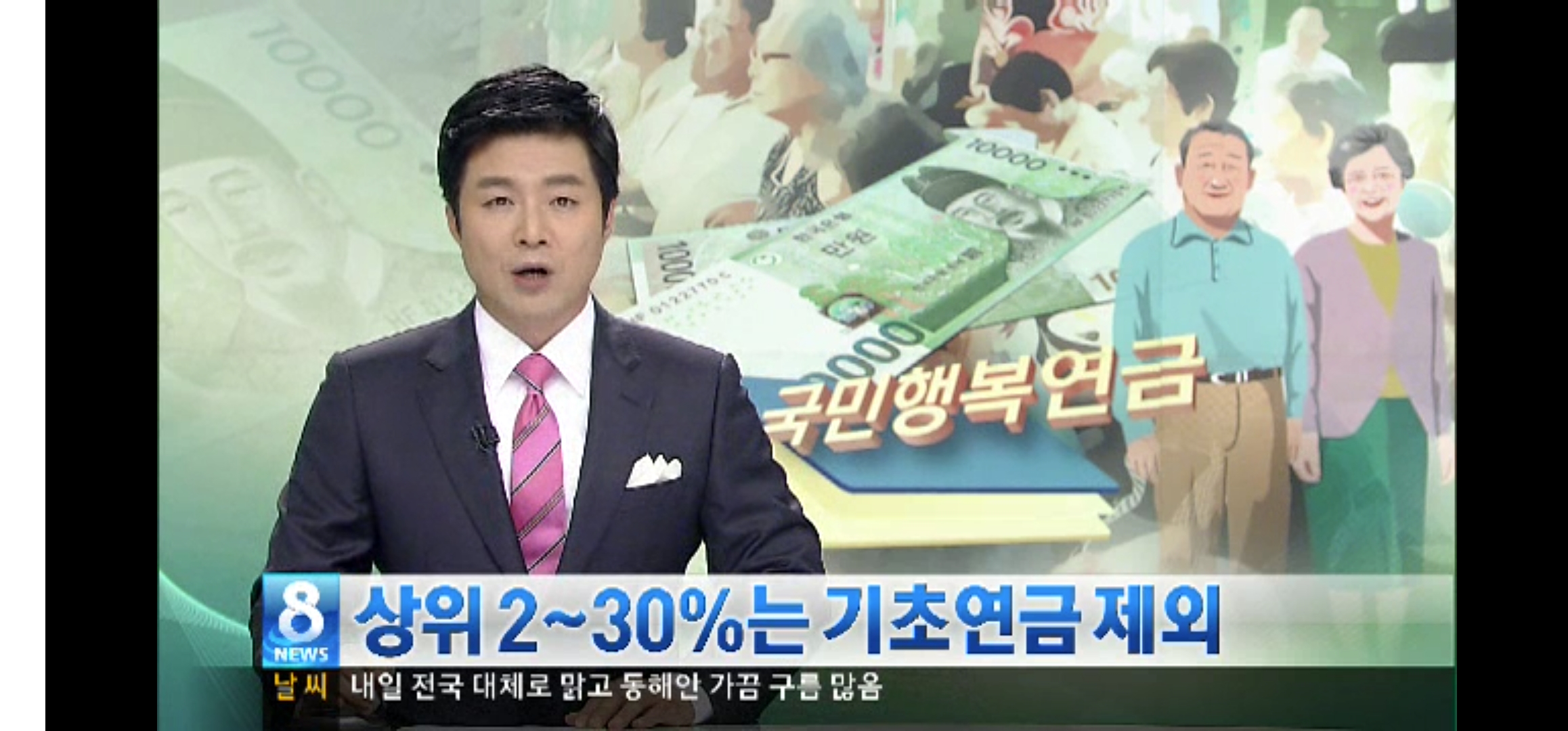
(SBS TV, on the 2013 National Happiness Pension) “National Happiness Pension” Takes Shape — Reverse Discrimination to Be Eliminated (June 8, 2013)
(Pension Future Forum comment:
This is a June 2023 SBS report
that the “National Happiness Pension Committee”
had decided to abolish
the provision linking the Basic Pension
to the National Pension contribution period,
which had been highly controversial
ever since the Park Geun-hye administration’s
presidential transition committee.
Taking these views into account,
at the end of August 2013,
then Minister of Health and Welfare Jin Young
is said to have reported the ministry’s position
to the presidential office.
After the presidential office instructed the ministry
to proceed in a direction different
from what the ministry had reported,
then Minister of Health and Welfare Jin Young
announced his intention to resign of his own accord.
Who in the presidential office at the time
led this decision
must be made clear.)
<Anchor>
The so-called “National Happiness Pension,” which greatly expands the current Basic Old-Age Pension, will take effect in July next year.
The outline of who will receive how much is emerging. Reporter Choi Ho-won reports.
<Reporter>
The committee drawing up the blueprint for the National Happiness Pension has settled on scrapping the plan to link benefit amounts to the National Pension.
This is to prevent reverse discrimination, in which some National Pension subscribers would be worse off than non-subscribers.
The committee also took into account that, over the past five months, more than 30,000 voluntary contributors have left the National Pension because of concerns about reverse discrimination.
As for eligibility, the leading option is to exclude high-income earners from the original “all older people aged 65 and over.”
Discussions are under way on whether to exclude the top 20% or the top 30% by income.
[Oh Gun-ho / Director, Global Political Economy Research Institute
(May 23, National Assembly debate): On excluding some of the top income groups, and, in my view, excluding beneficiaries of special occupational pensions, whether at 20% or at 30%, I think a social discussion on this is possible.]
There is also a view that, to alleviate elderly poverty, the low- and middle-income groups should simply be paid a flat 200,000 won a month.
[Yun Suk-myung / Advisory Committee Member, National Happiness Pension Committee:
Rather than paying the same amount of 200,000 won a month to everyone in the bottom 70% by income, it would be better to go in the direction of paying more, on a differentiated basis, to older people in the bottom 45% by income who are truly exposed to poverty in old age….]
The problem is funding.
An estimated 6 trillion won or so in additional taxes will be needed every year after the pension is launched.
For this reason, a plan to provide vouchers for housing, medical care, and the like instead, together with cash, is also being discussed.
The Ministry of Health and Welfare plans to receive the Happiness Pension Committee’s agreed proposal within this month, consult with the Saenuri Party next month, and then submit a final plan to the National Assembly.
(Video: Hong Jong-su; Editing: Kim Kyung-yeon)
Copyright Ⓒ SBS. All rights reserved.
Source: SBS News
Original link: https://news.sbs.co.kr/news/endPage.do?news_id=N1001824009&plink=COPYPASTE&cooper=SBSNEWSMOBEND
Attachments
- Screenshot_20261114_001327_KakaoTalk.jpg(768.2 KB)ViewDownload
- Screenshot_20261114_001150_KakaoTalk.jpg(496.8 KB)ViewDownload
- Screenshot_20261114_001315_KakaoTalk.jpg(422.7 KB)ViewDownload
- Screenshot_20261114_001253_KakaoTalk.jpg(880.9 KB)ViewDownload
- Screenshot_20261114_001352_KakaoTalk.jpg(600.7 KB)ViewDownload