
(Wolyo Sinmun) [Monday Guest Interview] Yun Suk-myung, Director of the Pension Research Center at the Korea Institute for Health and Social Affairs: “It Is As If People in a State of Hallucination Were Marching Off a Cliff” (February 21, 2014)
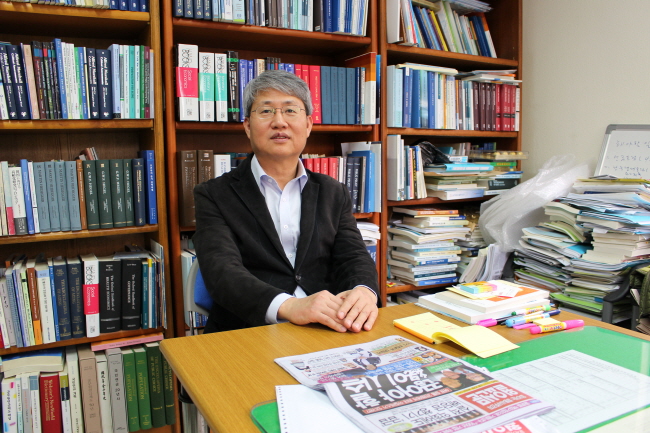
▲ Yun Suk-myung, Director of the Pension Research Center, Korea Institute for Health and Social Affairs (KIHASA)
[Wolyo Sinmun, Reporter Ahn So-yoon]
(With the government having submitted a Basic Pension bill that would, from this July, pay older people aged 65 and over in the bottom 70% of income differentiated amounts ranging from as little as 100,000 won to a maximum of 200,000 won according to their National Pension contribution period, it remains uncertain whether the bill can pass the National Assembly. Everyone agrees that livelihood bills must be handled swiftly, but opinions on this bill differ widely. As a result, the controversy over linking benefits to the contribution period continues unabated.)
“The Top Priority in Reform Must Be the Sustainability of the System”
“Break Out of a Narrow View and Pursue a System That Does Not Burden Future Generations”
[The reform of the Basic Pension Act, set off by the 18th presidential election, continues down a rough and thorny path. The ruling and opposition parties are at loggerheads, neither giving an inch in its bid to gain the upper hand, so no agreement has been reached at all. The core point of contention in the reform is precisely “whether to link the Basic Pension with the National Pension.”
Those who support the government plan argue that, since part of a National Pension benefit already carries the character of a basic pension, paying differentiated amounts according to the National Pension contribution period is both fairer and less of a fiscal burden. But there are also strong opposing voices warning that differentiated payments could weaken the willingness to stay in the National Pension over the long term, threaten the public pension system, and give rise to unnecessary social conflict and disputes over unfairness.
The ruling party has aimed at a long-term, comprehensive concept of welfare by integrating the National Pension and the old-age pension, whereas the opposition holds that, because the National Pension is not welfare, only the old-age pension should be approached as welfare.
Amid the never-ending controversy over the Basic Pension linkage bill, the public is now growing anxious even about the National Pension system itself.
In this connection, Wolyo Sinmun met Yun Suk-myung, Director of the Pension Research Center at the Korea Institute for Health and Social Affairs, and heard in detail his expert view of the Basic Pension reform bill and the direction it should take.]
With the recent heated debate over linking the National Pension and the Basic Pension, we would like to hear your view of the linkage from an expert’s standpoint.
First of all, I fully understand the background behind the government and ruling party’s intent to link the National Pension and the Basic Pension, because there is a good deal in it that I can sympathize with. With the older population surging, paying the Basic Pension to 70% of older people meant finding a way to cut costs, and as an alternative they chose a linkage scheme that reduces the Basic Pension as one’s National Pension contribution period grows longer. However, concerns have been raised that linking it to the contribution period could weaken the incentive for vulnerable groups with low expected National Pension benefits to join the National Pension. I fully understand the background of the contribution-period linkage itself, but I do not think it is the best approach.
Public opinion on the Basic Pension linkage points to the problem of weakening the incentive to join the National Pension. Please explain this in detail.
To have their retirement income secured, couples need to join the National Pension together or contribute over a long period, and the revised Basic Pension linkage plan is highly likely to discourage this. In particular, the weakened incentive for vulnerable groups to join could become a major problem. At present, every citizen with an income must join the National Pension without exception. There are, however, people excluded from coverage (those who are not subject to coverage at all) and people granted contribution exceptions (those who are subject to coverage but cannot pay contributions because they currently have no income-generating activity). Some of them cannot pay because they have no income, but there are certainly also people who do not pay because they do not want to pay into the National Pension. In this situation, linking benefits to the contribution period is highly likely to weaken the incentive for vulnerable groups with low expected National Pension benefits to contribute over the long term. This is because, once the linkage plan is implemented, low-income people are more likely to rely on the Basic Pension provided by the state than to prepare for old age on their own through the pension, and so are likely to choose to leave the National Pension, or to contribute for only 11 years and then receive a Basic Pension of 200,000 won after age 65. They would hide their income to avoid joining the National Pension. This runs counter to the goal of resolving the coverage gaps in the National Pension (vulnerable groups), the problem most criticized since the National Pension’s inception, so there is concern that the problem will instead grow.
Along with income redistribution, the issue of “equity” in the pension benefits received by different generations is being raised. What are your thoughts on this?
I think the equity issue raised by the government and ruling party and by the opposition is a mistaken approach driven by partisan logic. To put it simply, a person enrolled for 20 years at 500,000 won a month and a person enrolled for 10 years at 1,000,000 won a month end up with different Basic Pension amounts, even though the function of the pension is income redistribution. Their total payments are the same, but the former, with the longer contribution period, receives only half the Basic Pension, while the latter, with the shorter period, receives all of it. This is inconsistent with the “equity of benefits” the government claims. On the premise that the Basic Pension will continue unchanged forever, I understand the intent of the linkage itself, but the plan to link the National Pension and the Basic Pension, which has drawn considerable controversy, needs to be reexamined from scratch.
However, I think the criticism concerning equity in benefits between the current generation and future generations is misplaced. Korea is currently undergoing the fastest population aging among OECD member countries. If things continue as they are, older people will account for 40% of the total population in 2050. Yet the fertility rate has been falling for 20 years. A 20-year gap has opened up in which the population to be supported grows while the population supporting it shrinks. Even now, when we have more economic activity and a larger total population than at any time in our history, it is hard to solve the problem of supporting an older population that makes up 12%. In this situation, I think it is wrong to believe that we can maintain similar benefit levels for the current and future generations while fully supporting an older population that will account for 40%. Hence I think the argument for intergenerational equity does not get at the essence of the problem. It is like setting off blindly for a place no one has ever been; to put it bluntly, it looks as if people in a state of hallucination were marching en masse off a cliff.
What I have come to feel recently is that, for a pension system, fiscal sustainability along with fiscal stabilization is the top priority. Social institutions must not be understood from the perspective of ordinary economic institutions. Given a fertility rate far too low relative to the pace of aging, the discussion should focus on devising ways to care for the many older people exposed to poverty without placing a heavy burden on future generations.
At a time when the Basic Pension debate is being used for partisan advantage with an eye on the local elections, can it help bring about better pension improvements?
To offer a comparison, in Sweden’s case, the first controversy over the pension system began in 1985, and the reform was not passed until 1998. Over that long span of 13 years, governments changed, and some parties even refused to take part and walked out. Although it went through a great deal of pain over a long time, the outcome reached through social consensus has caused no major problems in the direction taken since. In Korea, by contrast, it has been less than a month since the improvement of the Basic Pension was formally taken up in the National Assembly. Yet with the local elections approaching, there is a mistaken perception that the issue must be dealt with quickly. In this process, I think matters that ought to be examined carefully could be overlooked and go undiscussed. In the long run, the pension system determines the fate of the nation. I am concerned whether such an important law can be examined thoroughly in so short a time.
In calculating public-sector debt, the government classified the National Pension as a kind of public asset and stated that it is not debt. But for citizens who have, through the pension, lent money to the government and public enterprises, the reality is that this logic is hard to accept. What do you think about this?
My position on this issue is firm, because debt is debt in whatever form it takes. If anything, I think the current scope of government debt should be broadened further. This is because, together with the pension amounts promised to be paid as long as the country does not collapse, the latent liabilities amount to a considerable sum of several tens of billions.
Even if there are separate criteria for classifying debt, the existence of such debt must be shared with the public. Only then can citizens accurately know the nation’s fiscal capacity, and only when that is taken into account can discussion of pension reform surface in a timely manner and sufficient persuasion take place to set the right direction. This, I believe, is reform itself. Refusing to disclose it on the grounds that it is not debt in a clear-cut sense can only be seen as a rush to cover it up for now. Having declared that it is not debt, the government cannot one day suddenly say it cannot pay; I think it should open a channel of communication with the public through disclosure.
The government is setting out to reform the Government Employees Pension. While high-quality reform is expected, backlash and friction from civil servants are anticipated. We would like to hear your view.
An effective way to build consensus on the need for reform is to look at foreign cases. Sweden, Norway, Germany, and others have built automatic adjustment mechanisms into many of their schemes, including the pension for government employees. Taking into account falling fertility and a growing older population, after much debate they put in place mechanisms under which pension amounts are reduced automatically. In Finland’s case in particular, the current burden of its government employees’ pension is twice ours. Even so, Finland’s political parties agreed on a 2017 pension reform on the grounds that the current system is not sustainable.
In Korea, the deficit subsidy for the Government Employees Pension came to 7.7 trillion won under the Lee Myung-bak administration and is expected to reach 15 trillion won under the Park Geun-hye administration. By the early 2020s, the annual deficit subsidy alone is projected to exceed 8 trillion won. The problem is that the subsidy keeps growing over time.
This is why reform of Korea’s Government Employees Pension is unavoidable, despite grumbling from the civil service that it has already been reformed twice and pays high contributions.
Another problem is that the Government Employees Pension stands in the way of National Pension reform. Even though benefit amounts have been cut by 43% through two reforms, a contribution increase for the National Pension is unavoidable owing to population aging. As long as the current Government Employees Pension is maintained, it is impossible to persuade the public of National Pension reform. This is because, compared with the National Pension, which cut benefits by 43% within 20 years of its introduction, the Government Employees Pension, with its 53-year history, has made far too little effort at reform.
Even as welfare spending surges, many citizens do not feel the benefits of welfare in their daily lives. Government Employees Pension reform is unavoidable and urgent, if only to embrace vulnerable groups being worn down day by day by income polarization and to give them greater welfare benefits.
What is the ideal direction for the pension system going forward?
The most important thing is to minimize social conflict by clarifying the operating principles and goals of the welfare system. Norway, despite enormous oil revenues every year, has made it a rule that the deficit in the government budget must not exceed 5%. Setting aside immediate greed, it is keeping most of its oil wealth in reserve against the growing burden on future generations from aging and other factors. And welfare in Sweden, the country with the best welfare system, peaked in the past and has been coming down little by little since the early 1990s. It reformed its pension system so that it can remain sustainable in the aging, low-growth society to come. Korea, however, tries to follow only the past peaks of Sweden and Norway. We are talking while looking at systems that have already been reformed and are gradually disappearing. Korea introduced its pension system very late. But I see a problem in a narrow view that looks only at the past peaks of countries whose pension systems have deep roots.
I think the most ideal direction for the pension system is to set as the principles and goals of the welfare state we pursue a robust social safety net that minimizes the fear of failure, a welfare system under which vulnerable groups receive more benefits, a pension system under which those who have diligently paid their contributions do not lose out, and a welfare system designed not to place a heavy burden on our descendants.
Reporter Ahn So-yoon
Source: Wolyo Sinmun (https://www.wolyo.co.kr)


