(Korea Economic Daily, Version 1) Young People Without Homes Support Older People with Homes — A “Basic Pension Bill” for Future Generations (November 10, 2026, 6:09 p.m.)
As older people’s assets and incomes swell…
the eligibility criterion unchanged for 12 years
Excluding those who pay the comprehensive real estate holding tax was considered, but
the government scrapped the overhaul, mindful of its approval ratings
If “70% of all older people” is kept,
more older people will receive the Basic Pension
and the imbalance in the burden between generations is likely to grow
The youth generation, which is struggling to build assets as it suffers a record-breaking “employment freeze,” is supporting the baby-boom generation, which built its assets through economic activity during the period of rapid growth. As the second baby-boom generation (born 1964–1974), which boasts the highest education levels and the largest assets in the nation’s history, also begins to retire in earnest, the incomes of older people have risen to a level not very different from the national average, yet the eligibility criterion for the Basic Pension has stayed fixed at “70% of all older people” for 12 years. With the current criterion likely to remain in place next year as well, critics say the imbalance in the burden of support between generations is deepening.
◇ Basic Pension Even with a 1.8 Billion Won Apartment in Seoul
View original Illustration = Reporter Choo Duk-young
According to Representative Yoon Young-seok of the People Power Party on the 10th, 4 million, or about 57%, of last year’s 7.066 million Basic Pension beneficiaries were homeowners. An analysis by the Korea Economic Daily of Basic Pension beneficiaries by autonomous district found that the number of older people living in Seoul’s three Gangnam districts (Seocho, Gangnam, and Songpa) and receiving the Basic Pension grew by nearly 40% in ten years, from 57,806 in 2015 to 80,710 in 2024.
Of course, it is hard to say across the board that someone is ineligible for the Basic Pension merely because they own a home or merely because they live in an area with high housing prices. But criticism that it is far from the policy goal of “alleviating old-age poverty” keeps coming up. This is because, under the current system, which pays the Basic Pension to 70% of all older people, older people with relatively high incomes are also included among the beneficiaries.
Compared with 2014, when the Basic Pension was first introduced, the incomes and assets of older people have generally increased. As a result, the “eligibility threshold,” which determines eligibility for the Basic Pension, has been raised every year to match the 70%-of-older-people criterion. The eligibility threshold, which was 1,392,000 won for a couple household, rose to 3,648,000 won last year and 3,952,000 won this year.
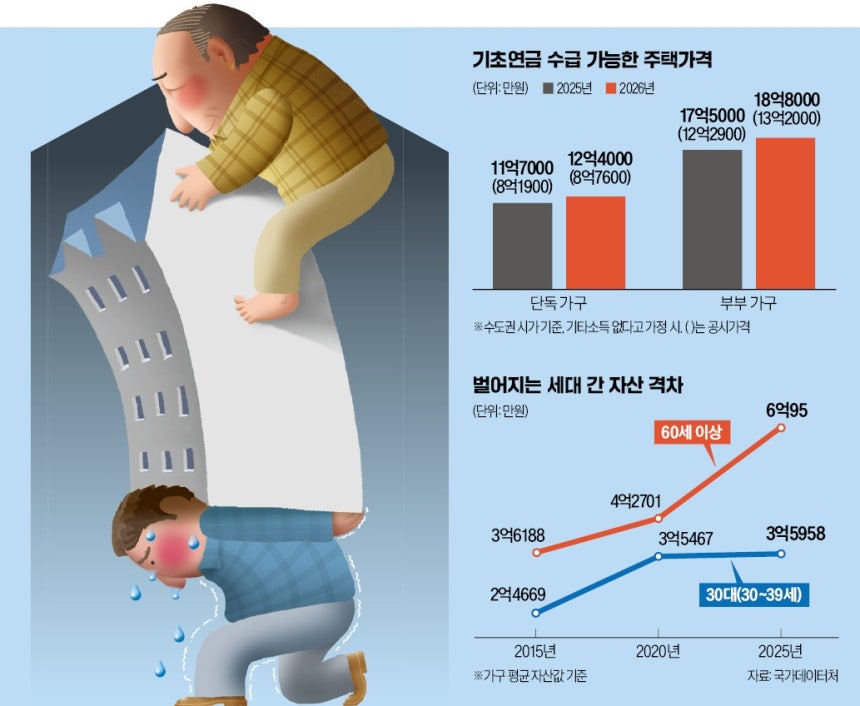
For housing in the Seoul metropolitan area, the amount measured against the eligibility threshold is calculated by subtracting a basic deduction of about 100 million won from the officially assessed price, multiplying by the property conversion rate (4%), and dividing by 12. For earned income, 1.16 million won is deducted as a basic deduction and the remainder is multiplied by 0.7. A couple with no other income who own only an apartment in the Seoul metropolitan area are eligible for the Basic Pension up to an officially assessed price of 1.32 billion won (a market price of about 1.88 billion won).
An older person earning the minimum wage (2,156,880 won a month as of this year) is eligible even with a house worth 1.1 billion won (by officially assessed price) in the Seoul metropolitan area. This means that someone who owns a house in Seoul with a market price of 1.5–1.6 billion won and has earned income of 2 million won a month still receives hundreds of thousands of won in Basic Pension every month. Because next year’s eligibility threshold, to be announced next month, is also likely to be raised, the maximum house price at which one can receive the Basic Pension is expected to rise.
◇ Asset Gap Between People in Their 30s and Those 60 and Over More Than Doubles
Because of this equity problem, the government this summer considered a Basic Pension overhaul that would exclude older people with relatively high incomes from the Basic Pension and use the funds secured in this way to give more support to low-income and poor older people. In the end, however, mindful of older voters and its approval ratings, it scrapped the overhaul.
The growing fiscal burden falls to future generations. Yet their situation is far from easy. According to the National Data Office, the youth employment rate as of September has been falling year on year for 29 consecutive months. As of 2024, of the entire population in their 30s (6,624,563 people), only 1,464,386, or 22%, own a home.
The average assets of households headed by people in their 30s (aged 30–39) rose from 246.69 million won in 2015 to 359.58 million won in 2025. Over the same period, the average assets of households headed by people aged 60 or over grew from 361.88 million won to 600.95 million won. The gap between the two generations more than doubled, from 115.19 million won to 241.37 million won.
Unlike when the welfare system was designed in the past, Korea is experiencing population decline and population aging at the same time, so even the population base that is to share the fiscal burden is shrinking. Lee Seung-hee, Research Fellow at the Korea Development Institute (KDI), said, “Because the Basic Pension is paid to too many older people, there are cases of people receiving it even though they have ample assets,” adding, “Even if the asset requirements are tightened, the eligibility threshold cannot help but rise as long as the ‘70% of the total’ criterion is maintained, so reform of who receives it is needed.”
Reporter Nam Jeong-min [email protected]
Attachments
- Screenshot_20261110_190656_Samsung Browser.jpg(491.0 KB)ViewDownload
- Screenshot_20261110_190707_Samsung Browser.jpg(589.9 KB)ViewDownload
- Screenshot_20261110_190714_Samsung Browser.jpg(713.6 KB)ViewDownload
- Screenshot_20261110_190724_Samsung Browser.jpg(677.1 KB)ViewDownload
- Screenshot_20261110_190737_Samsung Browser.jpg(653.0 KB)ViewDownload