(Commentary on a Yonhap News Article) Raising the Basic Pension Only Cuts the Livelihood Benefit — 780,000 Poor Older People Stay ‘Where They Were’ (November 8, 2026)
The Basic Pension overhaul plan: how will it work?
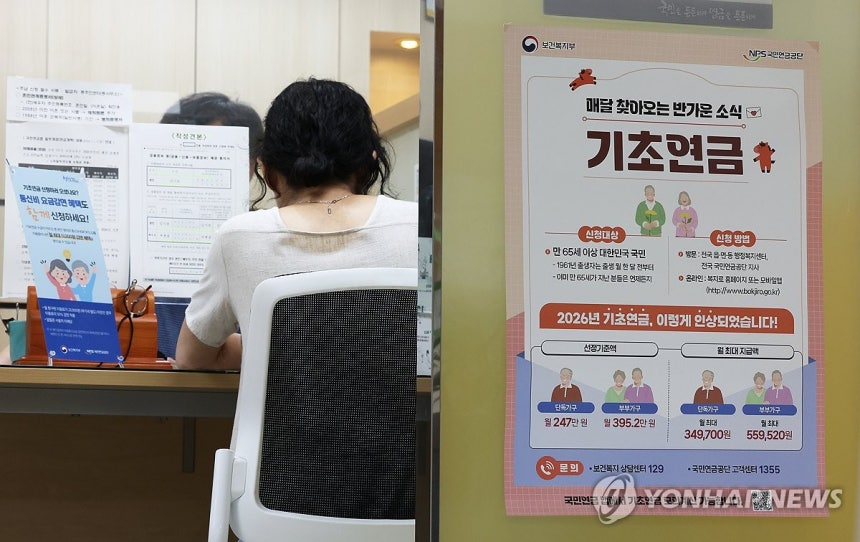
A citizen visiting the general counseling office of the National Pension Service’s Seoul Northern Regional Headquarters consults with a staff member. 2026.8.26 kjhpress@yna.co.kr
(The Pension Future Forum’s commentary on this article:
One national policy task of the Lee Jae-myung administration is
to raise the livelihood benefit, set at 30% of standard median income,
under the National Basic Living Security System (NBLSS)
to 35% of standard median income.
It has already been raised
to 32% of standard median income.
The livelihood benefit, 820,000 won a month in 2026,
is to rise to 875,000 won a month in 2027,
an increase of 55,000 won.
The Basic Pension, by contrast,
will rise by 30,000 won a month for the bottom 30% by income.
The increase for livelihood benefit recipients
is thus 25,000 won a month larger.
For once, most experts
have reached a consensus that the Basic Pension
should, in the long run, be converted
into a minimum income guarantee scheme.
In such a situation,
why the inflammatory slogan
of the “give-and-take-back” Basic Pension
keeps being raised as an issue
is hard to understand.
One cannot help wondering what the intention is
behind persistently raising the problem in a direction
that does not accord even
with the operating principles of the system!
We say this because, even as an increase in the livelihood benefit
under the NBLSS is being pursued,
they keep on raising
the problem.
Simply demanding more, no matter what,
without raising any question at all
about financing the required funds or bearing their cost—
this seems to be the bare face of Korean society itself.
However difficult the situation,
the Ministry of Health and Welfare must continue to uphold
the principles it has kept until now.
We urge it to respond
with pride in having kept
ruinous welfare populism in check
all this time!)
Next year’s Basic Pension budget of 25.6 trillion won… a 30,000-won monthly increase for low-income people planned
Livelihood benefit cut by as much as the Basic Pension increase… National Assembly Budget Office: “System improvement is urgent”
(Seoul = Yonhap News) Reporter Seo Han-gi =
Although the government has allocated more than 25 trillion won to next year’s Basic Pension budget and is pushing to raise payments to low-income older people,
it has been pointed out that some 780,000 poor older people who also receive the livelihood benefit will not properly enjoy the benefit of the increase.
Because the current system cuts the livelihood benefit by as much as any Basic Pension increase, their actual income does not rise, and the National Assembly Budget Office pointed out that the income calculation methods of the two schemes need to be improved.
According to the National Assembly Budget Office’s “Analysis of the FY2027 Budget Proposal” report on the 8th, the Ministry of Health and Welfare has allocated 25.652968 trillion won to the FY2027 Basic Pension payment program, an increase of 2.538909 trillion won (11.0%) over the previous year’s first supplementary budget.
The aim is to provide a stable income base for the bottom 70% by income among people aged 65 and over.
In particular, from 2027 the government is pursuing a “more for the lower, less for the upper” overhaul that gives more support to low-income people, planning differentiated payments of 380,000 won a month to the bottom 30% income bracket (about 3.63 million people), 358,790 won a month to the 30–45% bracket, and 349,700 won a month to the 45–70% bracket.
For the lowest-income bottom 30%, this is an increase of 30,000 won a month over the current standard.
The problem is that the differentiated increase the government is pushing to help vulnerable older people ends up being pie in the sky for the very poorest. (!)
The livelihood benefit takes the form of a supplementary benefit that makes up the amount by which recognized income falls short of the statutory eligibility threshold, and in calculating recognized income, the Basic Pension amount received is counted 100% as income.
It is a structure in which, when the Basic Pension rises, the livelihood benefit is cut by exactly the amount of the increase. In the end, no matter how much the Basic Pension is raised, there is no change at all in final disposable income, the sum of the livelihood benefit and the Basic Pension.
More of the nation’s money goes in, yet vulnerable older people are no better off; it amounts to nothing more than a bookkeeping shift between government budget items.
The number of older people who receive both the livelihood benefit and the Basic Pension, and so experience this offsetting effect, is growing rapidly every year.
The number of dual recipients surged 37.9% in four years, from 568,000 in 2021 to 621,000 in 2022, 644,000 in 2023, 686,000 in 2024, and 783,000 in 2025.
The average Basic Pension amount they received also rose from 297,000 won in 2022 to 331,000 won in 2025.
By contrast, the number of livelihood benefit recipients aged 65 and over who do not receive the Basic Pension rose 59.6%, from 89,000 in 2022 to 142,000 in 2025.
This shows the reality that many of the poorest older people either fall into the Basic Pension’s coverage gap or, even if they are among the dual recipients, are caught in a structure in which the effect of the increase is offset by the reduction in the livelihood benefit and does not lead to a real escape from poverty. (!)
The planned 30,000-won monthly increase for the bottom 30% by income, to be introduced in 2027, likewise takes in most older livelihood benefit recipients, because that bracket reaches only about 20% of standard median income.
Unless the system is improved, for example by partially deducting the Basic Pension from income when calculating the livelihood benefit, the very purpose of the “more for the lower, less for the upper” policy will inevitably be neutralized. (!)
Astronomical fiscal resources are poured into the Basic Pension every year, rising from 14.9634 trillion won in 2021 to 21.3514 trillion won in 2025 and 25.6529 trillion won in 2027.
Yet it fails to help the poorest 780,000 older people climb above the poverty line.
The National Assembly Budget Office pointed out, “Within the budgetary cycle in which livelihood benefit spending falls by as much as Basic Pension spending rises, so that the practical gains of policy expansion can reach vulnerable groups,
the consistency of the income calculation methods of the two schemes must be put in order promptly.”
[email protected]