(Pension Future Forum Commentary, on the Statement of the Public Pension Strengthening People’s Action) [Statement] Stop Killing the National Pension (January 30, 2023)
(Pension Future Forum Commentary:
this is the official position of the Pension Future Forum
on the statement
of the Public Pension Strengthening People’s Action.
The Public Pension Strengthening People’s Action
is asked to answer the Pension Future Forum’s official inquiry
in good faith.
This is because it was the Public Pension Strengthening People’s Action
that first raised the issue.)
[As the Public Pension Strengthening People’s Action
states below, from January 27 to 28, 2023,
over two days,
the advisory committee members of the 21st National Assembly Special Committee on Pension Reform,
in order to reach a final agreement,
held intensive discussions at the National Pension Service (NPS)
Gangnam Regional Headquarters, located in Sinsa-dong, Seoul.
The content and outcome of the discussions were as follows.]
[An attempt was made to reach agreement on two differing proposals, but because agreement could not be reached, a vote was held on the two proposals.
The proposals put to the vote were “maintaining the income replacement rate at 40%—raising the contribution rate to 15%” and “raising the income replacement rate to 50%—raising the contribution rate to 12% or 13%.”
Of the 15 voters in total, including Co-Chairs Kim Yeon-myeong and Kim Yong-ha,
10 voted in favor of the proposal of “maintaining the income replacement rate at 40%—raising the contribution rate to 15%,” and 5 voted in favor of the proposal of “raising the income replacement rate to 50%—raising the contribution rate to 12% or 13%.”
The sides that had proposed the two plans agreed to set out clearly the rationale behind each proposal and present it to the public. At that very moment, however, one member, saying that they would mediate, proposed a 45% income replacement rate plan, and when another member seconded it, it was recognized as a third proposal.
In this situation, the side that had proposed “maintaining the income replacement rate at 40%—raising the contribution rate to 15%” additionally proposed “lowering the income replacement rate to 30%—raising the contribution rate to 12%.” This was because it was judged that, if the matter were left as it was, the middle option, the “45% income replacement rate” proposal, would be favored in the political sphere, contrary to the experts’ judgment.
As this proposal was also seconded, the number of proposals suddenly grew to four even though the meeting had already reached its conclusion, and in the end it resulted in no agreement at all.
A matter that had already been settled by the experts’ vote, through one member’s unexpected move, ultimately provided the starting point for the National Assembly’s passage of the “43% income replacement rate” proposal by way of the Public Deliberation Committee.
At the time, Lee Ki-il, First Vice Minister of Health and Welfare, who had provided lunch to the members at the meeting venue, left the room, but numerous officials of government ministries, including Lee Seu-ran, Director-General for Pension Policy, were present and observed the entire discussion process. This means that there are numerous historical witnesses to what the Pension Future Forum is raising here.
Unlike the views of this majority of experts, the Public Pension Strengthening People’s Action, while advocating the “50% income replacement rate” proposal, has claimed, through the biased operation of the Public Deliberation Committee, that the “50% income replacement rate—13% contribution rate” proposal was the great choice of the citizens.
The Pension Future Forum asks.
The Public Pension Strengthening People’s Action has long claimed that the composition of the Fifth National Pension Financial Estimation Committee was biased. Yet the advisory committee of the 21st Special Committee on Pension Reform was the very embodiment of a biased composition, because specialists in ‘social welfare studies’ and in ‘similar fields’ made up an overwhelming majority of its members.
Given such a composition, why do you think the “40% income replacement rate—15% contribution rate” proposal nevertheless received twice as much support!
Under the “50% income replacement rate” proposal that the Public Pension Strengthening People’s Action has advocated, the PAYG cost rate required to operate the National Pension system after the fund is depleted would far exceed 40%. Do you consider this level of contributions to be the “appropriate burden” mentioned in the Public Pension Strengthening People’s Action’s statement below!
Above all, do you assess it as an appropriate level of burden in the eyes of young people and future generations, who will bear responsibility for the future of the pension system!
Furthermore, do you judge that young people and future generations can agree to such a claim!
Because it is an issue that the Public Pension Strengthening People’s Action raised first, the Pension Future Forum is making this public inquiry on the basis of its statement.
We request a responsible answer from the Public Pension Strengthening People’s Action—above all, a public answer in a form that anyone can easily access and read.
Because the Public Pension Strengthening People’s Action has mentioned the Pension Future Forum several times before,
for the Public Pension Strengthening People’s Action to answer in good faith the questions that the Pension Future Forum is publicly asking
is ‘in keeping with the way the world works’—
such is the judgment of the Pension Future Forum.
We will be watching for a sincere answer from the Public Pension Strengthening People’s Action.]
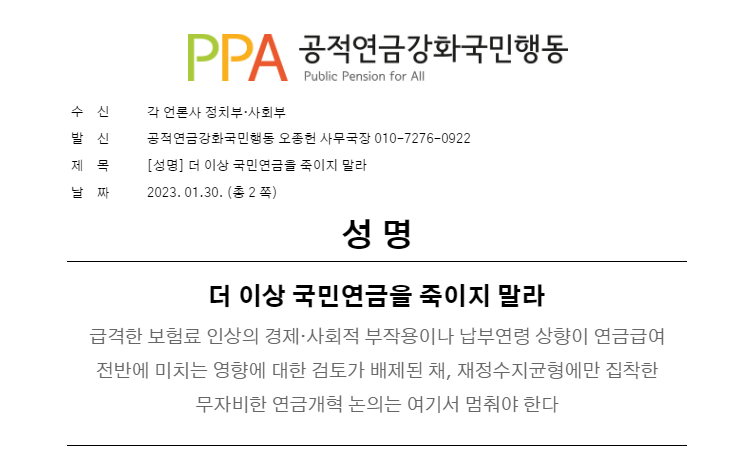
[Statement of the Public Pension Strengthening People’s Action]
[Statement] Stop Killing the National Pension
January 30, 2023
It is reported that the expert advisory committee of the National Assembly Special Committee on Pension Reform discussed pension reform plans on January 27–28 but failed to produce a single proposal. The media also reported that it ‘agreed to raise the National Pension contribution rate from 9% to 15%’ but ‘failed to reach agreement as multiple proposals of 40% and 50% emerged for the income replacement rate,’ and that ‘the contribution age will be raised to 64.’
The reported plan to raise the contribution rate by 6 percentage points to 15% excludes any review of its economic and social impact and cannot be regarded as a proper reform discussion. The National Pension is a system that, as long as the state exists, persists as a collective support system through intragenerational and intergenerational solidarity across successive generations.
Advocates of fiscal balance detach the National Pension from its institutional environment and are fixated solely on a mechanical balance between contributions and benefits, and this time, too, they are insisting on a steep contribution increase with no increase in pension benefits. Given the difficult economic situation brought on by interest rate hikes, high inflation, and economic recession, a 6-percentage-point contribution increase over a short period has a considerably low chance of being implemented as a reform. Moreover, considering that the contribution level at which things balance from the standpoint of the insured, including fund management returns, is about 12–13% on the basis of 30 years of coverage, raising the contribution rate to 15% is a harsh burden on the insured after the reform. An oversized fund, in which the peak of the fund curve rises, likewise sacrifices healthy economic growth for the sake of a balanced ledger between contributions and benefits, in a reality where the size of the fund relative to GDP is already the largest in the world. In particular, a steep contribution increase risks widening the coverage gap problem, centered on individually insured contributors, who have no employer contribution. A reckless discussion of contribution increases that proceeds while excluding a comprehensive review of these various problems cannot but be criticized as a truly dismal pension reform discussion.
The plan to raise the contribution age from the current 59 to 64 also requires a comprehensive review. Extending the contribution period may be necessary in the future, but if only the contribution age is raised without an accompanying extension of the retirement age, there is a risk of the side effect that the adequacy of pension benefits declines across the board because of a fall in the A value (the economy-wide average of insured earnings).
The clash of positions among experts over the National Pension is no longer a clash between so-called advocates of income security and advocates of fiscal stabilization. It is now a clash between those who would strengthen the National Pension and those who would weaken it. The claim that threatens the public with fund depletion and insists that contributions must simply be raised sharply, whatever becomes of the system, destroys the National Pension system and trust in it, confines public pensions to basic protection, and drives the public toward private pensions such as retirement pensions and personal pensions. Stop killing the National Pension.
Let us improve the system through a pension reform of appropriate burden and appropriate benefits, so that the National Pension can securely guarantee the public’s old age.
January 30, 2023
The Public Pension Strengthening People’s Action
(www.pensionforall.kr)