(Commentary on a Yonhap News Article) A Three-Year ‘Income Cliff’ from Retirement to Pension — 60% of Re-Employment in Temporary and Daily Jobs (November 2, 2026)
(The Pension Future Forum’s commentary on this article:
The Korea Institute for Health and Social Affairs (KIHASA) report,
which addresses the realities of the labor market
for middle-aged and older people and measures to deal with them,
seems to overlook the most important point.
For the past 20-odd years, the OECD
has stressed the need to reform the Korean labor market,
which is assessed as the most rigid
among OECD member countries.
Had Korea’s rigid labor market,
in particular its seniority-based wage system,
been overhauled toward job-based pay
even to some degree,
as the OECD recommended,
the retirement-age issue now under dispute
could have been resolved in large part
according to the situation or conditions of each workplace.
The reality is that, even now, when extending the retirement age is under discussion,
visible efforts to reform the labor market,
said to be the most rigid—particularly a reform centered
on the labor unions of large corporations—
are hard to find.
By contrast, at the majority of small and medium-sized enterprises
paying around the minimum wage, cases in which labor and management, out of mutual need,
agree to extend the retirement age
are commonplace.
Even though this is our situation,
the KIHASA report,
without any mention of labor market reform,
proposes “a phased extension of the retirement age
and the introduction of a re-employment system at small and medium-sized enterprises.”
This, even though most small and medium-sized enterprises
have already introduced re-employment systems voluntarily.
“Although at large corporations, public institutions, and other
so-called good workplaces,
the introduction of re-employment systems
is most urgently needed,
no policy proposal on this
appears to have been made at all.”
This judgment
is based on the following content of the article.
“They recommended introducing a phased extension of the retirement age
aligned with the pension eligibility age
and a re-employment system at small and medium-sized enterprises,
as well as extending, starting with workers aged 60 and over who have income,
the upper age limit
for National Pension coverage.”
Even though, as the report proposes,
“retirement and the pension eligibility age
must be aligned,” there is a precondition.
It is the reform of Korea’s labor market,
said to be the most rigid
among OECD member countries.
The fact that this most urgent precondition
is missing from the KIHASA report’s
policy recommendations
appears to be the report’s limitation.)
KIHASA analysis —
more than 70% of households whose income plunged are in deficit,
struggling to get by even after cutting consumption
Early pensions and retirement pensions also fall short for the vulnerable —
proposals to extend the retirement age and introduce partial pensions
(Seoul = Yonhap News) Reporter Seo Han-gi =
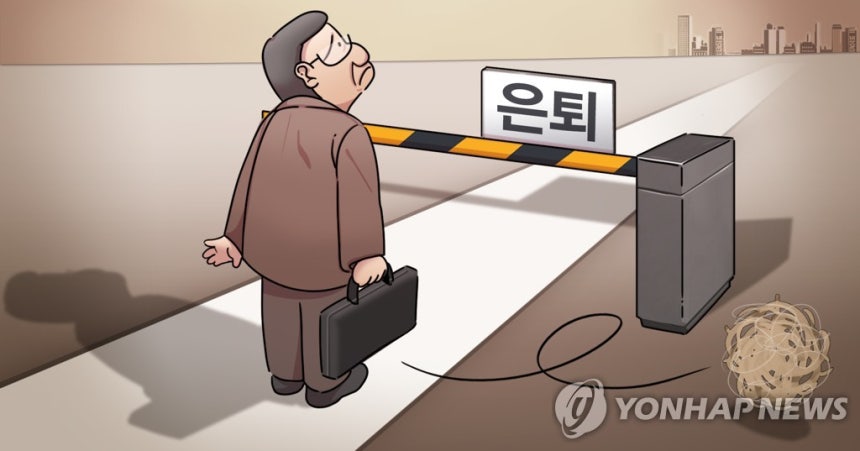
As the age at which people receive the National Pension is raised in stages, the institutional income gap, in which income drops off abruptly after the statutory retirement age until the pension begins, has widened to as long as three years.
It was found that many middle-aged and older people who reach retirement without having bridged the widening gap between the retirement age and the start of pension receipt are setting out to find work, but most are being pushed into low-quality part-time and temporary jobs and are shouldering their livelihoods on their own.
In particular, among vulnerable groups whose income has fallen sharply, even minimal defenses such as drawing the pension early or spending down assets do not work, so seven in ten are sinking into a quagmire of deficits.
On the 2nd, according to the Korea Institute for Health and Social Affairs (KIHASA) research report ‘The Current State of the Income Gap among Middle-Aged and Older People and Policy Responses’ (Jung Hae-sik, Ryu Jae-rin, Lee Da-mi, and Han Gyeo-re), the pension eligibility age for the National Pension, under the 1998 reform of the scheme, is being raised by one year every five years, starting at 61 in 2013 and reaching 65 in 2033.

View original [Data: provided by the Korea Institute for Health and Social Affairs]
By contrast, the age up to which people are required to join the National Pension remains frozen at 59. As a result, as of 2026, those born in 1961–1964 (pension eligibility age of 63) are caught in an institutional coverage gap for the three years from age 60 to 62, during which they can neither join the National Pension nor receive a pension.
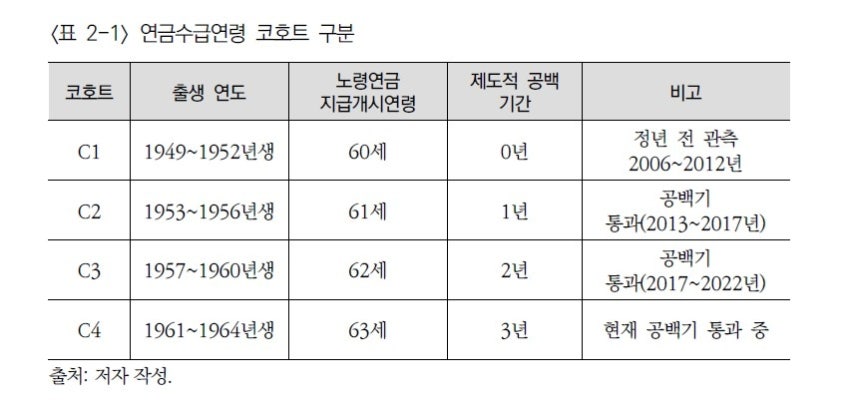
View original [Data: provided by the Korea Institute for Health and Social Affairs]
With the state having created an institutional gap without putting in place a proper buffer, the burden of making a living has fallen entirely on individuals.
In fact, the labor force participation rate of those aged 60–64 jumped from 57.0% in 2011 to 66.7% in 2025, and the share of wage workers also rose steeply from 49.4% to 66.2%. This reflects the reality that people must keep working no matter what to hold out until their pension starts

View original [Data: provided by the Korea Institute for Health and Social Affairs]
60% of newly found jobs are temporary or daily jobs — 70% of vulnerable households whose income slumped are in deficit. While more older people are working, the quality of their jobs has plummeted. The employment rate of those born in 1961–1964 during the gap period was 66.5%, 7.3 percentage points lower than before retirement (73.8%), mostly because they left stable regular jobs.
Among re-entrants who found work again after age 60, the share in temporary or daily jobs reached 61.3%, while only 22.1% held regular positions.
Compared with the share of regular positions (59.0%) among those who stayed on at their existing workplaces, job security is far lower. Most of the newly obtained jobs were contract or part-time positions, and as working hours fell, these workers could not escape the trap of low wages.

View original [Data: provided by the Korea Institute for Health and Social Affairs]
Household finances also took a direct hit. Earned and business income from work accounted for 83.0% of household income during the gap period, showing that dependence on labor remained absolute.
However, when the head of the household was pushed out of their main job, there was almost no buffering effect from a spouse working more to fill the gap.
Households whose income plunged during the gap period to less than half of the pre-retirement median income accounted for 15.6–17.2%, depending on the birth cohort.
These households with plunging income held out by slashing discretionary spending such as eating out, leisure, and clothing to one-third the level of ordinary households, but seven in ten of these vulnerable households (70.2–72.5%) could not avoid a household budget deficit.
No pension to draw early, no house to sell — measures urgently needed for the vulnerable on the brink. Financial and pension schemes previously cited as alternatives were also of no use to low-income vulnerable groups. More than 70% of the assets of middle-aged and older households were tied up in real estate such as their homes, leaving them short of cash for immediate living expenses. Nor was there any statistically clear trend of people selling the homes they lived in around age 60 to cover living costs.

View original [Data: provided by the Korea Institute for Health and Social Affairs]
The public pension system, too, worked in favor only of those who had long held stable jobs. The early old-age pension, drawn early during the gap period at the cost of a reduction, has in effect become ‘an option for those with long contribution records,’ with the share of eligible claimants with contribution periods of 20 years or more exceeding 77%.
In fact, the average pension received during the gap period by households whose income was maintained was 1,918,000 won a month, whereas vulnerable households whose income fell to half or less received only 527,000 won a month. As of 2023, the take-up rate of retirement pensions among those aged 60–64 was also just 1.4%, making them a distant prospect for most ordinary people.

View original [Data: provided by the Korea Institute for Health and Social Affairs]
In in-depth interviews, too, retirees confided, “I only felt the income cutoff when I saw my bank balance shrinking.” Men repeatedly stumbled at the threshold of re-employment because of age limits and mismatched careers, while women, limited by their physical stamina, had no option but to cut spending. With care costs and hospital bills for elderly parents and soaring food prices, even cuttable spending has hit its limit, and even social relationships are being severed.
The researchers pointed out that tailored measures are urgently needed for vulnerable groups who have been excluded from the resources and opportunities to hold out now that the pension eligibility age has been pushed back.
They recommended introducing a phased extension of the retirement age aligned with the pension eligibility age and a re-employment system at small and medium-sized enterprises, as well as extending, starting with workers aged 60 and over who have income, the upper age limit for National Pension coverage.
They also stressed that a tightly woven safety net must be built quickly, including introducing a partial pension scheme under which people receive only as much of their pension as they need, easing the eligibility criteria for unemployment benefits, and expanding public bridge jobs.
Seo Han-gi ([email protected])